'Incredibly lucky' find yields important fish fossil
September 7, 2007 'Incredibly lucky' find yields important fish fossil

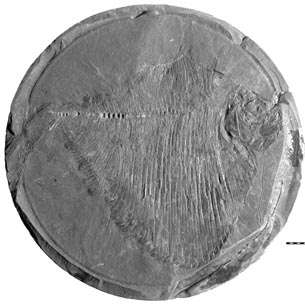
This Tycheroichthys dunveganensis specimen was found just south of Grande Prairie.

Searching for a different kind of riches in the ground, an oil company made a priceless find it never expected.

Working in west-central Alberta, the now defunct Cequel Energy Inc. company thrust a 7.5-centimetre-wide drill more than 1,300 metres into the ground. When the tube pulled up a sample of earth, it revealed a 96-million-year-old fish fossil neatly encircled in the core sample - only the very tip of the fish's snout and tail were cut off by the drill.

"It was incredibly lucky. Sometimes in a core sample you'll find a bone or parts of a bone, but I can't ever remember finding a whole, intact fossil. It's really quite amazing," said Alison Murray, a paleontologist at the University of Alberta.

Not only were the circumstances of the discovery amazing, Murray added, but the fossil represents a new genus of fish. Found just south of Grande Prairie, in an area known as the Dunvegan Formation, Tycheroichthys dunveganensis (meaning lucky fish of the Dunvegan) belongs to an extinct group of fishes, the Paraclupeidae, which are related to the modern-day herrings. It is the first time this group, which is known to have existed in areas around Lebanon and Brazil, has been found in Canada.

"This fish is what we call a list type. It's a single specimen, the only one of its kind, and that makes it priceless," said Murray, adding that she wouldn't put a price value on the specimen even if she had to, as it is illegal to sell fossils found in Alberta.

Murray and a team of paleontologists from across Canada pieced together the history of the fish and published their findings recently in the Canadian Journal of Earth Sciences.

The researchers believe the fish comes from the Western Interior Seaway, a shallow marine sea that stretched from the Gulf of Mexico to the Arctic Ocean, covering the majority of Alberta during the latter part of the Cretaceous period (110 to 65 million years ago).

"We don't have many articulated fish specimens from that period, and this find gives us a clue to the evolution of this family of fishes," Murray added.

Michael Hay, an archeologist working on the original drilling site, said that fish fossils -

unlike small or fragmented fossils of oysters and snail shells, for example - are rarely preserved because they tend to get eaten or broken apart by waves and currents.

The Dunvegan fossil was extracted from the ground in 1988 and eventually came to Murray and Stephen Cumbaa, a co-author of the paper, a few years ago when Murray was a research assistant at the Canadian Museum of Nature in Ottawa. The fossil now sits in a locked cabinet reserved for the most valuable specimens in the museum.

Source: University of Alberta


print this article email this article download pdf blog this article bookmark this article     Stumble it Digg this share on Facebook retweet share on Reddit add to delicious
Rate this story - 4.5 /5 (58 votes)


September 7, 2007 all stories

Comments: 0

4.5 /5 (58 votes)
  • Stumble this up

  • Digg this

  • share this

  • hide
  • Related Stories


  • hide
  • Relevant PhysicsForums posts

  • Is there a gay gene?
    created Nov 23, 2009
  • Super quick question about Starling forces?
    created Nov 22, 2009
  • Questions about diffusion
    created Nov 22, 2009
  • Human Leukocyte Antigen (HLA) typing
    created Nov 21, 2009
  • More from Physics Forums - Biology

Other News

Climate change could boost incidence of civil war in Africa

Other Sciences / Social Sciences

created 17 hours ago | popularity 2.2 / 5 (13) | comments 6

Climate change could increase the likelihood of civil war in sub-Saharan Africa by over 50 percent within the next two decades, according to a new study led by a team of researchers at University of California, Berkeley, ...


Do kids benefit from homework?

Do kids benefit from homework?

Other Sciences / Social Sciences

created 12 hours ago | popularity not rated yet | comments 3

(PhysOrg.com) -- Homework is as old as school itself. Yet the practice is controversial as people debate the benefits or consider the shortcomings and hassles. Research into the topic is often contradictory ...


As robots become more common, Stanford experts consider the legal challenges

Other Sciences / Social Sciences

created 15 hours ago | popularity 4.7 / 5 (3) | comments 0

(PhysOrg.com) -- They already detect and defuse bombs, control traffic patterns and do some basic household chores. And scientists predict that pretty soon, robots will be using artificial intelligence to play a larger role ...


The cause behind the characteristic shape of a long leaf revealed

The cause behind the characteristic shape of a long leaf revealed

Other Sciences / Mathematics

created 17 hours ago | popularity 5 / 5 (2) | comments 0

Applied mathematicians dissected the morphology of the plantain lily (Hosta lancifolia), a characteristic long leaf with a saddle-like arc midsection and closely packed ripples along the edges. The simple ...


5-day delivery no sure cure for postal woes, economist says

Other Sciences / Economics

created 13 hours ago | popularity 2 / 5 (1) | comments 0

Scaling back mail delivery from six days a week to five may be the best bet to stem mounting U.S. Postal Service losses, but could still be a gamble, says a University of Illinois economist who has studied the agency's persistent ...