First Solar Dynamic Observatory Instrument Arrives at Goddard
September 7, 2007
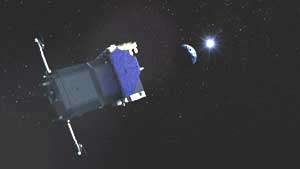
SDO spacecraft

Artist rendition of the SDO spacecraft. Credit: NASA

The University of Colorado at Boulder delivered the Extreme Ultraviolet Variability Experiment (EVE), first of three Solar Dynamic Observatory instruments, to NASA Goddard Space Flight Center, Greenbelt, Md. EVE will measure how much the sun's ultraviolet brightness changes.

Rapid changes in the ultraviolet radiation of the sun can cause outages in radio communications and affect satellites orbiting the Earth. Increases in solar ultraviolet radiation from flares heat Earth's upper atmosphere, causing it to expand. The expansion makes the air more dense at low-Earth-orbit altitudes, where many satellites fly. The more dense air increases the drag on these satellites, slowing them down and causing them to prematurely burn up in the lower atmosphere if there is no more fuel onboard to give them a boost.

EVE will take measurements of the sun's ultraviolet brightness as often as every ten seconds, providing space weather forecasters with warnings of communications and navigation outages.

The sun's extreme ultraviolet output constantly changes. The small solar flares that happen almost every day can double the output while the large flares that happen about once a month can increase the ultraviolet a 1000 times in minutes. This harmful ultraviolet radiation is completely absorbed in the atmosphere, which means we can only observe it from satellites.

"LASP is very excited about delivering the state-of-the-art EVE instrument to measure the solar extreme ultraviolet irradiance with best ever spectral resolution and time cadence," said Tom Woods, SDO EVE Principal Investigator. "These future SDO EVE measurements are important for many different space weather applications such as how solar storms can degrade or even disrupt our navigation and communications."

After launch SDO will study how solar activity is created and how space weather comes from that activity. SDO is designed to help us understand the sun's influence on Earth and near-Earth space by studying the solar atmosphere on small scales of space and time and in many wavelengths simultaneously.

SDO’s other instruments include Helioseismic and Magnetic Imager (HMI) and Atmospheric Imaging Assembly (AIA). Those instruments are expected to arrive at Goddard by the end of October.

"These three instruments together will enable scientists to better understand the causes of violent solar activity, and whether it's possible to make accurate and reliable forecasts of space weather," said Liz Citrin, SDO Project Manager at NASA Goddard. "SDO will provide a full disk picture of the sun in Super HD quality."

SDO is the first mission of NASA's Living With a Star program, which seeks to understand the causes of solar variability and its impacts on Earth. SDO is being designed, managed, and assembled at NASA Goddard. HMI is being built by Stanford University, Stanford, Calif. AIA is being built by the Lockheed Martin Solar Astrophysics Laboratory (LMSAL), Palo Alto, Calif. EVE is being built by the University of Colorado.

SDO is expected to launch no earlier than August 2008.

Source: by Rani Gran, Goddard Space Flight Center


Rank 4 /5 (3 votes)
Tags

Relevant PhysicsForums posts
  • Never ending outer space.....
    createdFeb 11, 2012
  • Neutron Star fragments?
    createdFeb 11, 2012
  • stationary or not?
    createdFeb 11, 2012
  • Scale of the Universe
    createdFeb 10, 2012
  • Titan's lack of impact craters
    createdFeb 09, 2012
  • Real pictures of black hole eating a star?
    createdFeb 08, 2012
  • More from Physics Forums - General Astronomy

More news stories

With climate change, today's '100-year floods' may happen every three to 20 years: research

Last August, Hurricane Irene spun through the Caribbean and parts of the eastern United States, leaving widespread wreckage in its wake. The Category 3 storm whipped up water levels, generating storm surges ...

Space & Earth / Environment

created 34 minutes ago | popularity 2.3 / 5 (3) | comments 0 | with audio podcast

China's pollution puts a dent in its economy

Although China has made substantial progress in cleaning up its air pollution,a new MIT study shows that the economic impact from ozone and particulates in its air has increased dramatically. ...

Space & Earth / Environment

created 11 minutes ago | popularity not rated yet | comments 0

New European rocket lifts off on maiden flight

A lightweight rocket aimed at securing Europe a stake in the market to launch small satellites lifted off from Kourou space base on its maiden flight on Monday.

Space & Earth / Space Exploration

created 1 hour ago | popularity 5 / 5 (4) | comments 1

Climate change causes harmful algal blooms in North Atlantic: study

Warming oceans and increases in windiness could be causing of an abundance of harmful algal blooms in the North Atlantic Ocean and North Sea, according to new research.

Space & Earth / Environment

created 3 hours ago | popularity not rated yet | comments 0

NASA budget will axe Mars deal with Europe: scientists

US President Barack Obama's budget proposal to be submitted next week for 2013 will cut NASA's budget by 20 percent and eliminate a major partnership with Europe on Mars exploration, scientists said Thursday.

Space & Earth / Space Exploration

created Feb 10, 2012 | popularity 5 / 5 (4) | comments 59


Researchers make better heat sensor based on butterfly wings

(PhysOrg.com) -- Scientists have long known that butterfly wings produce their iridescent colors by bouncing light around and between tiny ridges in structures made of chitin. More recently they’ve discovered ...

Manipulating genes with hidden TALENs

(PhysOrg.com) -- A better understanding of gene function in model plant and animal systems could be used to develop useful traits in livestock and crop plants, and might someday lead to developments in stem ...

The joy of cheques

An electronic cheque which eliminates the need for costly processing by banks but preserves the simplicity and ease of a traditional cheque book has been designed by a team of academics in the UK.

Research shows promise in converting camelina oil into jet fuel

(PhysOrg.com) -- Researchers at Montana State University-Northern have developed a process to convert camelina oil to jet fuel and other high-value chemicals. MSU has applied for a U.S. patent and research is ongoing.

Couples in the same place emotionally stay together, study says

(Medical Xpress) -- Despite life’s ups and downs, couples whose feelings are in sync consistently over time are more likely to stay together, says a University of California, Davis, study.

Researchers make breakthrough in stem cell research

(Medical Xpress) -- University of Queensland scientists have developed a world-first method for producing adult stem cells that will substantially impact patients who have a range of serious diseases.