Groovy Project Solving Cloudy Problem
September 7, 2007 Groovy Project Solving Cloudy Problem

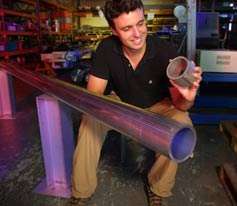
Mauro Pivi holds a section of beam pipe with built-in grooves. (Image courtesy of Brad Plummer)

Experiments in the PEP-II accelerator have shown that beam pipes with grooves can snare unwelcome electrons, greatly reducing the formation of electron clouds that can disturb the beam.

While electron clouds presently pose little threat to the PEP-II beam, they are a major concern for the International Linear Collider (ILC) or a future B-factory project. In high energy storage rings, synchrotron radiation liberates electrons from the beam pipe walls. A positron or proton beam will accelerate the free electrons, and these electrons can then strike the chamber walls, releasing more electrons in a cascade effect until a cloud forms. Ultimately, scientists think the grooved chambers will be a good solution for certain sections of the ILC positron damping ring.

While PEP-II continued to provide beams for the BaBar experiment this summer, the ILC Group monitored the performance of four segments of beam pipe installed in a straight section of the accelerator where there are no magnets. Two sections have smooth interior walls, like normal beam pipes. Two sections have grooves cut into the interior walls that look like metal teeth on a comb. Data show that the beam pipes with grooves had 20 to 30 times less current from electron clouds than the two smooth segments. The grooves, or teeth, act as traps.

"The geometry of the grooves is important. We ran plenty of simulations to figure out the most effective grooves, and we tested two different designs in PEP-II," said Mauro Pivi of SLAC's ILC Accelerator Design group. Robert Kirby, Lanfa Wang, Tor Raubenheimer, Morrison Munro, Gennady Stupakov, Bobby McKee and Tom Markiewicz have also contributed to the project.

The teeth are far enough apart so that radiation strikes the interior wall rather than the top of the teeth. The incoming radiation frees electrons from the beam pipe walls, but the teeth are tall enough to trap electrons, which bounce between the teeth until they run out of energy.

The next step is to test a beam pipe in sections of the accelerator with magnetic fields. Under these conditions, researchers think triangular grooves, like shark teeth, will make the best trap. "Simulations say that it will also work very well to suppress electron clouds, but it's a lot trickier to design," Pivi said.

Both grooved and smooth pipe segments were coated with titanium nitride to suppress the number of electrons generated from synchrotron radiation. The grooved pipes have 100 times less current from electron clouds than PEP-II's regular stainless steel smooth chambers.

Source: Heather Rock Woods, SLAC


print this article email this article download pdf blog this article bookmark this article     Stumble it Digg this share on Facebook retweet share on Reddit add to delicious
Rate this story - 4.7 /5 (10 votes)


September 7, 2007 all stories

Comments: 0

4.7 /5 (10 votes)
  • Stumble this up

  • Digg this

  • share this

  • hide
  • Related Stories

  • X-rays used to reveal secrets of famous fossil
    created Feb 15, 2009 | popularity not rated yet | comments 0
  • Breakthrough In Nanoimprinting Yields Simple Way To Make Microscopic Electronics
    created Jul 22, 2004 | popularity not rated yet | comments 0
  • Atomic-level Snapshot Catches Protein Motor in Action (w/ Video)
    created Nov 20, 2009 | popularity not rated yet | comments 0
  • Tapering a Free-Electron Laser to Extract More Juice
    created Nov 20, 2009 | popularity not rated yet | comments 0
  • Crashing the size barrier
    created Nov 18, 2009 | popularity not rated yet | comments 0


  • hide
  • Relevant PhysicsForums posts

  • Wave dispersion
    created 2 hours ago
  • Neutron
    created 3 hours ago
  • Obtaining research papers from journals
    created 8 hours ago
  • Vibration into Electricity?
    created 10 hours ago
  • More from Physics Forums - General Physics

Other News

Spin polarization achieved in room temperature silicon

Spin polarization achieved in room temperature silicon

Physics / General Physics

created 23 hours ago | popularity 4.9 / 5 (17) | comments 0

(PhysOrg.com) -- A group in The Netherlands has achieved a first: injection of spin-polarized electrons in silicon at room temperature. This has previously been observed only at extremely low temperatures, ...


Multiferroic compounds used to produce smaller and cheaper digital memories

Multiferroic compounds used to produce smaller and cheaper digital memories

Physics / Condensed Matter

created 18 hours ago | popularity 4.7 / 5 (3) | comments 0

(PhysOrg.com) -- Is it possible to make even more compact digital memories for portable electronic devices and which consume even less energy? A team of French researchers has recently demonstrated that it ...


Superconductor magnet heat shield being developed

Superconductor magnet spacecraft heat shield being developed

Physics / General Physics

created Nov 26, 2009 | popularity 5 / 5 (25) | comments 23

(PhysOrg.com) -- European space agencies and an aerospace giant are developing a new re-entry heat shield that will use superconductor magnets to generate a magnetic field strong enough to deflect the superhot ...


Restored machine to explore mysteries of Big Bang (AP)

Restored machine to explore mysteries of Big Bang

Physics / General Physics

created Nov 21, 2009 | popularity 4.6 / 5 (18) | comments 26

(AP) -- Scientists are preparing the world's largest atom smasher to explore the depths of matter after successfully restarting the $10 billion machine following more than a year of repairs.


Scientists react as they stand in front of a screen at CERN

First atoms reported smashed in Large Hadron Collider (Update)

Physics / General Physics

created Nov 23, 2009 | popularity 4.5 / 5 (31) | comments 22

Two circulating beams on Monday produced the first particle collisions in the world's biggest atom smasher, the Large Hadron Collider (LHC), three days after its restart, scientists announced.