Expedition discovers marine treasures
February 14, 2006 Expedition discovers marine treasures

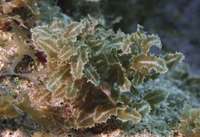
Scientists have discovered more than a dozen new species of seaweeds including this unique new species of Sargassum.

An underwater mountain that forms the world's third-largest atoll has some of the richest diversity of marine life ever found in the Caribbean, according to scientists who recently explored the area.

The two-week expedition in January encountered new species of fish, seaweed and other ocean life at little-studied Saba Bank Atoll, a coral-crowned seamount 250 kilometers southeast of Puerto Rico in the Dutch Windward Islands.

In a series of dives buffeted by high winds and strong currents, scientists from Conservation International (CI), the Netherlands Antilles government and Smithsonian Institution's Museum of Natural History found scores more fish species than previously known in the region and vast beds of diverse seaweed, including a dozen or more possible new species.

"We discovered a new species literally every day we were there," said Michael Smith, director of CI's Caribbean Biodiversity Initiative. Among the apparent new fish species found were two types of gobi, while the total number of fish species recorded reached 200, compared to fewer than 50 before the expedition.

The unprecedented richness of marine life and vulnerable status of the atoll's coral beds make Saba Bank a prime candidate for designation as a Particularly Sensitive Sea Area (PSSA) under the International Maritime Organization (IMO).

Mark Littler, marine botanist of the Smithsonian Institution's National Museum of Natural History, declared Saba Bank the richest area for seaweeds in the Caribbean basin, including as many as a dozen new species along with commercially valuable species that will facilitate the creation of economic activity zones under PSSA designation.

Paul Hoetjes, marine biologist with the Ministry of Nature Affairs for the Netherlands Antilles (MINA), called the expedition crucial to getting the area protected to benefit local populations.

"The community of about 1,500 people on nearby Saba Island derives a large part of its economy from the atoll, and the atoll is being damaged," Hoetjes said.

A petroleum trans-shipment depot on neighboring St. Eustatius Island causes significant marine traffic, including oil supertankers in the area around the submerged atoll. The fragile ecosystems of Saba Bank get damaged by anchors and chains of ships that wait at the atoll to avoid anchoring fees in territorial waters of St. Eustatius.

The large ships also endanger local fishermen of Saba in their small boats, forcing them away from traditional fishing grounds and causing the loss of fish pots that become so-called ''ghost traps" that harm fish stocks.

Leroy Peterson, a Saba fisherman, called the expedition crucial for protecting Saba Bank's unique marine life.

"Some of the scientists actually found new species not located anywhere else," Peterson said. "There should be no-anchor zones. For things to survive there must be stricter controls."


print this article email this article download pdf blog this article bookmark this article     Stumble it Digg this share on Facebook retweet share on Reddit add to delicious
Rate this story - 4.6 /5 (20 votes)


February 14, 2006 all stories

Comments: 0

4.6 /5 (20 votes)
  • Stumble this up

  • Digg this

  • share this

  • hide
  • Related Stories

  • Genes that drive you to drink (but don't make you an alcoholic)
    created Oct 26, 2009 | popularity not rated yet | comments 0
  • Official: US flu victims may be infecting others
    created Apr 28, 2009 | popularity not rated yet | comments 0
  • Hypertension, diabetes and increased carotid artery wall thickness means increased risk of stroke
    created Apr 23, 2009 | popularity not rated yet | comments 0
  • New genetic techniques to combat lung cancer
    created Apr 25, 2008 | popularity not rated yet | comments 0
  • Prehistoric site found in Yemen
    created Feb 10, 2008 | popularity not rated yet | comments 0


Other News

MIT scientists pinpoint origin of dissolved arsenic in Bangladesh drinking water

Scientists pinpoint origin of dissolved arsenic in Bangladesh drinking water

Space & Earth / Environment

created 21 hours ago | popularity 4.9 / 5 (14) | comments 0

Researchers in MIT's Department of Civil and Environmental Engineering believe they have pinpointed a pathway by which arsenic may be contaminating the drinking water in Bangladesh, a phenomenon that has puzzled ...


NASA fuels space shuttle Atlantis for liftoff (AP)

NASA fuels space shuttle Atlantis for liftoff

Space & Earth / Space Exploration

created 5 hours ago | popularity not rated yet | comments 0

(AP) -- NASA is fueling space shuttle Atlantis for its afternoon liftoff.


Warmer means windier on world's biggest lake

Space & Earth / Earth Sciences

created 21 hours ago | popularity 3.8 / 5 (5) | comments 0

Rising water temperatures are kicking up more powerful winds on Lake Superior, with consequences for currents, biological cycles, pollution and more on the world's largest lake and its smaller brethren.


Geeky 'tweeters' to report on space shuttle launch (AP)

Geeky 'tweeters' to report on space shuttle launch

Space & Earth / Space Exploration

created 20 hours ago | popularity not rated yet | comments 0

(AP) -- Fingers will be flying when space shuttle Atlantis blasts off Monday: About 100 of NASA's geekiest fans will be on hand, pecking away at iPhones, BlackBerrys, laptops and other Twittering gadgets.


Controversial new climate change results

Controversial new climate change results

Space & Earth / Environment

created Nov 10, 2009 | popularity 4.1 / 5 (44) | comments 90

(PhysOrg.com) -- New data show that the balance between the airborne and the absorbed fraction of CO2 has stayed approximately constant since 1850, despite emissions of CO2 having risen from about 2 billion ...