Drawing nanoscale features the fast and easy way
September 10, 2007
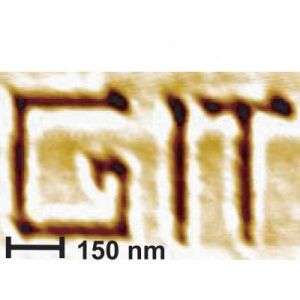
The initials for the Georgia Institute of Technology written with the thermochemical nanolithography technique. Credit: Georgia Tech
Scientists at the Georgia Institute of Technology have developed a new technique for nanolithography that is extremely fast and capable of being used in a range of environments including air (outside a vacuum) and liquids. Researchers have demonstrated the technique, known as thermochemical nanolithography, as a proof of concept. The technique may allow industry to produce a variety of nanopatterned structures, including nanocircuits, at a speed and scale that could make their manufacture commercially viable.
The research, which has potential applications for fields ranging from the electronics industry to nanofluidics to medicine, appeared earlier this year in the journal Nano Letters.
The technique is surprisingly simple. Using an atomic force microscope (AFM), researchers heat a silicon tip and run it over a thin polymer film. The heat from the tip induces a chemical reaction at the surface of the film. This reaction changes the film’s chemical reactivity and transforms it from a hydrophobic substance to a hydrophilic one that can stick to other molecules. The technique is extremely fast and can write at speeds faster than millimeters per second. That’s orders of magnitude faster than the widely used dip-pen nanolithography (DPN), which routinely clocks at a speed of 0.0001 millimeters per second.
Using the new technique, researchers were able to pattern with dimensions down to 12 nanometers in width in a variety of environments. Other techniques typically require the addition of other chemicals to be transferred to the surface or the presence of strong electric fields. TCNL doesn’t have these requirements and can be used in humid environments outside a vacuum. By using an array of AFM tips developed by IBM, TCNL also has the potential to be massively scalable, allowing users to independently draw features with thousands of tips at a time rather than just one.
“Thermochemical nanolithography is a rapid and versatile technique that puts us much closer to achieving the speeds required for commercial applications,” said Elisa Riedo, assistant professor in Georgia Tech’s School of Physics. “Because we’re not transferring any materials from the AFM tip to the polymer surface (we are only heating it to change its chemical structure) this method can be intrinsically faster than other techniques.”
It’s the heated AFM tips that are one key to the new technique. Designed and fabricated by a group led by William King at the University of Illinois, the tips can reach temperatures hotter than 1,000 degrees Celsius. They can also be repeatedly heated and cooled 1 million times per second.
“The heated tip is the world’s smallest controllable heat source,” said King.
TCNL is also tunable. By varying the amount of heat, the speed and the distance of the tip to the polymer, researchers can introduce topographical changes or modulate the range of chemical changes produced in the material.
“By changing the chemistry of the polymer, we’ve shown that we can selectively attach new substances, like metal ions or dyes to the patterned regions of the film in order to greatly increase the technique’s functionality,” said Seth Marder, professor in Tech’s School of Chemistry and Biochemistry and director of the Center for Organic Photonics and Electronics. Marder’s group developed the thermally switchable polymers used in this study.
“We expect thermochemical nanolithography to be widely adopted because it’s conceptually simple and can be broadly applied,” said Marder. “The scope is limited only by one’s imagination to develop new chemistries and applications.”
For nanolithography to be commercially viable, it must be able to write at high speeds, be used in a variety of environments and write on a variety of materials. While the technique demonstrated here doesn’t yet allow writing at the centimeters per second rate that would be ideal, it does put researchers much closer to the goal than previous techniques. Once perfected, nanolithography could be used to draw nanocircuits for the electronics industry, create nanochannels for nanofluidics devices or be adapted for drug delivery or biosensing technologies.
Source: Georgia Institute of Technology
-
Researchers ink nanostructures with tiny 'soldering iron'
Nov 07, 2011 |
4.8 / 5 (4) |
0
-
Heated AFM tip allows direct fabrication of ferroelectric nanostructures on plastic
Jul 18, 2011 |
5 / 5 (5) |
1
-
Writing with a nanoquill: Dip-pen nanolithography with a porous tip generates nanopatterns with viruses
Dec 09, 2010 |
5 / 5 (2) |
0
-
Nanotechnologists form near-frictionless diamond material
Feb 25, 2010 |
4.8 / 5 (16) |
4
-
Thermochemical nanolithography now allows multiple chemicals on a chip
Dec 16, 2009 |
4.5 / 5 (4) |
0
-
Engineers build first sub-10-nm carbon nanotube transistor
Feb 01, 2012 |
4.9 / 5 (33) |
30
-
Something old, something new: Evolution and the structural divergence of duplicate genes
Jan 31, 2012 |
4.6 / 5 (7) |
1
-
The hidden nanoworld of ice crystals: Revealing the dynamic behavior of quasi-liquid layers
Jan 30, 2012 |
5 / 5 (4) |
1
-
Stock market network reveals investor clustering
Jan 27, 2012 |
3.9 / 5 (23) |
8
-
Of microchemistry and molecules: Electronic microfluidic device synthesizes biocompatible probes
Jan 26, 2012 |
5 / 5 (2) |
0
-
What is delta Δ ?
1 hour ago
-
Can we define force if ......
1 hour ago
-
Need some help understanding Hertz–Knudsen formula
2 hours ago
-
Anatomy of Fat man: implosion-critical bomb
4 hours ago
-
what makes two sounds similar???
4 hours ago
-
What would happen when a jet travelling at Mach 10 experiences engine failure
11 hours ago
- More from Physics Forums - General Physics
More news stories
Lab study raises questions over nano-particle impact
Tests involving chickens have raised questions about the impact on health from engineered nano-particles, the ultra-fine grains commonly used in drugs and processed foods, scientists said on Sunday.
Nanotechnology / Bio & Medicine
6 hours ago |
5 / 5 (5) |
0
New kind of solar cell could capture significantly more energy than current cells
New solar cells could increase the maximum efficiency of solar panels by over 25%, according to scientists from the University of Cambridge.
Feb 08, 2012 |
4.5 / 5 (13) |
14
|
Nanoshell whispering galleries improve thin solar panels
Visitors to Statuary Hall in the U.S. Capitol Building may have experienced a curious acoustic feature that allows a person to whisper softly at one side of the cavernous, half-domed room and for another on ...
Nanotechnology / Nanomaterials
Feb 07, 2012 |
4.4 / 5 (7) |
6
|
'Dark plasmons' transmit energy
Microscopic channels of gold nanoparticles have the ability to transmit electromagnetic energy that starts as light and propagates via "dark plasmons," according to researchers at Rice University.
Feb 09, 2012 |
4.8 / 5 (10) |
1
|
Revealing how a battery material works
Since its discovery 15 years ago, lithium iron phosphate (LiFePO4) has become one of the most promising materials for rechargeable batteries because of its stability, durability, safety and ability to deliver ...
Nanotechnology / Nanomaterials
Feb 08, 2012 |
5 / 5 (6) |
0
|
Scientists discover molecular secrets of 2,000-year-old Chinese herbal remedy
For roughly two thousand years, Chinese herbalists have treated Malaria using a root extract, commonly known as Chang Shan, from a type of hydrangea that grows in Tibet and Nepal. More recent studies suggest that halofuginone, ...
New method to examine batteries -- MRI from the inside
There is an ever-increasing need for advanced batteries for portable electronics, such as phones, cameras, and music players, but also to power electric vehicles and to facilitate the distribution and storage of energy derived ...
Overeating may double risk of memory loss
New research suggests that consuming between 2,100 and 6,000 calories per day may double the risk of memory loss, or mild cognitive impairment (MCI), among people age 70 and older. The study was released today and will be ...
A mitosis mystery solved: How chromosomes align perfectly in a dividing cell
Although the process of mitotic cell division has been studied intensely for more than 50 years, Whitehead Institute researchers have only now solved the mystery of how cells correctly align their chromosomes during symmetric ...
Google might launch Drive for cloud storage soon
(PhysOrg.com) -- Google's next big move, according to the Wall Street Journal, is a cloud storage service called Drive. Hardly first to the plate, Google is simply catching up to introducing its cloud reposi ...
Starve a virus, feed a cure? Findings show how some cells protect themselves against HIV
A protein that protects some of our immune cells from the most common and virulent form of HIV works by starving the virus of the molecular building blocks that it needs to replicate, according to research published online ...