Japanese beetle may help fight hemlock-killing insect
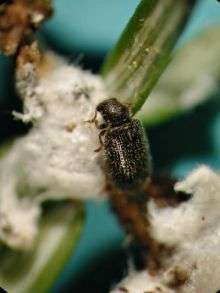
The eastern hemlock, a tall, long-lived coniferous tree that shelters river and streamside ecosystems throughout the eastern United States and Canada, is in serious danger of extinction because a tiny, non-native insect is literally sucking the life out of it.
Entomologists at Virginia Tech are now studying a beetle from Japan that may be a natural predator of Adelges tsugae, or hemlock woolly adelgid (HWA). Scientists hope the Japanese beetle will curb the rapid spread of the HWA without damaging forest ecosystems.
Virginia Tech leads the biological control efforts to curb the spread of HWA, which feeds on the cells that transfer and store nutrients in hemlock trees until their needles desiccate. “Mass application of pesticides would not be effective,” said Scott Salom, professor of entomology in the College of Agriculture and Life Sciences and HWA project leader. “Unlike the gypsy moth, which lives in tree canopies, you cannot spray pesticides over a forest in an aerial flight to kill the hemlock woolly adelgid, which lives at the base of newly formed needles.”
Salom and his colleagues traveled to Japan in 2006 to collect 300 adult insects and hundreds of larvae for evaluation at the Beneficial Insects Quarantine Laboratory at Virginia Tech after a scientist at the Osaka Museum of Natural History discovered an adelgid predator in the island country that had never previously been observed. The Japanese beetle does not currently have a scientific name.
Last year, Yale University researchers performed a series of DNA comparisons between HWA and other adelgid populations in China, Japan, and western North American and discovered that the insect plaguing eastern hemlocks originated in the Osaka region of Japan. Virginia Tech researchers are hopeful that the Japanese beetle now under quarantine in Blacksburg will be an effective natural enemy against the HWA because both originate from the same area, Salom said.
This follows more than a decade of research on the beetle’s North American cousin. In 1997, Salom’s research team imported Laricobius nigrinus, a tiny beetle from British Columbia, to evaluate its effectiveness and safety as a biological control agent. By the end of 2006, scientists at Virginia Tech, Clemson University, and the University of Tennessee at Knoxville had completed more than 22 research-based releases using protocols developed at a Virginia Tech insectory. In all, more than 17,000 British Columbia beetles were released in U.S. forests with encouraging results, in that their research shows that the beetle is establishing at most of the release locations.
Unlike other predators that have been released into the wild, such as the Asian lady beetle, the British Columbian and Japanese beetles only thrive on one food source. “If the beetles we introduce cannot feed or reproduce on other hosts, then the natural conclusion is that there is no risk,” Salom said.
American scientists first noticed the tiny, aphid-like insect in the West as early as the 1920s, but it was not until the 1950s that they spotted HWA producing its cottony egg masses near Richmond, Va. Unlike hemlock stands in Asia and in the western United States, eastern hemlocks did not co-evolve with an adelgid species and therefore never developed a natural immunity to the insect. Today, HWA infestations span more than half of the geographic range of eastern hemlocks. In Virginia, they have reportedly killed more than 90 percent of hemlocks in the Shenandoah Valley.
Source: Virginia Tech


