Gray whales a fraction of historic levels, genetic research says
September 10, 2007
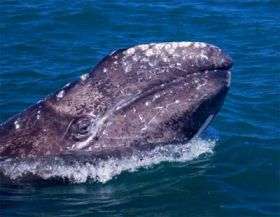
Gray whales (Eschrichtius robustus) return from Arctic feeding grounds to lagoons in Mexico each winter to give birth. New genetic results indicate that in the past, the number of whales returning to these lagoons may have been much larger. Photo location: Laguna San Ignacio, Mexico. Credit: Geoff Shester
Gray whales in the Pacific Ocean, long thought to have fully recovered from whaling, were once three to five times as plentiful as they are now, according to a report to be published September 10 in the Proceedings of the National Academy of Sciences.
Today’s population of more than 22,000 gray whales has successfully been brought back from the threat of extinction and is now the most abundant whale on the North American west coast. But the new findings from researchers at Stanford University and the University of Washington suggest that the current population is actually far below the original number—estimated by genetic methods at 96,000 animals—that once roved the Pacific Ocean.
The report also weighs in about why large numbers of gray whales have recently been discovered suffering from starvation. Previously it was assumed that the thin and starving animals are a consequence of the gray whale population exceeding its historical ecological limits. But if the Pacific normally housed 96,000 gray whales, then starving whales may be suffering reduced food supply from changing climate conditions in their Arctic feeding grounds. This possibility parallels reports last year of major climate shifts in the Arctic ecosystems in which gray whales feed. The study also suggests that lowered numbers of gray whales no longer play their normal role in ocean ecology.
Gray whales were hunted extensively in the late 19th century. "The lagoons of Baja California were the primary killing fields for gray whales," recounted lead author S. Elizabeth Alter, a Stanford researcher. "But we don't know exactly how many there were before whaling took its toll." The new research measures the amount of genetic variation in current gray whales across ten different sections of their genome, and back calculates the long-term population size based on new measurement of the mutation rate of these gene segments.
Steve Palumbi, the Harold A. Miller Professor in Marine Sciences at Stanford's Hopkins Marine Station, explained, "Our survey uncovers too much variation for a population of 22,000. The overabundance of genetic variation suggests a much larger population in past centuries." The study uses computer-based genetic simulations to show that the level of genetic variation is instead more likely to be from a past population of 76,000 to 118,000 animals (with an average of 96,000).
Such a vastly reduced population of gray whales has likely exerted large changes in Pacific ocean ecosystems. Unique among whales, the gray bulldozes the oceans, digging troughs through the sea floor for food. In the process, they resuspend ocean sediments bring food to the surface. "A population of 96,000 gray whales would have resuspended 12 times more sediment each year than the biggest river in the Arctic, the Yukon," said Alter, "and would have played a critical role in the ecology of the Bering Sea."
Other species may have felt the loss of whales as well. "The feeding plumes of gray whales are foraging grounds for Arctic seabirds," Palumbi said. "96,000 gray whales would have helped feed over a million seabirds a year."
The research also raises questions about how many whales the current oceans can now support— and whether the future of whales, even if whaling is limited, may be reduced by new problems in the guise of oceanic overfishing and global climate change. "Despite our best efforts," Palumbi said, "these genetic results suggest gray whales have not fully recovered from whaling. They might be telling us that whales now face a new threat - from changes to the oceans that are limiting their recovery."
"Decades ago, whales were the first creatures to tell us that we were overfishing the oceans," Palumbi concluded. "Maybe now they trying to tell us the oceans are in deeper trouble."
Source: SeaWeb
-
Gray whales likely survived the Ice Ages by changing their diets
Jul 06, 2011 |
4.7 / 5 (3) |
0
-
Dispatches from the edge of doom
May 09, 2011 |
not rated yet |
1
-
Off California coast, a bumper gray whale season
Jan 27, 2011 |
not rated yet |
0
-
Oil giant plans new platform near feeding ground of critically endangered whale
Jan 17, 2011 |
5 / 5 (1) |
2
-
Seismic probe threat to endangered whales: experts
Jun 24, 2010 |
4 / 5 (2) |
0
-
Engineers build first sub-10-nm carbon nanotube transistor
Feb 01, 2012 |
4.9 / 5 (31) |
30
-
Something old, something new: Evolution and the structural divergence of duplicate genes
Jan 31, 2012 |
4.6 / 5 (7) |
1
-
The hidden nanoworld of ice crystals: Revealing the dynamic behavior of quasi-liquid layers
Jan 30, 2012 |
5 / 5 (3) |
1
-
Stock market network reveals investor clustering
Jan 27, 2012 |
3.9 / 5 (23) |
8
-
Of microchemistry and molecules: Electronic microfluidic device synthesizes biocompatible probes
Jan 26, 2012 |
5 / 5 (1) |
0
More news stories
The power of estrogen -- male snakes attract other males
A new study has shown that boosting the estrogen levels of male garter snakes causes them to secrete the same pheromones that females use to attract suitors, and turned the males into just about the sexiest ...
14 hours ago |
4.8 / 5 (6) |
1
|
Grass to gas: Researchers' genome map speeds biofuel development
Researchers at the University of Georgia have taken a major step in the ongoing effort to find sources of cleaner, renewable energy by mapping the genomes of two originator cells of Miscanthus x giganteus, a large perenn ...
11 hours ago |
3.8 / 5 (5) |
0
|
Experts reveal how plants don't get sunburn
(PhysOrg.com) -- Experts at the University of Glasgow have discovered how plants survive the harmful rays of the sun.
14 hours ago |
4.8 / 5 (5) |
0
|
Miami battling invasion of giant African snails
No one knows how they got there. But an invasion of African giant snails has southern Florida in a panic over potential crop damage, disease and general yuckiness surrounding the slimy gastropods.
18 hours ago |
4 / 5 (1) |
4
Protein libraries in a snap
(PhysOrg.com) -- A Rice University undergraduate will depart with not only a degree but also a possible patent for his invention of an efficient way to create protein libraries, an important component of biomolecular ...
17 hours ago |
4.8 / 5 (4) |
0
|
Google users warned of threat to smartphone wallets
Users of Google smartphone wallets were being warned on Friday that there is a way to crack pass codes intended to thwart thieves from going on illicit shopping sprees.
Anonymous knocks CIA website offline (Update)
The website of the Central Intelligence Agency was inaccessible on Friday after the hacker group Anonymous claimed to have knocked it offline.
New error-correcting codes guarantee the fastest possible rate of data transmission
Error-correcting codes are one of the triumphs of the digital age. Theyre a way of encoding information so that it can be transmitted across a communication channel such as an optical fiber o ...
Complex wiring of the nervous system may rely on a just a handful of genes and proteins
Researchers at the Salk Institute have discovered a startling feature of early brain development that helps to explain how complex neuron wiring patterns are programmed using just a handful of critical genes. ...
Humans may have helped the decline of African rainforests 3000 years ago
(PhysOrg.com) -- Large areas of rainforests in Central Africa mysteriously disappeared over three thousand years ago, to be replaced by savannas. The prevailing theory has been that the cause was a change ...
New power source discovered
(PhysOrg.com) -- Researchers at the Massachusetts Institute of Technology (MIT) and RMIT University have made a breakthrough in energy storage and power generation.