Brain network related to intelligence identified
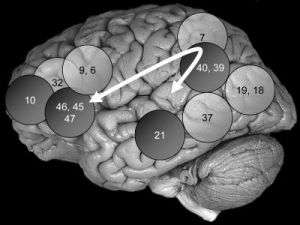
A primary mystery puzzling neuroscientists -- where in the brain lies intelligence" -- just may have a unified answer.
In a review of 37 imaging studies related to intelligence, including their own, Richard Haier of the University of California, Irvine and Rex Jung of the University of New Mexico have uncovered evidence of a distinct neurobiology of human intelligence. Their Parieto-Frontal Integration Theory (P-FIT) identifies a brain network related to intelligence, one that primarily involves areas in the frontal and the parietal lobes.
Their report includes peer commentary from 19 researchers and appears online in the journal Behavioral and Brain Sciences.
“Recent neuroscience studies suggest that intelligence is related to how well information travels throughout the brain,” said Haier, a professor of psychology in the School of Medicine and longtime human intelligence researcher. “Our review of imaging studies identifies the stations along the routes intelligent information processing takes. Once we know where the stations are, we can study how they relate to intelligence.”
The data suggest that some of the brain areas related to intelligence are the same areas related to attention and memory and to more complex functions like language. Haier and Jung say this possible integration of cognitive functions suggests that intelligence levels might be based on how efficient the frontal-parietal networks process information.
Brain imaging studies of intelligence are relatively new, with Haier doing some of the first ones only 20 years ago. Although there is still discussion about how to define and measure intelligence, Haier and Jung found surprising consistency in the studies they reviewed despite the fact the studies represented a variety of approaches.
In his peer commentary, University of Washington psychologist Earl Hunt writes: “The Jung & Haier P-FIT model shows how far we have progressed toward understanding the biological basis of intelligence. Twenty-five years ago researchers in the field were engaged in an unedifying discussion of the relation between skull sizes and intelligence test scores. By taking advantage of the huge advances in measurement of the brain that have occurred in the past quarter century, [Jung and Haier] can take the far more sophisticated view that individual differences in intelligence depend, in part, upon individual differences in specific areas of the brain and in the connections between them.”
Haier and Jung have made some of the seminal findings in intelligence studies. In a 2004 study, they found that regions related to general intelligence are located throughout the brain and that a single “intelligence center,” such as the frontal lobe, is unlikely. And in a 2005 study, they found that while there are essentially no disparities in general intelligence between the sexes, women have more white matter and men more gray matter related to intelligence test scores, suggesting that no single neuroanatomical structure determines general intelligence and that different types of brain designs can produce equivalent intellectual performance.
“Genetic research has demonstrated that intelligence levels can be inherited, and since genes work through biology, there must be a biological basis for intelligence,” Haier said. “We have a long way to go before we understand the details, but our P-FIT model provides a framework for testing new hypotheses in future experiments.”
Source: University of California - Irvine


