Hubble Captures Stars Going Out in Style
September 11, 2007 Hubble Captures Stars Going Out in Style

Image credit: NASA, ESA, and The Hubble Heritage Team (STScI/AURA)

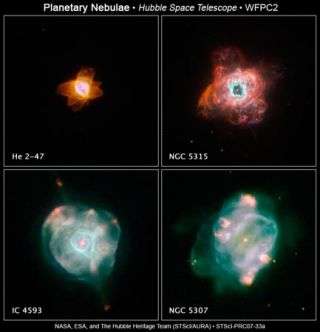
The colorful, intricate shapes in these NASA Hubble Space Telescope images reveal how the glowing gas ejected by dying Sun-like stars evolves dramatically over time.

These gaseous clouds, called planetary nebulae, are created when stars in the last stages of life cast off their outer layers of material into space. Ultraviolet light from the remnant star makes the material glow. Planetary nebulae last for only 10,000 years, a fleeting episode in the 10-billion-year lifespan of Sun-like stars.

The name planetary nebula has nothing to do with planets. They got their name because their round shapes resembled planets when seen through the small telescopes of the eighteenth century.

The Hubble images show the evolution of planetary nebulae, revealing how they expand in size and change temperature over time. A young planetary nebula, such as He 2-47, at top, left, for example, is small and is dominated by relatively cool, glowing nitrogen gas. In the Hubble images, the red, green, and blue colors represent light emitted by nitrogen, hydrogen, and oxygen, respectively.

Over thousands of years, the clouds of gas expand away and the nebulae become larger. Energetic ultraviolet light from the star penetrates more deeply into the gas, causing the hydrogen and oxygen to glow more prominently, as seen near the center of NGC 5315. In the older nebulae, such as IC 4593, at bottom, left, and NGC 5307, at bottom, right, hydrogen and oxygen appear more extended in these regions, and red knots of nitrogen are still visible.

These four nebulae all lie in our Milky Way Galaxy. Their distances from Earth are all roughly the same, about 7,000 light-years. The snapshots were taken with Hubble's Wide Field Planetary Camera 2 in February 2007. Like snowflakes, planetary nebulae show a wide variety of shapes, indicative of the complex processes that occur at the end of stellar life.

He 2-47, at top, left, is dubbed the "starfish" because of its shape. The six lobes of gas and dust, which resemble the legs of a starfish, suggest that He 2-47 puffed off material at least three times in three different directions. Each time, the star fired off a narrow pair of opposite jets of gas. He 2-47 is in the southern constellation Carina.

NGC 5315, the chaotic-looking nebula at top, right, reveals an x-shaped structure. This shape suggests that the star ejected material in two different outbursts in two distinct directions. Each outburst unleashed a pair of diametrically opposed outflows. NGC 5315 lies in the southern constellation Circinus.

IC 4593, at bottom, left, is in the northern constellation Hercules.

NGC 5307, at bottom, right, displays a spiral pattern, which may have been caused by the dying star wobbling as it expelled jets of gas in different directions. NGC 5307 resides in the southern constellation Centaurus.

Source: Space Telescope Science Institute


print this article email this article download pdf blog this article bookmark this article     Stumble it Digg this share on Facebook retweet share on Reddit add to delicious
Rate this story - 4.3 /5 (10 votes)


September 11, 2007 all stories

Comments: 0

4.3 /5 (10 votes)
  • Stumble this up

  • Digg this

  • share this

  • hide
  • Related Stories

  • The Ring Nebula
    created Nov 02, 2009 | popularity not rated yet | comments 0
  • Super Planetary Nebulae
    created Aug 14, 2009 | popularity not rated yet | comments 0
  • Scientists discovers 'firework' display in Helix Nebula
    created Jul 20, 2009 | popularity not rated yet | comments 0
  • Hubble Photographs a Planetary Nebula to Commemorate Decommissioning of Super Camera
    created May 11, 2009 | popularity not rated yet | comments 0
  • Galactic Dust Bunnies Found to Contain Carbon After All
    created Mar 12, 2009 | popularity not rated yet | comments 0


  • hide
  • Relevant PhysicsForums posts

  • Planet Formation Question
    created 1hour ago
  • Gravity on Mars
    created 14 hours ago
  • Question about the orbit between Mars and Earth
    created 22 hours ago
  • SIMBAD/NED help
    created Nov 16, 2009
  • More from Physics Forums - General Astronomy

Other News

Close-up movie shows hidden details in the birth of super-suns

Close-up movie shows hidden details in the birth of super-suns (w/ Video)

Space & Earth / Astronomy

created 13 hours ago | popularity 4.8 / 5 (5) | comments 0

(PhysOrg.com) -- The constellation of Orion is a hotbed of massive star formation, most prominently in the Great Nebula that sits in Orion's sword. The glowing gas of the Nebula is powered by a group of young ...


Volatile gas could turn Rwandan lake into a freshwater time bomb

Space & Earth / Earth Sciences

created 11 hours ago | popularity 4.5 / 5 (8) | comments 3

A dangerous level of carbon dioxide and methane gas haunts Lake Kivu, the freshwater lake system bordering Rwanda and the Republic of Congo.


Ghostly 'Spokes' Puff Out From Saturn's Ring's

Ghostly 'Spokes' Puff Out From Saturn's Ring's (w/ Video)

Space & Earth / Space Exploration

created 9 hours ago | popularity 4.7 / 5 (3) | comments 0

(PhysOrg.com) -- Massive, bright clouds of tiny ice particles hover above the darkened rings of Saturn in an image captured by the Cassini spacecraft on Sept. 22, 2009, around the time of Saturn's equinox. ...


NASA 'Drops' Next Generation Robotic Lander During Autonomous Tests

NASA 'Drops' Next Generation Robotic Lander During Autonomous Tests

Space & Earth / Space Exploration

created 9 hours ago | popularity 4.3 / 5 (4) | comments 1

(PhysOrg.com) -- NASA has successfully completed a series of autonomous "drop" tests of a robotic lander test article - in a record 10 months - to demonstrate the ability to perform a controlled landing on ...


Space shuttle Atlantis lifts off on supply mission (AP)

Space shuttle Atlantis lifts off on supply mission

Space & Earth / Space Exploration

created 9 hours ago | popularity 3.5 / 5 (2) | comments 0

(AP) -- With 100 Internet-savvy NASA fans cheering on the shuttle and churning out constant Twitter updates, Atlantis sailed smoothly into orbit Monday with six astronauts and a full load of spare parts for ...