Stem cells make new heart valves
September 11, 2007
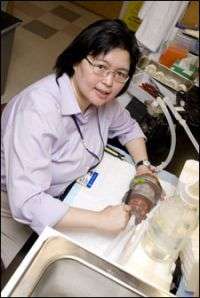
Virna Sales hopes to produce valves that grow along with the hearts of children suffering from heart defects and thus avoid numerous surgeries. Photo courtesy of Boston Children’s Hospital
Researchers have coaxed adult stem cells into forming artificial heart valves that could one day mean fewer surgeries for children suffering from heart defects.
The scientists, at Harvard-affiliated Boston Children’s Hospital, grew the valves from a type of stem cell that normally gives rise to the inner lining of blood vessels. They used a biodegradable scaffold to give the cells shape and a mix of proteins and growth factors to stimulate the cells to grow into the proper tissue type.
Instructor in Medicine Virna Sales, a researcher in Boston Children’s Department of Cardiac Surgery, said the work, which used the tissue of laboratory animals, builds on research conducted over the past decade by Professor of Surgery John Mayer.
Mayer, also in Boston Children’s Department of Cardiac Surgery, was the senior investigator of the study. His research over the past 10 years has focused on helping the 25,000 to 30,000 children born each year with heart defects.
Today, Sales said, the defects are corrected using prosthetics made from artificial materials and tissue from pigs. The problem with those materials, she said, is that they don’t grow. Depending on the defect type and the age of the child at the time of surgery, the child may (and often does) need additional surgeries as his or her heart gets larger.
Researchers hope to be able to screen the blood-vessel stem cells, called endothelial progenitor cells, from a child’s blood and use them to make valves out of a child’s own tissue. Since the valves would be made from living tissue, they would grow, sparing the child additional surgery.
The research, published in the journal Circulation, is still five to 10 years away from being used in humans, Sales said.
The body has two major types of stem cells. Embryonic stem cells are present at the very early stages of life and have the ability to change into any type of cell in the body. More limited are adult stem cells, which give rise to different cells within a particular tissue type. Blood stem cells, for example, are found in the bone marrow and are constantly growing and differentiating, replacing cells in the bloodstream as they are needed.
Prior research has sought both the right cells to start with and the proper mix of proteins and growth factors to coax the cells to differentiate into the right kind of tissue.
The body uses these growth factors and proteins to signal stem cells to divide, grow, and change into the type of tissue needed.
Though the natural process may seem straightforward, the mix of factors, including dosage, and timing, are delicately balanced in nature and provide researchers a significant challenge to reproduce.
As researchers learn to fine-tune the process, Sales said, they can use multiple coatings on the scaffold to expose the tissues to different factors at different times. That way, she said, it may be possible to “customize” one’s heart valve.
Now that they’ve successfully grown the valves from animal tissue, researchers are working to refine the technology. They’re testing the mechanical properties of the engineered valves in a bioreactor, a device designed to mimic the never-ending motion of the heart. They’re also experimenting with a different mix of the growth factors and proteins to see if they can get the valves to grow more naturally, without the supporting scaffold.
“I’m going back to the basics,” Sales said, “[We’re] going to mimic mother nature.”
Source: Harvard University
-
Neurologic improvement detected in rats receiving stem cell transplant
5 hours ago |
not rated yet |
0
-
Scientists use an old theory to discover new targets in the fight against breast cancer
Feb 07, 2012 |
5 / 5 (2) |
0
-
Exercise triggers stem cells in muscle
Feb 06, 2012 |
4.7 / 5 (6) |
0
-
Scientists make strides toward fixing infant hearts
Feb 06, 2012 |
4.7 / 5 (3) |
0
-
Neurons from stem cells could replace mice in botulinum test
Feb 06, 2012 |
5 / 5 (2) |
0
-
Engineers build first sub-10-nm carbon nanotube transistor
Feb 01, 2012 |
4.9 / 5 (31) |
30
-
Something old, something new: Evolution and the structural divergence of duplicate genes
Jan 31, 2012 |
4.6 / 5 (7) |
1
-
The hidden nanoworld of ice crystals: Revealing the dynamic behavior of quasi-liquid layers
Jan 30, 2012 |
5 / 5 (3) |
1
-
Stock market network reveals investor clustering
Jan 27, 2012 |
3.9 / 5 (23) |
8
-
Of microchemistry and molecules: Electronic microfluidic device synthesizes biocompatible probes
Jan 26, 2012 |
5 / 5 (1) |
0
-
Is Everyday Technology Killing Us?
Feb 08, 2012
-
Exercise and weight loss
Feb 08, 2012
-
Why do we have head aches? Our brains can't feel anything.
Feb 07, 2012
-
"The end of diseases" by David Agus, interview from Daily Show with Jon Stewart
Feb 04, 2012
-
Oncolytic adenovirus
Feb 04, 2012
-
Nutrition label stuffs and diets
Feb 02, 2012
- More from Physics Forums - Medical Sciences
More news stories
Complex wiring of the nervous system may rely on a just a handful of genes and proteins
Researchers at the Salk Institute have discovered a startling feature of early brain development that helps to explain how complex neuron wiring patterns are programmed using just a handful of critical genes. ...
2 hours ago |
5 / 5 (4) |
0
|
Human cognitive performance suffers following natural disasters, researchers find
Not surprisingly, victims of a natural disaster can experience stress and anxiety, but a new study indicates that it might also cause them to make more errors - some serious - in their daily lives. In their upcoming Human Fa ...
Medicine & Health / Psychology & Psychiatry
4 hours ago |
4 / 5 (1) |
0
Both maternal and paternal age linked to autism
Older maternal and paternal age are jointly associated with having a child with autism, according to a recently published study led by researchers at The University of Texas Health Science Center at Houston (UTHealth).
Medicine & Health / Psychology & Psychiatry
7 hours ago |
5 / 5 (1) |
0
|
New understanding of DNA repair could eventually lead to cancer therapy
A research group in the Faculty of Medicine & Dentistry at the University of Alberta is hoping its latest discovery could one day be used to develop new therapies that target certain types of cancers.
6 hours ago |
4.8 / 5 (4) |
0
|
Curry spice component may help slow prostate tumor growth
Curcumin, an active component of the Indian curry spice turmeric, may help slow down tumor growth in castration-resistant prostate cancer patients on androgen deprivation therapy (ADT), a study from researchers ...
8 hours ago |
4.6 / 5 (5) |
0
|
Google users warned of threat to smartphone wallets
Users of Google smartphone wallets were being warned on Friday that there is a way to crack pass codes intended to thwart thieves from going on illicit shopping sprees.
Anonymous knocks CIA website offline (Update)
The website of the Central Intelligence Agency was inaccessible on Friday after the hacker group Anonymous claimed to have knocked it offline.
NASA sees wide-eyed cyclone Jasmine
Cyclone Jasmine's eye has opened wider on NASA satellite imagery, as it moves through the Southern Pacific Ocean.
NASA sees Giovanna reach cyclone strength, threaten Madagascar
Tropical Storm 12S built up steam and became a cyclone on February 10, 2012 as NASA's Terra satellite passed overhead. Residents of east-central Madagascar should prepare for this cyclone to make landfall ...
Putting the squeeze on planets outside our solar system
(PhysOrg.com) -- Using high-powered lasers, scientists at Lawrence Livermore National Laboratory and collaborators discovered that molten magnesium silicate undergoes a phase change in the liquid state, abruptly ...
The power of estrogen -- male snakes attract other males
A new study has shown that boosting the estrogen levels of male garter snakes causes them to secrete the same pheromones that females use to attract suitors, and turned the males into just about the sexiest ...