Gamma-ray afterglow from galactic centre gas clouds reveals prehistoric particle accelerator
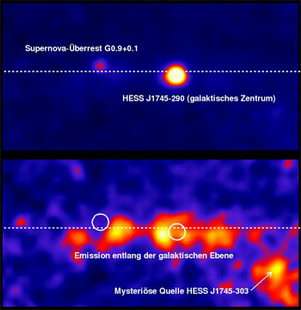
Astrophysicists using the H.E.S.S. gamma-ray telescopes, in Namibia, have announced the detection of very-high-energy gamma rays from huge gas clouds known to pervade the centre of our Galaxy.
These gamma rays are expected to result from the even more energetic cosmic-ray particles, which permeate our entire Galaxy, crashing into the clouds. However, thanks to the extreme sensitivity of the H.E.S.S instrument in this energy range, precise measurements of the intensity and energies of these gamma rays further show that in the central region of our Galaxy these cosmic-ray particles are typically more energetic than those measured falling onto the Earth's atmosphere. Possible reasons why cosmic rays are enhanced and of higher energies at the heart of our Galaxy include the echo of a supernova which exploded some ten thousand years beforehand, or a burst of particle acceleration from the super massive black hole at the very centre of our Galaxy.
Gamma rays resemble normal light or X-rays, but are much more energetic. Visible light has an energy of about one electronvolt (1 eV), in physicist's terms. X-rays are thousands to millions of eV. H.E.S.S. detects very-high-energy gamma-ray photons with an energy of a million million eVs, or one teraelectronvolt. These high-energy gamma rays are quite rare; even for relatively strong astrophysical sources, only about one gamma ray per month hits a square metre at the top of the Earth's atmosphere.
High-energy particles from space continuously bombard the Earth's atmosphere from all directions. Their energies exceed, by far, those that can be reached using man-made particle accelerators. Cosmic rays were discovered in 1912 by Victor Hess, and while they have been extensively studied for almost a century, their origin - often declared as one of the key themes of astrophysics - is still not completely understood. One important early result of the H.E.S.S. experiment was to reveal a supernova explosion shock-wave as a site of intense particle acceleration
In a recent publication in Nature magazine, the international H.E.S.S. collaboration reported the discovery of gamma-ray emission from a complex of gas clouds near the centre of our own Milky Way Galaxy. These giant clouds of hydrogen gas encompass an amount of gas equivalent to 50 million times the mass of the sun. With the highly sensitive H.E.S.S. gamma-ray telescopes, it is possible for the first time to show that these clouds are glowing in very-high-energy gamma rays.
One key issue in our understanding of cosmic rays is their distribution in space. Do they permeate the entire Galaxy uniformly, or do their density and distribution in energy vary depending on one's location in the Galaxy (for example, due to the proximity of cosmic particle accelerators)? Direct measurements of cosmic rays can only taken within our solar system, located about 25,000 light years from the centre of the Galaxy. However, a subterfuge allows astrophysicists to investigate cosmic rays elsewhere in the Galaxy; when a cosmic-ray particle collides with an interstellar gas particle, gamma rays are produced.
The central part of our Galaxy is a complex astronomical zoo, containing examples of every type of exotic object known to astronomers, such as the remnants of supernova explosions and a super-massive black hole. It also contains huge quantities of interstellar gas, which tends to clump into clouds. If gamma rays are detected from the direction of such a gas cloud, scientists can infer the density of cosmic rays at the location of the cloud. The intensity and distribution in energy of these gamma rays reflects that of the cosmic rays.
At low energies, around 100 million electronvolts (man-made accelerators reach energies up to 1,000,000 million electronvolts), this technique has been used by the EGRET satellite to map cosmic rays in our Galaxy. At really high energies - the true domain of cosmic-ray accelerators - no instrument has been so far sensitive enough to "see" interstellar gas clouds shining in very-high-energy gamma rays. H.E.S.S. has for the first time demonstrated the presence of cosmic rays in this central region of our Galaxy.
The H.E.S.S. data show that the density of cosmic rays exceeds that in the solar neighbourhood by a significant factor. Interestingly, this difference increases as we go up in energy, which implies that the cosmic rays have been recently accelerated. So, these data hint that the clouds are illuminated by a nearby cosmic-ray accelerator, which was active over the last ten thousand years. Candidates for such accelerators are a gigantic stellar explosion which apparently went off near the heart of our Galaxy in "recent" history; another possible acceleration site is the super-massive black hole at the centre of the Galaxy. Jim Hinton, one of the scientists involved in the discovery, concludes "This is only the first step. We are of course continuing to point our telescopes at the centre of the Galaxy, and will work hard to pinpoint the exact acceleration site - I'm sure that there are further exciting discoveries to come."
The High Energy Stereoscopic System (H.E.S.S.) team consists of scientists from Germany, France, the UK, the Czech Republic, Ireland, Armenia, South Africa and Namibia.
The results were obtained using the High Energy Stereoscopic System (H.E.S.S.) telescopes in Namibia, in south-western Africa. This system of four 13 m diameter telescopes is currently the most sensitive detector of very-high-energy gamma rays. These are absorbed in the atmosphere, where they give a short-lived shower of particles. The H.E.S.S. telescopes detect the faint, short flashes of bluish light which these particles emit (named Cherenkov light, lasting a few billionths of a second), collecting the light with large mirrors which reflect onto extremely sensitive cameras. Each image gives the position in the sky of a single gamma-ray photon, and the amount of light collected gives the energy of the initial gamma ray. Building up the images photon-by-photon allows H.E.S.S. to create maps of astronomical objects as they appear in gamma rays.
The H.E.S.S. telescope array represents a multi-year construction effort by an international team of more than 100 scientists and engineers. The instrument was inaugurated in September 2004 by the Namibian Prime Minister, Theo-Ben Guirab, and its first data have already resulted in a number of important discoveries, including the first astronomical image of a supernova shock wave at the highest gamma-ray energies.
Source: Max Planck Institute for Nuclear Physics


