WFU professor designs atomic emission detector
September 12, 2007
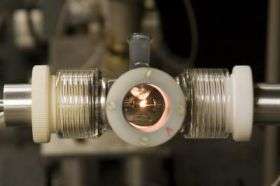
This photo shows the tungsten coil component of a prototype atomic emission detector that researchers at Wake Forest University and three other institutions are developing for the US Department of Homeland Security. Credit: Tommy Murphy, instructional technology consultant, Wake Forest University
Brad Jones, a professor of chemistry at Wake Forest University, is leading a team of researchers at four institutions to develop the first handheld, field instrument capable of detecting and identifying radioactive particles at the site of potential contamination. The device will enable authorities to quickly test dust, soil, water and crops in the event of a terrorist attack such as a “dirty” bomb.
The three-year project is funded by the National Science Foundation in conjunction with the Department of Homeland Security, which asked scientists to submit proposals for radioactivity detection devices. Jones, who specializes in creating spectroscopic instruments, saw the potential to adapt a design he originally conceived years ago to permit rapid field testing for lead in blood samples.
Jones’ “Tungsten Coil Atomic Emission Spectrometer” is constructed using the metal coil filament from a standard slide projector bulb powered by a 12-volt battery, such as the type used to start boats or automobiles. Environmental samples of suspect particles are dissolved in liquid, and droplets are placed on the coil. The samples are dried at low voltage and the residue vaporized at 3,000 degrees, producing a flash of light. Each metal displays a unique color signature, which is captured by a fiber optic sensor connected to a laptop computer. Test results are then charted on a graph showing each sample’s wavelength and intensity, allowing scientists to identify specific elements and amounts of radioactivity.
“It’s just a natural application,” Jones says, noting that the radioisotopes likely to be stolen from medical or industrial facilities and used by terrorists are also the most brightly emitting elements in atomic spectrometry. “But, the proposed device represents a new way of thinking in the field of nuclear forensics. Atomic emission spectrometry is traditionally a laboratory-based technique using very large, very expensive instruments. With immediate on-site results, residents could be given timely information about a potential threat or reassured that none existed rather than waiting for samples to be transported to laboratories for analysis.”
Portability may also lead to new applications of atomic spectrometry in the field, Jones adds, such as testing for contamination by pesticides and other pollutants.
Instrument manufacturer Teledyne Leeman Labs is interested in the production and marketing of the device once Jones’ research group perfects their prototype. Jones has collaborated with the company for more than a decade.
Source: Wake Forest University
-
Italian scientists claim to have demonstrated cold fusion (w/ Video)
Jan 20, 2011 |
3.8 / 5 (156) |
298
-
Removing a hydrogen fuel-cell roadblock
Mar 27, 2007 |
4.3 / 5 (40) |
0
-
Sandia piezoelectric films to be part of NASA space station experiment
Aug 08, 2006 |
4.7 / 5 (3) |
0
-
World's First UV 'Ruler' Sizes Up Atomic World
May 18, 2005 |
5 / 5 (1) |
0
-
Electrons in concert: A simple probe for collective motion in ultracold plasmas
Feb 06, 2012 |
4.2 / 5 (5) |
0
-
Engineers build first sub-10-nm carbon nanotube transistor
Feb 01, 2012 |
4.9 / 5 (33) |
30
-
Something old, something new: Evolution and the structural divergence of duplicate genes
Jan 31, 2012 |
4.6 / 5 (7) |
1
-
The hidden nanoworld of ice crystals: Revealing the dynamic behavior of quasi-liquid layers
Jan 30, 2012 |
5 / 5 (5) |
1
-
Stock market network reveals investor clustering
Jan 27, 2012 |
3.9 / 5 (23) |
8
-
Of microchemistry and molecules: Electronic microfluidic device synthesizes biocompatible probes
Jan 26, 2012 |
5 / 5 (2) |
0
More news stories
Ordered planar polymers created for the first time
(PhysOrg.com) -- Scientists under the direction of ETH Zurich have created a minor sensation in synthetic chemistry. They succeeded for the first time in producing regularly ordered planar polymers that form ...
1 hour ago |
5 / 5 (1) |
0
|
Scientists discover molecular secrets of 2,000-year-old Chinese herbal remedy
For roughly two thousand years, Chinese herbalists have treated Malaria using a root extract, commonly known as Chang Shan, from a type of hydrangea that grows in Tibet and Nepal. More recent studies suggest that halofuginone, ...
17 hours ago |
4.5 / 5 (19) |
17
|
New method to examine batteries -- MRI from the inside
There is an ever-increasing need for advanced batteries for portable electronics, such as phones, cameras, and music players, but also to power electric vehicles and to facilitate the distribution and storage of energy derived ...
Chemistry / Analytical Chemistry
17 hours ago |
5 / 5 (7) |
0
|
Hydrogen from acidic water: Researchers develop potential low cost alternative to platinum for splitting water
A technique for creating a new molecule that structurally and chemically replicates the active part of the widely used industrial catalyst molybdenite has been developed by researchers with the Lawrence Berkeley ...
Feb 09, 2012 |
4.8 / 5 (16) |
21
|
Fool's gold may prove an unlikely alternative to overexploited catalytic materials
Catalytic materials, which lower the energy barriers for chemical reactions, are used in everything from the commercial production of chemicals to catalytic converters in car engines. However, with current catalytic materials ...
Feb 10, 2012 |
4.4 / 5 (8) |
9
|
New molecule has potential to help treat genetic diseases and HIV
(PhysOrg.com) -- Chemists at The University of Texas at Austin have created a molecule that's so good at tangling itself inside the double helix of a DNA sequence that it can stay there for up to 16 days before ...
With climate change, today's '100-year floods' may happen every three to 20 years: research
Last August, Hurricane Irene spun through the Caribbean and parts of the eastern United States, leaving widespread wreckage in its wake. The Category 3 storm whipped up water levels, generating storm surges ...
Social psychologist: Lust makes you smarter and evidence that seven deadly sins are good for you
(Medical Xpress) -- Good news for lovers on Valentine’s Day - the seven deadly sins, including Lust, are good for you. University of Melbourne social psychologist Dr Simon Laham uses modern research to make a compelling ...
The joy of cheques
An electronic cheque which eliminates the need for costly processing by banks but preserves the simplicity and ease of a traditional cheque book has been designed by a team of academics in the UK.
Research shows promise in converting camelina oil into jet fuel
(PhysOrg.com) -- Researchers at Montana State University-Northern have developed a process to convert camelina oil to jet fuel and other high-value chemicals. MSU has applied for a U.S. patent and research is ongoing.
Couples in the same place emotionally stay together, study says
(Medical Xpress) -- Despite lifes ups and downs, couples whose feelings are in sync consistently over time are more likely to stay together, says a University of California, Davis, study.