Taxol bristle ball: a wrench in the works for cancer
September 12th, 2007 TaxolBall

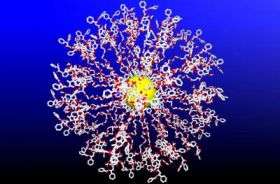
Using gold nanoparticles, Rice chemists have created tiny spheres that literally bristle with molecules of the anti-cancer drug Taxol. Credit: Eugene Zubarev/Rice University

Rice University chemists have discovered a way to load dozens of molecules of the anti-cancer drug paclitaxel onto tiny gold spheres. The result is a tiny ball, many times smaller than a living cell that literally bristles with the drug.

Paclitaxel, which is sold under the brand name Taxol®, prevents cancer cells from dividing by jamming their inner works.

"Paclitaxel is one of the most effective anti-cancer drugs, and many researchers are exploring how to deliver much more of the drug directly to cancer cells," said lead researcher Eugene Zubarev, the Norman Hackerman-Welch Young Investigator and assistant professor of chemistry at Rice. "We looked for an approach that would clear the major hurdles people have encountered -- solubility, drug efficacy, bioavailability and uniform dispersion -- and our initial results look very promising."

The research is available online and will appear in the Sept. 19 issue of the Journal of the American Chemical Society.

First isolated from the bark of the yew tree in 1967, paclitaxel is one of the most widely prescribed chemotherapy drugs in use today. The drug is used to treat breast, ovarian and other cancers.

Paclitaxel works by attaching itself to structural supports called microtubules, which form the framework inside living cells. In order to divide, cells must break down their internal framework, and paclitaxel stops this process by locking the support into place.

Since cancer cells divide more rapidly than healthy cells, paclitaxel is very effective at slowing the growth of tumors in some patients. However, one problem with using paclitaxel as a general inhibitor of cell division is that it works on all cells, including healthy cells that tend to divide rapidly. This is why patients undergoing chemotherapy sometimes suffer side effects like hair loss and suppressed immune function.

"Ideally, we'd like to deliver more of the drug directly to the cancer cells and reduce the side effects of chemotherapy," Zubarev said. "In addition, we'd like to improve the effectiveness of the drug, perhaps by increasing its ability to stay bound to microtubules within the cell."

Zubarev's new delivery system centers on a tiny ball of gold that's barely wider than a strand of DNA. Finding a chemical process to attach a uniform number of paclitaxel molecules to the ball -- without chemically altering the drugs -- was not easy. Only a specific region of the drug binds with microtubules. This region of the drugs fits neatly into the cell's support structure, like a chemical "key" fitting into a lock. Zubarev and graduate student Jacob Gibson knew they had to find a way to make sure the drug's key was located on the face of each bristle.

Zubarev and Gibson first designed a chemical "wrapper" to shroud the key, protecting it from the chemical reactions they needed to perform to create the ball. Using the wrapped version of the drug, they undertook a series of reactions to attach the drug to linker molecules that were, in turn, attached to the ball. In the final step of the reaction, they dissolved the wrapper, restoring the key.

"We are already working on follow-up studies to determine the potency of the paclitaxel-loaded nanoparticles," Zubarev said. "Since each ball is loaded with a uniform number of drug molecules, we expect it will be relatively easy to compare the effectiveness of the nanoparticles with the effectiveness of generally administered paclitaxel."

Citation: J. Am. Chem. Soc. 2007, vol. 129, pgs.11653-11661

Source: Rice University


print this article email this article download pdf blog this article bookmark this article     Digg this Stumble it share on Facebook share on Reddit add to delicious save to Yahoo! bookmarks
4.8/5 after 34 votes


September 12th, 2007 all stories
Chemistry /

Comments: 0
Rank: 4.8/5 after 34 votes

  • Stumble this up

  • Digg this

  • Share it:
  • share on Facebook
  • share on MySpace
  • share on Slashdot
  • rss-newsfeed
  • share on Google
  • share on Reddit
  • add to delicious
  • save to Yahoo! bookmarks
  • share on Windows Live
  • Add to Mixx!
Rating: 4.8/5 after 34 votes


Tags


  • Physicists Demonstrate Quantum Memory with Matter Qubits
    Physicists Demonstrate Quantum Memory with Matter Qubits
    Physics / General Physics
    created Jul 03, 2009 | popularity 4.4 / 5 (17) | comments 1
  • 'Holey' Nanosheets for Wastewater Dye Removal
    Nanotechnology / Nanomaterials
    created Jul 01, 2009 | popularity 5 / 5 (5) | comments 1
  • Jellyfish Robot Swims Like its Biological Counterpart
    Jellyfish Robot Swims Like its Biological Counterpart
    Electronics / Robotics
    created Jun 26, 2009 | popularity 4.4 / 5 (8) | comments 1
  • Could Maxwell's Demon Exist in Nanoscale Systems?
    Could Maxwell's Demon Exist in Nanoscale Systems?
    Physics / General Physics
    created Jun 24, 2009 | popularity 4.4 / 5 (18) | comments 29
  • Living Safely with Robots, Beyond Asimov's Laws
    Living Safely with Robots, Beyond Asimov's Laws
    Electronics / Robotics
    created Jun 22, 2009 | popularity 4.6 / 5 (52) | comments 40
  • Other News

    Scientists find molecule that regulates heart size by using zebrafish screening model

    Chemistry / Biochemistry

    created 14 hours ago | popularity not rated yet | comments 0

    Using zebrafish, researchers at the University of Pittsburgh have identified and described an enzyme inhibitor that allows them to increase the number of cardiac progenitor cells and therefore influence the size of the developing ...


    Scientists find a biological 'fountain of youth' in new world bat caves

    Chemistry / Biochemistry

    created Jun 30, 2009 | popularity 3.9 / 5 (28) | comments 30

    Scientists from Texas are batty over a new discovery which could lead to the single most important medical breakthrough in human history -- significantly longer lifespans. The discovery, featured on the cover of the July ...


    urine

    Producing hydrogen from urine

    Chemistry / Analytical Chemistry

    created Jul 03, 2009 | popularity 4.6 / 5 (35) | comments 18

    (PhysOrg.com) -- You do two things at motorway services: fill up one tank and empty another. US chemists have combined refuelling your car and relieving yourself by creating a new catalyst that can extract ...


    Stanford researchers find a quicker, cheaper way to sort isotopes

    Researchers find quicker, cheaper way to sort isotopes

    Chemistry / Analytical Chemistry

    created Jun 29, 2009 | popularity 5 / 5 (2) | comments 3

    (PhysOrg.com) -- Whether it's the summer grass that tickles your feet or the red Bordeaux smacking on your palette, nearly every part of the world around you carries special chemical markers. These markers, ...


    Oxygen key to 'cut and paste' of genes

    Oxygen key to 'cut and paste' of genes

    Chemistry / Biochemistry

    created Jul 03, 2009 | popularity 4.5 / 5 (4) | comments 0

    (PhysOrg.com) -- An oxygen-sensitive enzyme has been found to play a key role in how genes create the many different proteins that make up our bodies.