Software transforms digital photos into old-fashioned paintings
September 12, 2007 by Lisa Zyga
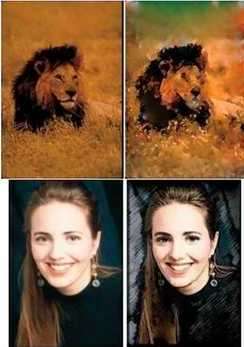
(1) (Left) Picture of lion. (Right) Mixed media rendering using a composite of paint daubs, watercolor, and colored pencil. (2) (Left) Picture of a face. (Right) Mixed media portrait. Credit: Stephen Brooks. Copyright 2007 IEEE.
While today’s most cutting-edge digital imaging technology strives for high-res and high focus, Stephen Brooks is interested in distorting photos and deliberately making them unfocused. His system can produce a unique piece of artwork that looks hand-made, whether by oil painting, watercolors, ink drawing, or a mixture of many media types.
Brooks is a computer scientist at Dalhousie University, and also has a background in traditional drawing. The method he recently developed can transform digital photos taken with an ordinary camera into mixed-media paintings and portraits, making him a pioneer in a subject area that is largely unexplored. While the system requires very little input from the user, the results can be tweaked if desired, and produce realistic compositions of “nonphotorealistic renderings” (NPR).
“Mixed media compositions incorporate two or more traditional visual media such as oil, watercolor, tempera, ink, or pencil,” Brooks explained. “By mixing materials, the artist is able to explore new channels of artistic expression or rejuvenate existing ones.”
As Brooks explains, mixed media is often used by artists when a single medium is insufficient to fully develop an artistic idea. From ancient Egyptians to Rembrandt and Picasso, and even contemporary cartoonists such as Dave McKean, mixed media has been used to give variety to work and emphasize certain details.
To give the appearance of mixed media to photos, Brooks’ system analyzes the input image and computes a measure of detail at each pixel. The areas of the image with different levels of detail are separated into distinct regions, and then each region is processed independently with a different NPR filter chosen by the user. Examples of filters can be “paint daubs,” “soft glow,” “crystallize,” “ink outlines,” “cartoon,” etc. Choosing the filters is the only step that requires user input.
Finally, the different areas of the image are smoothly fused. Here, the user has the option of determining the gradient level of blended areas, but Brooks notes that all the samples he presents in his research are created automatically by the system. The system performs the blending process in separate stages to allow the user to see the intermediate processing. Brooks explains that this step-by-step process resembles how an artist produces a mixed media work in stages.
One of the most challenging types of images to transform is facial portraits, as people are highly sensitive to the treatment of faces. Using Brooks’ standard technique, the facial areas around the cheeks and forehead are perceived as low detail areas, while the eyes and mouth have more detail, which produces undesirable results. Brooks approached this special case by developing systems for skin filtering, face point detection, and face point clustering to create a more satisfactory mixed media portrait.
“The most advanced component of my system is the module that handles portraits,” Brooks said. “Automatic face detection and processing is quite tricky if one wants to make the system robust. I use a combination of skin detection, cascaded weak detectors, and Gaussian mixture model clustering.”
Brooks is currently exploring more advanced features and improvements, including integrating 2.5-dimensional physical materials such as felts and cardboards, as well as the possibility of adapting the technique to video.
“We have recently begun collaborating with the film school at the Nova Scotia College of Art and Design,” he said. “We are looking at developing a new kind of digital film production system which could involve extending mixed media processing to video. So, it may be released as part of a larger film processing package.”
Citation: Brooks, Stephen. “Mixed-Media Painting and Portraiture.” IEEE Transactions on Visualization and Computer Graphics, vol. 13, no. 5, September/October 2007.
-
British police arrest 5 in tabloid bribery probe
Jan 29, 2012 |
5 / 5 (2) |
2
-
China looks at carbon tax, official says in US
Jan 11, 2012 |
3.7 / 5 (6) |
12
-
Georgia Tech identifies coming media megatrends in FutureMedia Outlook 2012
Dec 14, 2011 |
not rated yet |
0
-
Serendipitous news reading online is gaining prominence
Dec 01, 2011 |
not rated yet |
1
-
New study finds that even the cleanest wastewater contributes to more 'super bacteria'
Nov 14, 2011 |
5 / 5 (4) |
2
-
Engineers build first sub-10-nm carbon nanotube transistor
Feb 01, 2012 |
4.9 / 5 (33) |
30
-
Something old, something new: Evolution and the structural divergence of duplicate genes
Jan 31, 2012 |
4.6 / 5 (7) |
1
-
The hidden nanoworld of ice crystals: Revealing the dynamic behavior of quasi-liquid layers
Jan 30, 2012 |
5 / 5 (4) |
1
-
Stock market network reveals investor clustering
Jan 27, 2012 |
3.9 / 5 (23) |
8
-
Of microchemistry and molecules: Electronic microfluidic device synthesizes biocompatible probes
Jan 26, 2012 |
5 / 5 (2) |
0
-
Synergistic relations between computer science and technology.
Feb 06, 2012
-
how do iphone gloves work?
Feb 05, 2012
-
iPhone battery over time
Jan 30, 2012
-
Best alternate Tablet to an iPad for writing math or physics equations?
Jan 26, 2012
-
Sending SMS to a website
Jan 20, 2012
-
Need help with my technical fest!
Jan 19, 2012
- More from Physics Forums - Computing & Technology
More news stories
Google might launch Drive for cloud storage soon
(PhysOrg.com) -- Google's next big move, according to the Wall Street Journal, is a cloud storage service called Drive. Hardly first to the plate, Google is simply catching up to introducing its cloud reposi ...
Iran blocks email, restricts net access: reports
Iran has further restricted access to the Internet and blocked popular email services for the past few days, in a move a top lawmaker said could "cost the regime dearly," media reports said on Sunday.
5 hours ago |
5 / 5 (1) |
3
Love a click away in Indonesia's Twitter Republic
He was a geeky kid from Yogyakarta, she a glamorous city girl in Jakarta. In a country with one of the world's most vibrant social networking scenes they fell in love on Twitter.
13 hours ago |
4 / 5 (1) |
0
Walney offshore wind farm is world's biggest (for now)
(PhysOrg.com) -- The Walney wind farm on the Irish Sea--characterized by high tides, waves and windy weather--officially opened this week. The farm is treated in the press as a very big deal as the Walney ...
Navy to begin tests on electromagnetic railgun prototype launcher
The Office of Naval Research (ONR)'s Electromagnetic (EM) Railgun program will take an important step forward in the coming weeks when the first industry railgun prototype launcher is tested at a facility ...
Feb 06, 2012 |
4.5 / 5 (17) |
94
|
Scientists discover molecular secrets of 2,000-year-old Chinese herbal remedy
For roughly two thousand years, Chinese herbalists have treated Malaria using a root extract, commonly known as Chang Shan, from a type of hydrangea that grows in Tibet and Nepal. More recent studies suggest that halofuginone, ...
Overeating may double risk of memory loss
New research suggests that consuming between 2,100 and 6,000 calories per day may double the risk of memory loss, or mild cognitive impairment (MCI), among people age 70 and older. The study was released today and will be ...
New method to examine batteries -- MRI from the inside
There is an ever-increasing need for advanced batteries for portable electronics, such as phones, cameras, and music players, but also to power electric vehicles and to facilitate the distribution and storage of energy derived ...
A mitosis mystery solved: How chromosomes align perfectly in a dividing cell
Although the process of mitotic cell division has been studied intensely for more than 50 years, Whitehead Institute researchers have only now solved the mystery of how cells correctly align their chromosomes during symmetric ...
Lab study raises questions over nano-particle impact
Tests involving chickens have raised questions about the impact on health from engineered nano-particles, the ultra-fine grains commonly used in drugs and processed foods, scientists said on Sunday.
Starve a virus, feed a cure? Findings show how some cells protect themselves against HIV
A protein that protects some of our immune cells from the most common and virulent form of HIV works by starving the virus of the molecular building blocks that it needs to replicate, according to research published online ...
Jan 25, 2008
Rank: not rated yet