Matter-antimatter molecules of positronium observed in the lab for the first time
September 12th, 2007 Positronium Molecules Seen in Lab

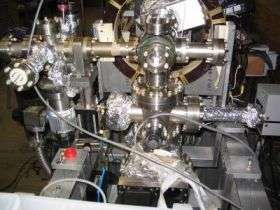
The ultra-high vacuum target chamber, where the intense positron pulse is implanted into the porous silica film. The magnet coils carry a current of 1000 amps for a few hundred milliseconds to generate the strong magnetic field needed to compress the positron beam. Credit: David Cassidy, UC-Riverside

Physicists at UC Riverside have created molecular positronium, an entirely new object in the laboratory. Briefly stable, each molecule is made up of a pair of electrons and a pair of their antiparticles, called positrons.

The research paves the way for studying multi-positronium interactions – useful for generating coherent gamma radiation – and could one day help develop fusion power generation as well as directed energy weapons such as gamma-ray lasers. It also could help explain how the observable universe ended up with so much more matter than “antimatter.”

Study results appear in the Sept. 13 issue of Nature.

The researchers made the positronium molecules by firing intense bursts of positrons into a thin film of porous silica, which is the chemical name for the mineral quartz. Upon slowing down in silica, the positrons were captured by ordinary electrons to form positronium atoms.

Positronium atoms, by nature, are extremely short-lived. But those positronium atoms that stuck to the internal pore surfaces of silica, the way dirt particles might cling to the inside surface of the holes in a sponge, lived long enough to interact with one another to form molecules of positronium, the physicists found.

“Silica acts in effect like a useful cage, trapping positronium atoms,” said David Cassidy, the lead author of the research paper and an assistant researcher working in the laboratory of Allen Mills, a professor of physics, the research paper’s coauthor. “This is the first step in our experiments. What we hope to achieve next is to get many more of the positronium atoms to interact simultaneously with one another – not just two positronium atoms at a time.”

When an electron meets a positron, their mutual annihilation may ensue or positronium, a briefly stable, hydrogen-like atom, may be formed. The stability of a positronium atom is threatened again when the atom collides with another positronium atom. Such a collision of two positronium atoms can result in their annihilation, accompanied by the production of a powerful and energetic type of electromagnetic radiation called gamma radiation, or the creation of a molecule of positronium, the kind Cassidy and Mills observed in their lab.

“Their research is giving us new ways to understand matter and antimatter,” said Clifford M. Surko, a professor of physics at UC San Diego, who was not involved in the research. “It also provides novel techniques to create even larger collections of antimatter that will likely lead to new science and, potentially, to important new technologies.”

Matter, the “stuff” that every known object is made of, and antimatter cannot co-exist close to each other for more than a very small measure of time because they annihilate each other to release enormous amounts of energy in the form of gamma radiation. The apparent asymmetry of matter and antimatter in the visible universe is an unsolved problem in physics.

Currently, antimatter finds use in medicine where it helps identify diseases with the Positron Emission Tomography or PET scan.

Cassidy and Mills plan to work next on using a more intense positron source to generate a “Bose-Einstein condensate” of positronium – a collection of positronium atoms that are in the same quantum state, allowing for more interactions and gamma radiation. According to them, such a condensate would be necessary for the development of a gamma-ray laser.

Source: University of California - Riverside


print this article email this article download pdf blog this article bookmark this article     Digg this Stumble it share on Facebook share on Reddit add to delicious save to Yahoo! bookmarks
4.8/5 after 112 votes


September 12th, 2007 all stories
Physics / General Physics

Comments: 0
Rank: 4.8/5 after 112 votes

  • Stumble this up

  • Digg this

  • Share it:
  • share on Facebook
  • share on MySpace
  • share on Slashdot
  • rss-newsfeed
  • share on Google
  • share on Reddit
  • add to delicious
  • save to Yahoo! bookmarks
  • share on Windows Live
  • Add to Mixx!
Rating: 4.8/5 after 112 votes

  • Related Stories

  • Physicists offer new approach to studying antimatter in the lab
    created Oct 31, 2005 | popularity not rated yet | comments 0
  • What is the lifetime of positronium ions?
    created Feb 22, 2006 | popularity not rated yet | comments 0
  • Proposed Particle Help Explains Odd Galactic Photons
    created Jul 25, 2008 | popularity not rated yet | comments 0
  • A new particle discovered by Babar experiment
    created Jul 06, 2005 | popularity not rated yet | comments 0

Tags


  • Physicists Demonstrate Quantum Memory with Matter Qubits
    Physicists Demonstrate Quantum Memory with Matter Qubits
    Physics / General Physics
    created 15 hours ago | popularity 4.8 / 5 (8) | comments 1
  • 'Holey' Nanosheets for Wastewater Dye Removal
    Nanotechnology / Nanomaterials
    created Jul 01, 2009 | popularity 5 / 5 (5) | comments 1
  • Jellyfish Robot Swims Like its Biological Counterpart
    Jellyfish Robot Swims Like its Biological Counterpart
    Electronics / Robotics
    created Jun 26, 2009 | popularity 4.4 / 5 (7) | comments 1
  • Could Maxwell's Demon Exist in Nanoscale Systems?
    Could Maxwell's Demon Exist in Nanoscale Systems?
    Physics / General Physics
    created Jun 24, 2009 | popularity 4.4 / 5 (18) | comments 29
  • Living Safely with Robots, Beyond Asimov's Laws
    Living Safely with Robots, Beyond Asimov's Laws
    Electronics / Robotics
    created Jun 22, 2009 | popularity 4.6 / 5 (50) | comments 39
  • Other News

    Physicists Demonstrate Quantum Memory with Matter Qubits

    Physicists Demonstrate Quantum Memory with Matter Qubits

    Physics / General Physics

    created 15 hours ago | popularity 4.8 / 5 (8) | comments 1

    (PhysOrg.com) -- For the first time, scientists have successfully operated a quantum gate between two remote particles of matter, marking an important step toward the development of a quantum computer. In ...


    Scientists create first electronic quantum processor

    Scientists create first electronic quantum processor

    Physics / General Physics

    created Jun 28, 2009 | popularity 4.8 / 5 (49) | comments 38

    A team led by Yale University researchers has created the first rudimentary solid-state quantum processor, taking another step toward the ultimate dream of building a quantum computer.


    Fermilab's CDF observes Omega-sub-b baryon

    Fermilab's CDF observes Omega-sub-b baryon

    Physics / General Physics

    created Jun 29, 2009 | popularity 4.6 / 5 (13) | comments 7

    (PhysOrg.com) -- At a recent physics seminar at the Department of Energy’s Fermi National Accelerator Laboratory, Fermilab physicist Pat Lukens of the CDF experiment announced the observation of a new particle, ...


    New insights, and a new angle, on high-temperature superconductivity

    New insights, and a new angle, on high-temperature superconductivity

    Physics / Superconductivity

    created Jun 29, 2009 | popularity 4.8 / 5 (12) | comments 6

    (PhysOrg.com) -- A Princeton-led research team has revealed surprising information about how electron behavior influences the conduction of electricity in a class of high-temperature superconductors. An increased ...


    The art of invisibility and the perfect cat's eye

    The art of invisibility and the perfect cat's eye

    Physics / Optics & Photonics

    created Jun 30, 2009 | popularity 3.9 / 5 (7) | comments 6

    (PhysOrg.com) -- In recent years scientists have explored the impossible by developing invisibility or 'cloaking' devices, but can the same technology also help make things more visible?