Gorillas classified as critically endangered
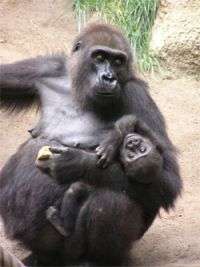
The World Conservation Union (IUCN) has released its newly revised Red List of Threatened Species. One notable change is the elevation of western gorillas to the highest threat status, Critically Endangered. The rise in status is attributed to uncontrolled poaching and massive outbreaks of the lethal Ebola virus, which has killed about one third of gorillas in protected areas over the last fifteen years.
The rise in status is noteworthy because western gorillas have yet to dwindle to the tiny remnant population size typical of Critically Endangered species. Rather, the listing is based on the dizzying rate of decline in a species that was until recently widespread and common. The combined effects of poaching and Ebola have caused western gorilla populations to drop by at least 60% in the last twenty years.
"Critically Endangeredstatus is extremely encouraging", said Peter D. Walsh of the Max Planck Institute for Evolutionary Anthropology, one of the experts who worked on the listing. "For once we are paying attention before it is too late. A relatively modest investment in anti-poaching and Ebola control could ensure the future of one of our closest relatives."
Experts were able to estimate the population decline due to Ebola because outbreaks cause a distinctive "all or none" pattern in which large zones of 95% mortality transition abruptly into zones of normal gorilla density. Estimating impact was then a matter of using sleeping nest surveys to estimate what proportion of habitat lay in the dead zones.
Poaching and Ebola represent a devastating one-two punch because poaching is concentrated in accessible areas while Ebola impact has been in remote areas, often inside national parks and other protected areas. For instance, Ebola outbreaks killed gorillas viewed by tourists at Lossi Sanctuary and Odzala National Park in Northern Republic of Congo while animals in the mountain gorilla tourism program at Volcanoes National Park in Rwanda were recently killed by poachers.
Law enforcement, particularly anti-poaching patrols, has been effective in controlling poaching in the past while several different experimental vaccines might be used against Ebola. "Unfortunately, funding for law enforcement has dwindled in recent years in favor of more politically correct programs such as ecotourism and nobody wants to pay for an Ebola vaccination program" said Walsh. "Unless we get more serious about law enforcement and Ebola control right now, there won’t be many gorillas left for tourists to see."
A vaccination program would use one of the five experimental vaccines that have successfully protected laboratory monkeys against Ebola. What is necessary to move one of these vaccines from the lab to the field are safety and efficacy tests on captive animals and a method of vaccine delivery in the wild. Walsh and Colleagues at Max Planck, the Leipzig Zoo, and Impfstoffwerk Dessau-Tornau, a private vaccine manufacturer, have already started oral bait trials on captive gorillas. They are currently looking for funding to carry out vaccine safety trials on captive animals, as well as oral baiting and darting trials in the wild.
Gorillas are currently divided into two species, the western gorilla (Gorilla gorilla) and the eastern gorilla (Gorilla beringei). Reliable abundance estimates are not available for the two species, but eastern gorillas probably number in the mid thousands while western gorillas number in the tens of thousands. Habitat loss is the greatest threat to eastern gorillas but a relatively minor threat to western gorillas. Eastern gorillas are also threatened by illegal hunting but to a lesser extent than western gorillas. Only western gorillas and common chimpanzees are currently threatened by Ebola.
Source: Max Planck Institute for Evolutionary Anthropology


