Putting stem cell research on the fast track
Engineers at Rensselaer Polytechnic Institute have developed tools to help solve two of the main problems slowing the progress of stem cell research — how to quickly test stem cell response to different drugs or genes, and how to create a large supply of healthy, viable stem cells to study from only a few available cells.
The researchers have created methods to study millions of stems cells on devices the size of a standard microscope slide. The techniques enable thousands of individual stem cell experiments to be carried out quickly and in parallel on one small device.
“Rensselaer is quickly establishing itself as leader in the development of stem cell technology that hastens the speed and accuracy of stem cell research,” Provost Robert Palazzo said. “Our scientists and engineers are filling a vital niche in the global scientific effort to develop medical therapies using stem cells. Tools like these, which enable high-throughput study of stem cells, will quickly advance stem cell research in medical labs around the world.”
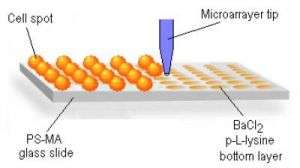
The two groups of researchers used microarrays to develop miniaturized stem cell laboratories. With this technique researchers can perform high-throughput analysis of the material or cells on a single slide, analyzing tens of thousands of samples in one experiment. Each of the teams developed separate specialized microarray platforms.
Helping Develop Stem Cell Drugs
A team led by Jonathan Dordick, the Howard P. Isermann Professor of Chemical and Biological Engineering, and visiting doctoral student Tiago Fernandez and Professor Joaquim M.S. Cabral from the Instituto Superior Téchinco-Lisbon in Portugal developed a platform that will enhance the speed of drug discovery by revealing how different molecules help or hinder stem cell function. Their research was presented at the 234th American Chemical Society (ACS) National Meeting in Boston on Aug. 19.
The platform will serve as a tool in the discovery of new drugs that target stem cells, Dordick said. He explained that although this three-dimensional system can be used to discover materials that support stem cell development and growth, not all stem cells are worth saving. “New research is showing that some stem cells could be the precursor for cancer and the reason that cancer reappears after having been totally eradicated by chemotherapy,” he said. “With this platform we may be able to rapidly screen new drug candidates that target and kill these stem cells. Instead of going for the mature liver cell that spreads cancer, we can catch a liver stem cell before it can kick off cancer development.”
The device will enable drug researchers to quickly screen thousands of small molecules (the basic element of many modern drugs) for their impacts on the fate of stem cells.
Dordick’s group was able to prepare up to 1,000 drops as small as 20 nanoliters on a chemically modified slide. The drops contained a mixture of mouse embryonic stem cells encased in a specialized gel. The researchers discovered that in this mixture, the cells remained viable and could be used in various forms of cell-based screening.
Helping Understand Gene Function in Stem Cells
A separate team led by Professor of Chemical and Biological Engineering Ravi Kane and Rensselaer doctoral student Randolph Ashton created a platform that will allow researchers to quickly understand how different genes impact stem cell function or development. Their research will be published in upcoming edition of the journal Stem Cells.
“There are millions of DNA bases and tens of thousands of genes within the human genome,” Kane said. “In order to screen how all these different DNA sequences affect stem cell function you need an extremely high throughput method.”
In order to become a specialized organ, tissue, or neural cell, a stem cell needs to be pointed in the right direction, and that guidance is believed to be provided by a highly complex arrangement of genes. If researchers can isolate the specific genetic sequences that cause a stem cell to transform into a neural cell, the example that Kane used in his research, they can begin to develop medical treatments for common diseases like Parkinson’s disease using specially programmed stem cells infected with the correct arrangement of genes to produce healthy neural cells.
Kane and his team developed a specialized stamping technique that can be used to quickly understand how different genetic sequences affect stem cell development. The stamp is covered with thousands of mircoscale prongs, similar to the surface of a LEGO®. Those prongs imprint the surface of the corresponding slide, creating a microarray platform with thousands of individual cell-adhesive divots — the perfect mircoscale Petri dishes. The master stamp can create thousands of stamped surfaces without the needs for a clean room or sophisticated machinery.
To develop the stem cell mixture added to the stamped surface, the researchers first created a stem cell library. Each stem cell within this library would overexpress a different genetic sequence. Cells from the library are then dropped onto the micropatterned surface, such that each divot contains only one type of cell. Those seeded populations then divide to form individual clonal populations of cells. A stamped surface the size of a microscope slide can contain 3,500 clonal cell populations. These populations can then be screened at the same time for researchers to determine which cells exhibit a desired behavior (i.e. the development of healthy neural cells). The researcher then immediately knows what DNA sequence is responsible for the observed behavior.
To exhibit the effectiveness of their technology, Kane and his group screened clonal populations of rat neural stem cells to identify a sequence that promoted neural stem cell proliferation.
Source: Rensselaer Polytechnic Institute


