Cassini Gets Close-Up Views of Saturn's Moon Iapetus
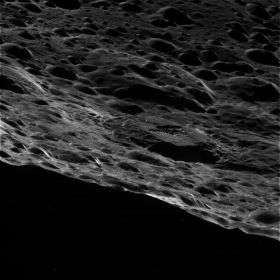
September 12, 2007 Cassini Gets Close-Up Views of Saturn's Moon Iapetus

Saturn's moon Iapetus. Image credit: NASA/JPL/Space Science Institute

Cassini completed its closest flyby of the odd moon Iapetus on Sept. 10, 2007. The spacecraft flew about 1,640 kilometers (1,000 miles) from Iapetus' surface and is returning amazing views of the bizarre moon.

All the data were successfully recorded on the spacecraft. Twenty-one minutes into the first post-flyby data downlink, the spacecraft went into a precautionary condition called "safe mode. The cause has been determined to be a solid state power switch that was tripped due to a galactic cosmic ray hit.

While in safe mode, the spacecraft turns off all unnecessary activities and transmits only essential engineering telemetry at a low data rate, while it awaits commands from Earth.

Tuesday morning, Sept. 11, commands were sent to the spacecraft to resume high rate science and engineering data playback. The project expects all data on the spacecraft will be returned to Earth during downlinks on Tuesday and Wednesday, with no impact on the Iapetus science data return beyond a brief delay.

Due to the safing event, the sequence executing on the spacecraft was halted, and Cassini's instruments will not be turned back on for three or four days. The last time Cassini was in safe mode was over four years ago.

Source: NASA


print this article email this article download pdf blog this article bookmark this article     Stumble it Digg this share on Facebook retweet share on Reddit add to delicious
Rate this story - 4.3 /5 (14 votes)


September 12, 2007 all stories

Comments: 0

4.3 /5 (14 votes)
  • Stumble this up

  • Digg this

  • share this

  • hide
  • Related Stories

  • NASA's Mars Reconnaissance Orbiter Resumes Observations
    created Dec 16, 2009 | popularity not rated yet | comments 0
  • SwRI's integrated avionics control NASA's WISE spacecraft
    created Dec 14, 2009 | popularity not rated yet | comments 0
  • Mars Reconnaissance Orbiter Spacecraft Out of Safe Mode
    created Dec 09, 2009 | popularity not rated yet | comments 0
  • Mars Odyssey Orbiter Puts Itself Into Safe Standby
    created Dec 01, 2009 | popularity not rated yet | comments 0
  • Mars Reconnaissance Orbite Team Plans Uplink of Protective Files
    created Nov 25, 2009 | popularity not rated yet | comments 0


  • hide
  • Relevant PhysicsForums posts

  • Spectrometers
    created 10 hours ago
  • what accretion disk of BH?
    created 12 hours ago
  • Will the Moon escape Earth's orbit in billions of years?
    created Dec 21, 2009
  • How do I calculate light years to years?
    created Dec 21, 2009
  • More from Physics Forums - General Astronomy

Other News

Shallow Origins

Shallow Origins

Space & Earth / Earth Sciences

created 33 minutes ago | popularity 5 / 5 (1) | comments 0

In finding answers to the mystery of the origin of life, scientists may not have to dig too deep. New research is shedding light on shallower waters as a possible location for where life on Earth began.


Astronauts dock at International Space Station

Space & Earth / Space Exploration

created 43 minutes ago | popularity not rated yet | comments 0

A Russian rocket carrying three astronauts from Japan, Russia and the United States docked at the International Space Station Wednesday, the Russian flight control centre said.


Volcanic Quakes Help Forecast Eruptions

Volcanic Quakes Help Forecast Eruptions

Space & Earth / Earth Sciences

created 1hour ago | popularity not rated yet | comments 0

Monitoring the earthquakes caused from magma movements inside an active volcano could help to improve the accuracy of forecasting an eruption.


The COROT satellite

Astronomers discover 'tilted planets'

Space & Earth / Astronomy

created 1hour ago | popularity 4.7 / 5 (3) | comments 0

(PhysOrg.com) -- University of Exeter, UK, research has added to a growing evidence that several giant planets have orbits so tilted that their orbits can be perpendicular or even backwards relative to their ...


Formation of the Gulf of Corinth rift, Greece

Formation of the Gulf of Corinth rift, Greece

Space & Earth / Earth Sciences

created 4 hours ago | popularity not rated yet | comments 0

A study of the structure and evolution of the Gulf of Corinth rift in central Greece will increase scientific understanding of rifted margin development and the tectonic mechanisms underlying seafloor spreading ...