To maximize biofuel potential, researchers look for sorghum's 'sweet spot'
September 12, 2007 Sorghum IV Arrows

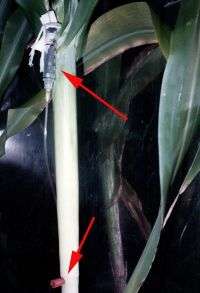
Researchers insert an IV into the sorghum plant as a means of infusing the tracer sucrose, so that they can track the movement and distribution of sugar within the growing plant. Credit: Jay Cockrell, TAES

Picture this - IV (intravenous) lines in a sorghum field. It's not as far-fetched as it sounds. It's one way that scientists at the Texas Agricultural Experiment Station are researching crops that may contribute to the biofuel revolution.

In Beaumont, Dr. Lee Tarpley, plant physiologist, and College Station colleague, Dr. Don Vietor, professor of crop physiology, have focused their research on sweet sorghum.

While sweet sorghum and sugarcane are close relatives, the researchers have shown that the two species have different ways of moving and storing sugar. Tracer sucrose is inserted into growing plants, using a system similar to an IV. Once the sucrose is inside the plants, the researchers can track the movement and distribution.

They found that, due to the plant's physiology, sweet sorghum appears to be more efficient in reusing the stored sugar to support growth of other parts of the plant. The mechanisms in sugarcane, however, allow it to accumulate very high levels of sucrose.

"The differences are critical, and need to be understood for breeders to develop new varieties specifically for the biofuel industry," Tarpley said. Sweet sorghum and sugarcane are both well suited for this purpose.

"While sorghum is an annual and can fit well into a crop rotation, sugarcane is a suitable perennial for many areas," Tarpley said. But to maximize the potential of sweet sorghum as a biofuel crop, breeders need to understand the physiology of the plant and not use sugarcane as a model.

"There is a large body of research on sugarcane that was previously thought to apply equally well to sorghum. Instead, we need to fully understand how sorghum moves and stores sugar in order to elevate to the next level in our breeding efforts," Tarpley said.

The study results were published in the June 2007 issue of BMC Plant Biology (http://www.biomedcentral.com/1471-2229/7/33).

Source: Texas A&M University


print this article email this article download pdf blog this article bookmark this article     Stumble it Digg this share on Facebook retweet share on Reddit add to delicious
Rate this story - 3.5 /5 (4 votes)


September 12, 2007 all stories

Comments: 0

3.5 /5 (4 votes)
  • Stumble this up

  • Digg this

  • share this

  • hide
  • Related Stories


Other News

Hammerhead shark

Wide heads give hammerheads exceptional stereo view

Biology / Plants & Animals

created 17 hours ago | popularity 4.4 / 5 (5) | comments 4

Hammerhead sharks are some of the Ocean's most distinctive residents. 'Everyone wants to understand why they have this strange head shape,' says Michelle McComb from Florida Atlantic University. One possible ...


Golden Oldie: Key Role for Ancient Protein in Algae Photosynthesis

Golden Oldie: Key Role for Ancient Protein in Algae Photosynthesis

Biology / Biotechnology

created 9 hours ago | popularity not rated yet | comments 1

The discovery that an ancient light harvesting protein plays a pivotal role in the photosynthesis of green algae should help the effort to develop algae as a biofuels feedstock. Researchers with the Lawrence ...


Tough yet stiff deer antler is materials scientist's dream

Biology / Plants & Animals

created 17 hours ago | popularity 3 / 5 (1) | comments 2

Prized for their impressive antlers, red deer have been caught in the hunters' sights for generations. But a deer's antlers are much more than decorative. They are lethal weapons that stags crash together when duelling. John ...


Indonesia rejects Bali plan for turtle sacrifices (AP)

Indonesia rejects Bali plan for turtle sacrifices

Biology / Ecology

created 15 hours ago | popularity not rated yet | comments 0

(AP) -- Indonesia has rejected a push by the resort island of Bali for rare turtles to be legally slain in Hindu ceremonies, siding with conservationists of the protected reptiles against religious advocates, ...


Ecologists sound out new solution for monitoring cryptic species

Biology / Ecology

created 18 hours ago | popularity not rated yet | comments 0

Ecologists have at last worked out a way of using recordings of birdsong to accurately measure the size of bird populations. This is the first time sound recordings from a microphone array have been translated into accurate ...