Physicists pin down spin of surface atoms
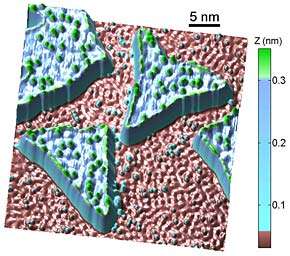
Scientists who dream of shrinking computers to the nanoscale look to atomic spin as one possible building block for both processor and memory, yet setting the spin of an atom, let alone measuring it, has been a challenge.
Now, University of California, Berkeley, physicists have succeeded in measuring the spin of a single atom, moving one step closer to quantum computers and "spintronic" devices built from nanoscale transistors based on atomic spin.
"From a technical point of view, this demonstrates a new ability to engineer, fabricate and measure spin-polarized nanostructures at the single atom level," said Michael F. Crommie, UC Berkeley professor of physics. "Now that I can see an atom's spin, I can ask, 'What can I do with that atomic spin" Can I manipulate it" Can I use it, change it"' This means we can now start incorporating it into other structures."
Crommie and his colleagues at UC Berkeley and the Center for Computational Materials Science (CCMS) at the Naval Research Laboratory in Washington, D.C., recently reported their success in the journal Physical Review Letters.
At the core of today's digital computers are billions of tiny transistor circuits that, because they can exist in two states, are used to represent the binary digits, or "bits" 0 and 1, which are the basis of all computer manipulations.
As researchers seek to reduce the size of digital computers, they have been searching for nanoscale materials that can do digital duty, one of them being a single atom whose outer unpaired electron can be in either of two spin states - up or down.
While researchers previously have been able to deduce the spin polarization of an atom in a surface or thin film where the atoms are packed together and the spins are in an orderly arrangement, no one had been able to directly measure the polarization of an individual "adatom" spin until now. Adatoms are atoms that sit on top of a surface and are not incorporated into it.
Crommie, UC Berkeley post-doctoral fellow Yossi Yayon and graduate student Victor W. Brar succeeded by creating islands of cobalt atoms on a cold copper substrate (4.8 Kelvin, or -451 degrees Fahrenheit) and sprinkling these islands with atoms of either iron or chromium.
Employing a relatively new technique called low-temperature spin-polarized scanning tunneling spectroscopy - essentially a scanning, tunneling microscope that can probe the spin and energy-dependent electron density of a surface - they were able to determine the spin of isolated adatoms atop these cobalt nanoislands.
"These magnetic islands are teeny tiny nanomagnets, but from the single-atom perspective they are just large fixed ferromagnets, like a refrigerator magnet," Crommie said. "We took individual atoms and coupled them to these large magnets so we could fix the direction of the spin of an atom and it would stay put."
Crommie's CCMS colleagues, Steve C. Erwin and post-doctoral fellow Laxmidhar Senapati, calculated that in such a situation, iron atoms would assume a spin state parallel to the spins of the atoms in the cobalt island, while chromium would assume an anti-parallel spin, which is exactly what the researchers found.
How spins couple to one another is an important question for a quantum computer, because in a practical device, the spin of an atom would be quantum mechanically intermingled or "entangled" with the spin of other atoms, manipulated in some sort of calculation, and then disentangled to obtain the result. Understanding such interactions also are critical in spintronic devices, where the spin of atoms is used to control the flow of spin-polarized electrons in a circuit.
"We are clearly not yet in a useful regime for quantum computation because the spins we are looking at are very strongly coupled to the environment," Crommie said. "Nevertheless, this measurement is very useful because it shows that we can observe the spin of these atoms and then start to understand the physics of how the surface is influencing the spin of individual atoms. We hope to next control the spin - that is where we are going with this."
Source: University of California - Berkeley


