Astronomers Find Metal-Rich Distant Galaxy
February 15, 2006
Astronomers Find Metal-Rich Distant Galaxy

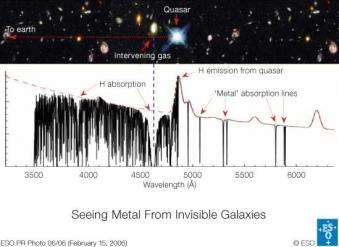
A distant quasar is used as a beacon in the Universe. Galaxies and intergalactic material that lie between the quasar and us will reveal themselves by the features seen in the spectrum. Figure courtesy of John Webb.

Astronomers, using the unique capabilities offered by the high-resolution spectrograph UVES on ESO's Very Large Telescope, have found a metal-rich hydrogen cloud in the distant universe. The result may help to solve the missing metal problem and provides insight on how galaxies form.

"Our discovery shows that significant quantities of metals are to be found in very remote galaxies that are too faint to be directly seen", said Céline Péroux (ESO), lead-author of the paper presenting the results.

The astronomers studied the light emitted by a quasar located 9 billion light-years away that is partially absorbed by an otherwise invisible galaxy sitting 6.3 billion light-years away along the line of sight.

The analysis of the spectrum shows that this galaxy has four times more metals than the Sun. This is the first time one finds such a large amount of 'metals' in a very distant object. The observations also indicate that the galaxy must be very dusty.

Almost all of the elements present in the Universe were formed in stars, which themselves are members of galaxies. By estimating how many stars formed over the history of the Universe, it is possible to estimate how much metals should have been produced. This apparently straightforward reasoning has however since several years been confronted with an apparent contradiction: adding up the amount of metals observable today in distant astronomical objects falls short of the predicted value. When the contribution of galaxies now observed at cosmological distances is added to that of the intergalactic medium, the total amounts for no more than a tenth of the metals expected.

Studying distant galaxies is however a difficult task. The further a galaxy, the fainter it is, and the small or intrinsically faint ones won't be observed. This may introduce severe biases in the observations as only the largest and most active galaxies are picked up.

Astronomers therefore came up with other ways to study distant galaxies: they use quasars, most probably the brightest distant objects known, as beacons in the Universe.

Interstellar clouds of gas in galaxies, located between the quasars and us on the same line of sight, absorb parts of the light emitted by the quasars. The resulting spectrum consequently presents dark 'valleys' that can be attributed to well-known elements. Thus, astronomers can measure the amount of metals present in these galaxies - that are in effect invisible - at various epochs.

"This can best be done by high-resolution spectrographs on the largest telescopes, such as the Ultra-violet and Visible Echelle Spectrograph (UVES) on ESO's Kueyen 8.2-m telescope at the Paranal Observatory," declared Péroux.

Her team studied in detail the spectrum of the quasar SDSS J1323-0021 that shows clear indications of absorption by a cloud of hydrogen and metals located between the quasar and us. From a careful analysis of the spectrum, the astronomers found this 'system' to be four times richer in zinc than the Sun. Other metals such as iron appear to have condensed into dust grains.

"If a large number of such 'invisible' galaxies with high metal content were to be discovered, they might well alleviate considerably the missing metals problem", said Péroux.

Source: ESO

4.6 /5 (12 votes)  

Rank 4.6 /5 (12 votes)
Tags

Relevant PhysicsForums posts

More news stories

Europe stakes billion-dollar bet on new rocket

A pencil-slim rocket is scheduled to lift into space from South America on Monday, carrying a billion-dollar bet that Europe can grab a juicy slice of the market to place satellites in low orbit.

Space & Earth / Space Exploration

created 5 hours ago | popularity 3.5 / 5 (2) | comments 0

NASA sees wide-eyed cyclone Jasmine

Cyclone Jasmine's eye has opened wider on NASA satellite imagery, as it moves through the Southern Pacific Ocean.

Space & Earth / Earth Sciences

created 21 hours ago | popularity 3.5 / 5 (2) | comments 2

NASA sees Giovanna reach cyclone strength, threaten Madagascar

Tropical Storm 12S built up steam and became a cyclone on February 10, 2012 as NASA's Terra satellite passed overhead. Residents of east-central Madagascar should prepare for this cyclone to make landfall ...

Space & Earth / Earth Sciences

created 21 hours ago | popularity not rated yet | comments 0

Political leaders play key role in how worried Americans are by climate change: study

More than extreme weather events and the work of scientists, it is national political leaders who influence how much Americans worry about the threat of climate change, new research finds.

Space & Earth / Environment

created Feb 06, 2012 | popularity 5 / 5 (6) | comments 68

Humans may have helped the decline of African rainforests 3000 years ago

(PhysOrg.com) -- Large areas of rainforests in Central Africa mysteriously disappeared over three thousand years ago, to be replaced by savannas. The prevailing theory has been that the cause was a change ...

Space & Earth / Environment

created Feb 10, 2012 | popularity 4.3 / 5 (13) | comments 15 | with audio podcast report


Walney offshore wind farm is world's biggest (for now)

(PhysOrg.com) -- The Walney wind farm on the Irish Sea--characterized by high tides, waves and windy weather--officially opened this week. The farm is treated in the press as a very big deal as the Walney ...

GPS court ruling leaves US phone tracking unclear

A US Supreme Court decision requiring a warrant to place a GPS device on the car of a criminal suspect leaves unresolved the bigger issue of police tracking using mobile phones, legal experts say.

Europeans protest controversial Internet pact

Tens of thousands of people marched in protests in more than a dozen European cities Saturday against a controversial anti-online piracy pact that critics say could curtail Internet freedom.

Anonymous briefly knocks CIA website offline (Update 2)

The website of the Central Intelligence Agency was briefly inaccessible on Friday after the hacker group Anonymous claimed to have knocked it offline.

Study finds that anti-diabetic medication can prevent the long-term effects of maternal obesity

In a study to be presented today at the Society for Maternal-Fetal Medicine's annual meeting, The Pregnancy Meeting, in Dallas, Texas, researchers will report findings that show that short therapy with the anti-diabetic medication ...

Netflix settlement trims 14 pct off 4Q earnings

(AP) -- Netflix pressed the rewind button on its fourth-quarter earnings after settling allegations that the video subscription service violated a consumer-privacy law.