Saturn's moon Iapetus is the yin-yang of the solar system
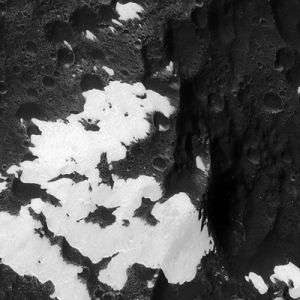
September 13, 2007 Saturn's moon Iapetus is the yin-yang of the solar system

Cassini zooms in, for the first time, on the patchy, bright and dark mountains on Saturn's two-toned moon, Iapetus. The mountains were originally identified in images from the NASA Voyager spacecraft taken more than 25 years earlier. The image was acquired during Cassini's only close flyby of Iapetus. The terrain seen here is located on the equator of Iapetus at approximately 199° West, in the transition region between the moon's bright and dark hemispheres. North is up in the image. The image was taken on 10 September 2007, with Cassini's narrow-angle camera at a distance of approximately 9240 km from Iapetus. Image scale is 55 m per pixel. Credits: NASA/ JPL/ Space Science Institute

Cassini scientists are poring through hundreds of images returned from the 10 September fly-by of Saturn's two-toned moon Iapetus.

The pictures show the moon's yin and yang - a white hemisphere resembling snow, and the other as black as tar.

Images returned late Tuesday and early Wednesday show a surface that is heavily cratered, along with the mountain ridge that runs along the moon's equator. Many of the close-up observations focused on studying the strange 20-km high mountain ridge that gives the moon a walnut-shaped appearance.

"The images are really stunning," said Tilmann Denk, Cassini imaging scientist at the Free University in Berlin, Germany, who was responsible for the imaging observation planning. "Every new picture contained its own charm. I was most pleased about the images showing huge mountains rising over the horizon. I knew about this scenic viewing opportunity for more than seven years, and now the real images have suddenly materialised."

This flyby was nearly 100 times closer to Iapetus than Cassini's 2004 flyby, bringing the spacecraft to about 1640 km from the surface. The moon's irregular walnut shape, the mountain ridge that lies almost directly on the equator and Iapetus’ brightness contrast are among the key mysteries scientists are trying to solve.

"There is never a dull moment on this mission," said Bob Mitchell, Cassini programme manager, NASA's Jet Propulsion Laboratory, USA. "We are very excited about the stunning images being returned. There is plenty here to keep many scientists busy for many years."

"Our flight over the surface of Iapetus was like a non-stop free fall, down the rabbit hole, directly into Wonderland! Very few places in our solar system are more bizarre than the patchwork of pitch dark and snowy bright we have seen on this moon," said Carolyn Porco, Cassini imaging team leader at the Space Science Institute, USA.

The return of images and other data was delayed early Tuesday due to a galactic cosmic ray hit which put the spacecraft into the so-called safe mode. This occurred after the spacecraft had placed all of the flyby data on its data recorders and during the first few minutes after it began sending the data home. The data flow resumed later that day and concluded on Wednesday. The spacecraft is operating normally and its instruments are expected to return to normal operations in a few days.

"Iapetus provides us with a window back in time, to the formation of the planets over four billion years ago. Since then its icy crust has been cold and stiff, preserving this ancient surface for our study," said Torrence Johnson, Cassini imaging team member at JPL.

Cassini's multiple observations of Iapetus will help to characterise the chemical composition of the surface; look for evidence of a faint atmosphere or erupting gas plumes; and map the night-time temperature of the surface. These and other results will be analysed in the weeks to come.

Source: European Space Agency


print this article email this article download pdf blog this article bookmark this article     Stumble it Digg this share on Facebook retweet share on Reddit add to delicious
Rate this story - 4.4 /5 (12 votes)


September 13, 2007 all stories

Comments: 0

4.4 /5 (12 votes)
  • Stumble this up

  • Digg this

  • share this

  • hide
  • Related Stories

  • Successful Flight Through Enceladus Plume (w/ Video)
    created Nov 04, 2009 | popularity not rated yet | comments 0
  • Hidden Territory on Mercury Revealed
    created Nov 04, 2009 | popularity not rated yet | comments 0
  • MESSENGER Spacecraft Flies by Mercury
    created Sep 30, 2009 | popularity not rated yet | comments 0
  • Space scientists set for final spacecraft flyby of Mercury
    created Sep 28, 2009 | popularity not rated yet | comments 0
  • MESSENGER Spacecraft Prepares for Final Pass by Mercury
    created Sep 23, 2009 | popularity not rated yet | comments 0


  • hide
  • Relevant PhysicsForums posts

  • Consistency of Meteor Shower Dates (i.e. the peak of Perseids always on Aug 13th)
    created Nov 10, 2009
  • Favourite Astronomy Book?
    created Nov 10, 2009
  • dark energy
    created Nov 10, 2009
  • The shape of our solar system's orbits.
    created Nov 07, 2009
  • More from Physics Forums - General Astronomy

Other News

A faraway planet intrigues: Exoplanet with extremely tilted orbit raises new interest in stellar astronomy

A faraway planet intrigues: Exoplanet with extremely tilted orbit raises new interest in stellar astronomy

Space & Earth / Astronomy

created 1hour ago | popularity 5 / 5 (1) | comments 2

(PhysOrg.com) -- Two teams of astronomers have found a planet outside the solar system that might be orbiting backwards compared to its star's rotation, a discovery that could shed light on how unique the ...


iceberg

Giant Antarctic iceberg heads towards N.Zealand: experts

Space & Earth / Earth Sciences

created 3 hours ago | popularity 3 / 5 (2) | comments 0

A giant iceberg twice the length of Beijing's "Bird's Nest" Stadium has been spotted floating off Australia and could be headed for New Zealand, scientists said on Thursday.


Exoplanets Clue to Sun's Curious Chemistry

Exoplanets Clue to Sun's Curious Chemistry

Space & Earth / Astronomy

created 19 hours ago | popularity 4.7 / 5 (15) | comments 12

(PhysOrg.com) -- A ground-breaking census of 500 stars, 70 of which are known to host planets, has successfully linked the long-standing "lithium mystery" observed in the Sun to the presence of planetary systems. ...


A bubbling ball of gas

A bubbling ball of gas (w/ Video)

Space & Earth / Space Exploration

created 20 hours ago | popularity 4.9 / 5 (15) | comments 5

The Sun is a bubbling mass. Packages of gas rise and sink, lending the sun its grainy surface structure, its granulation. Dark spots appear and disappear, clouds of matter dart up - and behind the whole thing ...


Earth's early ocean cooled more than a billion years earlier than thought: Stanford study

Earth's early ocean cooled more than a billion years earlier than thought (w/ Video)

Space & Earth / Earth Sciences

created 18 hours ago | popularity 4.6 / 5 (9) | comments 1

(PhysOrg.com) -- The scalding-hot sea that supposedly covered the early Earth may in fact never have existed, according to a new study by Stanford University researchers who analyzed isotope ratios in 3.4 ...