Salmon garnish points the way to green electronics
September 13, 2007
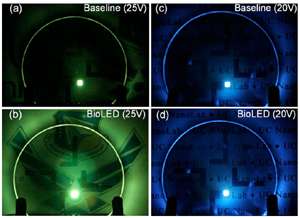
BioLEDs make colors brighter. Credit: University of Cincinnati
Professor Andrew Steckl, a leading expert in light-emitting diodes, is intensifying the properties of LEDs by introducing biological materials, specifically salmon DNA.
Electrons move constantly — think of tiny particles with a negative charge and attention deficit disorder. It is through the movement of these electrons that electric current flows and light is created.
Steckl is an Ohio Eminent Scholar in UC’s Department of Electrical and Computer Engineering. He believed that if the electrons’ mobility could be manipulated, then new properties could be revealed.
In considering materials to introduce to affect the movement of the electrons, Steckl evaluated the source of materials with an eye to supply, especially materials that do not harm the environment.
“Biological materials have many technologically important qualities — electronic, optical, structural, magnetic,” says Steckl. “But certain materials are hard for to duplicate, such as DNA and proteins.” He also wanted a source that was widely available, would not have to be mined, and was not subject to any organization or country’s monopoly. His answer?
Salmon sperm.
“Salmon sperm is considered a waste product of the fishing industry. It’s thrown away by the ton,” says Steckl with a smile. “It’s natural, renewable and perfectly biodegradable.” While Steckl is currently using DNA from salmon, he thinks that other animal or plant sources might be equally useful. And he points out that for the United States, the green device approach takes advantage of something in which we continue to be a world leader — agriculture.
Steckl is pursuing this research in collaboration with the Air Force Research Laboratory. The research was featured recently in such premier scientific publications as the inaugural issue of Nature Photonics and on the cover of Applied Physics Letters.
“The Air Force had already been working with DNA for other applications when they came to us and said, ‘We know that you know how to make devices,’” quotes Steckl. “They also knew that they had a good source of salmon DNA.” It was a match made in heaven.
So began Steckl’s work with BioLEDs, devices that incorporate DNA thin films as electron blocking layers. Most of the devices existing today are based on inorganic materials, such as silicon. In the last decade, researchers have been exploring using naturally occurring materials in devices like diodes and transistors.
“The driving force, of course, is cost: cost to the producer, cost to the consumer and cost to the environment” Steckl points out, “but performance has to follow.”
And what a performance — lights, camera, action!
“DNA has certain optical properties that make it unique,” Steckl says. “It allows improvements in one to two orders of magnitude in terms of efficiency, light, brightness — because we can trap electrons longer.”
When electrons collide with oppositely charged particles, they produce very tiny packets of light called “photons.”
“Some of the electrons rushing by have a chance to say ‘hello,’ and get that photon out before they pass out,” Steckl explains. “The more electrons we can keep around, the more photons we can generate.” That’s where the DNA comes in, thanks to a bunch of salmon.
“DNA serves as a barrier that affects the motion of the electrons,” says Steckl. It allows Steckl and his fellow researcher, the Air Force’s Dr. James Grote, to control the brightness of the light that comes out.
“The story continues,” says Steckl, again smiling. “I’m receiving salmon sperm from researchers around the world wanting to see if their sperm is good enough.” The next step is to now replace some other materials that go into an LED with biomaterials. The long-term goal is be able to make “green” devices that use only natural, renewable and biodegradable materials.
Source: University of Cincinnati
-
Engineers build first sub-10-nm carbon nanotube transistor
Feb 01, 2012 |
4.9 / 5 (33) |
30
-
Something old, something new: Evolution and the structural divergence of duplicate genes
Jan 31, 2012 |
4.6 / 5 (7) |
1
-
The hidden nanoworld of ice crystals: Revealing the dynamic behavior of quasi-liquid layers
Jan 30, 2012 |
5 / 5 (4) |
1
-
Stock market network reveals investor clustering
Jan 27, 2012 |
3.9 / 5 (23) |
8
-
Of microchemistry and molecules: Electronic microfluidic device synthesizes biocompatible probes
Jan 26, 2012 |
5 / 5 (2) |
0
-
Anatomy of Fat man: implosion-critical bomb
3 hours ago
-
what makes two sounds similar???
4 hours ago
-
What would happen when a jet travelling at Mach 10 experiences engine failure
10 hours ago
-
Rust from my microwave ruined a nice bowl of soup and also my day
12 hours ago
-
gas leaks in space
15 hours ago
-
Weight required to balance a boom stand?
17 hours ago
- More from Physics Forums - General Physics
More news stories
Explained: Sigma
It's a question that arises with virtually every major new finding in science or medicine: What makes a result reliable enough to be taken seriously? The answer has to do with statistical significance -- but ...
Feb 09, 2012 |
5 / 5 (20) |
76
Quantum physicist explains $100K offer for proof scaled-up quantum computing is impossible
(PhysOrg.com) -- MIT researcher Scott Aaronson has certainly riled the physics community with his offer this past Friday, of $100,000 to anyone who can prove that scaled-up quantum computing is impossible. ...
Diamond light, brighter than the sun
Its the size of five football pitches and generates light 10 billion times brighter than the sun. As the Diamond Light Source celebrates its tenth anniversary this year, Penny Bailey visits one of the ...
Feb 07, 2012 |
4.1 / 5 (10) |
18
|
Physicists 'record' magnetic breakthrough
An international team of scientists has demonstrated a revolutionary new way of magnetic recording which will allow information to be processed hundreds of times faster than by current hard drive technology.
Feb 07, 2012 |
4.6 / 5 (43) |
15
|
Hints of the Higgs - papers are submitted
Back in December 2011, the ATLAS and CMS experiments at CERN presented some exciting results that provided tantalising hints of the Higgs boson.
Feb 08, 2012 |
4.3 / 5 (8) |
10
Declining health-care productivity in England: Who says so?
Reports that the National Health Service in England has been declining in productivity in the last decade appear to have been accepted as fact. However, a Viewpoint published Online First by The Lancet disputes this. The Vi ...
Scientists discover molecular secrets of 2,000-year-old Chinese herbal remedy
For roughly two thousand years, Chinese herbalists have treated Malaria using a root extract, commonly known as Chang Shan, from a type of hydrangea that grows in Tibet and Nepal. More recent studies suggest that halofuginone, ...
Overeating may double risk of memory loss
New research suggests that consuming between 2,100 and 6,000 calories per day may double the risk of memory loss, or mild cognitive impairment (MCI), among people age 70 and older. The study was released today and will be ...
New method to examine batteries -- MRI from the inside
There is an ever-increasing need for advanced batteries for portable electronics, such as phones, cameras, and music players, but also to power electric vehicles and to facilitate the distribution and storage of energy derived ...
A mitosis mystery solved: How chromosomes align perfectly in a dividing cell
Although the process of mitotic cell division has been studied intensely for more than 50 years, Whitehead Institute researchers have only now solved the mystery of how cells correctly align their chromosomes during symmetric ...
Lab study raises questions over nano-particle impact
Tests involving chickens have raised questions about the impact on health from engineered nano-particles, the ultra-fine grains commonly used in drugs and processed foods, scientists said on Sunday.