Galaxy 'hunting' made easy
September 14, 2007 Chasing 'Hidden' Galaxies

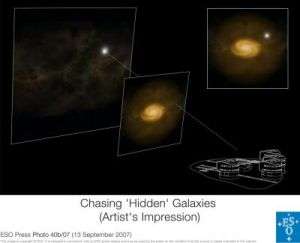
Artist's impression showing a galaxy located between an observer on Earth and a background quasar that acts as a beacon. The light that travels from the quasar is intercepted by the foreground galaxy on its sightline, carrying out the galaxy's signature all the way to the observer. The sketch shows a side-on view of the system. The inset shows a face-on view of it, the same view captured (albeit with less detail) by the images taken with the SINFONI instrument on ESO's Very Large Telescope. Credit: ESO/VLT

Astronomers using ESO's Very Large Telescope have discovered in a single pass about a dozen otherwise invisible galaxies halfway across the Universe. The discovery, based on a technique that exploits a first-class instrument, represents a major breakthrough in the field of galaxy 'hunting'.

The team of astronomers led by Nicolas Bouché have used quasars to find these galaxies. Quasars are very distant objects of extreme brilliance, which are used as cosmic beacons that reveal galaxies lying between the quasar and us. The galaxy's presence is revealed by a 'dip' in the spectrum of the quasar - caused by the absorption of light at a specific wavelength.

The team used huge catalogues of quasars, the so-called SDSS and 2QZ catalogues, to select quasars with dips. The next step was then to observe the patches of the sky around these quasars in search for the foreground galaxies from the time the Universe was about 6 billion years old, almost half of its current age.

"The difficulty in actually spotting and seeing these galaxies stems from the fact that the glare of the quasar is too strong compared to the dim light of the galaxy," says Bouché.

This is where observations taken with SINFONI on ESO's VLT made the difference. SINFONI is an infrared 'integral field spectrometer' that simultaneously delivers very sharp images and highly resolved colour information (spectra) of an object on the sky.

With this special technique, which untangles the light of the galaxy from the quasar light, the team detected 14 galaxies out of the 20 pre-selected quasar patches of sky, a hefty 70% success rate.

"This high detection rate alone is a very exciting result," says Bouché. "But, these are not just ordinary galaxies: they are most notable ones, actively forming a lot of new stars and qualifying as 'starburst galaxies'."

"We discovered that the galaxies located near the quasar sightlines are forming stars at a prodigious rate, equivalent to 20 suns per year," adds team member Celine Péroux.

These findings represent a big leap forward in the field, setting the stage for a very promising era of galaxy 'hunting'.

The astronomers now plan to use SINFONI to study in more detail each of these galaxies, by measuring their internal motions.

Source: ESO


print this article email this article download pdf blog this article bookmark this article     Stumble it Digg this share on Facebook retweet share on Reddit add to delicious
Rate this story - 4.4 /5 (8 votes)


September 14, 2007 all stories

Comments: 0

4.4 /5 (8 votes)
  • Stumble this up

  • Digg this

  • share this

  • hide
  • Related Stories

  • Computer Finds Massive Black Hole in Nearby Galaxy
    created Jun 09, 2009 | popularity not rated yet | comments 0
  • Fermi telescope reveals best-ever view of the gamma-ray sky
    created Mar 11, 2009 | popularity not rated yet | comments 0
  • Unexpected source of gamma rays discovered
    created Mar 06, 2009 | popularity not rated yet | comments 0
  • Colors of Quasars Reveal a Dusty Universe
    created Feb 26, 2009 | popularity not rated yet | comments 0
  • Infant galaxies -- small and hyperactive
    created Feb 05, 2009 | popularity not rated yet | comments 0


  • hide
  • Relevant PhysicsForums posts

Other News

New computer-developed map shows more extensive valley network on Mars

New computer-developed map shows more extensive valley network on Mars

Space & Earth / Space Exploration

created 7 hours ago | popularity 4.5 / 5 (4) | comments 0

New research adds to the growing body of evidence suggesting the Red Planet once had an ocean.


Supervolcano eruption -- in Sumatra -- deforested India 73,000 years ago

Supervolcano eruption -- in Sumatra -- deforested India 73,000 years ago

Space & Earth / Earth Sciences

created 9 hours ago | popularity 4 / 5 (6) | comments 1

A new study provides "incontrovertible evidence" that the volcanic super-eruption of Toba on the island of Sumatra about 73,000 years ago deforested much of central India, some 3,000 miles from the epicenter, ...


Spitzer Telescope Observes Baby Brown Dwarf

Spitzer Telescope Observes Baby Brown Dwarf

Space & Earth / Astronomy

created 6 hours ago | popularity 4.8 / 5 (5) | comments 0

(PhysOrg.com) -- NASA's Spitzer Space Telescope has contributed to the discovery of the youngest brown dwarf ever observed -- a finding that, if confirmed, may solve an astronomical mystery about how these ...


Is global warming unstoppable?

Space & Earth / Environment

created 18 hours ago | popularity 3.9 / 5 (22) | comments 22

In a provocative new study, a University of Utah scientist argues that rising carbon dioxide emissions - the major cause of global warming - cannot be stabilized unless the world's economy collapses or society builds the ...


Scientist: Leak of climate e-mails appalling

Space & Earth / Environment

created 12 hours ago | popularity 3 / 5 (7) | comments 7

(AP) -- A leading climate change scientist whose private e-mails are included in thousands of documents that were stolen by hackers and posted online said Sunday the leaks may have been aimed at undermining next month's ...