Satellites witness lowest Arctic ice coverage in history
September 14, 2007 Satellites witness lowest Arctic ice coverage in history

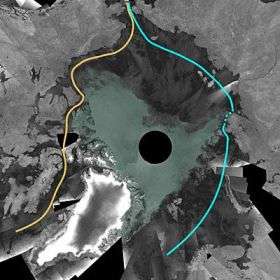
Envisat ASAR mosaic of the Arctic Ocean for early September 2007, clearly showing the most direct route of the Northwest Passage open (orange line) and the Northeast passage only partially blocked (blue line). The dark gray color represents the ice-free areas, while green represents areas with sea ice. Credit: ESA

The area covered by sea ice in the Arctic has shrunk to its lowest level this week since satellite measurements began nearly 30 years ago, opening up the Northwest Passage – a long-sought short cut between Europe and Asia that has been historically impassable.

In the mosaic image above, created from nearly 200 images acquired in early September 2007 by the Advanced Synthetic Aperture Radar (ASAR) instrument aboard ESA’s Envisat satellite, the dark gray colour represents the ice-free areas while green represents areas with sea ice.

Leif Toudal Pedersen from the Danish National Space Centre said: "We have seen the ice-covered area drop to just around 3 million sq km which is about 1 million sq km less than the previous minima of 2005 and 2006. There has been a reduction of the ice cover over the last 10 years of about 100 000 sq km per year on average, so a drop of 1 million sq km in just one year is extreme.

"The strong reduction in just one year certainly raises flags that the ice (in summer) may disappear much sooner than expected and that we urgently need to understand better the processes involved."

Arctic sea ice naturally extends its surface coverage each northern winter and recedes each northern summer, but the rate of overall loss since 1978 when satellite records began has accelerated.

The most direct route of the Northwest Passage (highlighted in the top mosaic by an orange line) across northern Canada is shown fully navigable, while the Northeast Passage (blue line) along the Siberian coast remains only partially blocked. To date, the Northwest Passage has been predicted to remain closed even during reduced ice cover by multi-year ice pack – sea ice that survives one or more summers. However, according to Pedersen, this year’s extreme event has shown the passage may well open sooner than expected.

The previous record low was in 2005 when the Arctic area covered by sea ice was just 4 million sq km. Even then, the most direct Northwest Passage did not fully open.

The Polar Regions are very sensitive indicators of climate change. The UN’s Intergovernmental Panel on Climate Change showed these regions are highly vulnerable to rising temperatures and predicted the Arctic would be virtually ice free by the summer of 2070. Still other scientists predict it could become ice free as early as 2040 due to rising temperatures and sea ice decline.

Because sea ice has a bright surface, the majority of solar energy that hits it is reflected back into space. When sea ice melts, the dark-coloured ocean surface is exposed. Solar energy is then absorbed rather than reflected, so the oceans get warmer and temperatures rise, making it difficult for new ice to form.

The Arctic is one of Earth’s most inaccessible areas, so obtaining measurements of sea ice was difficult before the advent of satellites. For more than 20 years, ESA has been providing satellite data to the cryosphere communities. Currently, ESA is contributing to the International Polar Year (IPY) – a large worldwide science programme focused on the Arctic and Antarctic.

Since 2006, ESA has supported Polar View, a satellite remote-sensing programme funded through the Earthwatch GMES Service Element (GSE) that focuses on the Arctic and the Antarctic.

In 2009, ESA will make another significant contribution to cryosphere research with the launch of CryoSat-2. The observations made over the three-year lifetime of the mission will provide conclusive evidence on the rates at which ice cover is diminishing.

Source: European Space Agency


print this article email this article download pdf blog this article bookmark this article     Stumble it Digg this share on Facebook retweet share on Reddit add to delicious
Rate this story - 4.1 /5 (38 votes)


September 14, 2007 all stories

Comments: 0

4.1 /5 (38 votes)
  • Stumble this up

  • Digg this

  • share this

  • hide
  • Related Stories

  • Taking a Bite of Antarctic Ice
    created Nov 16, 2009 | popularity not rated yet | comments 0
  • Cave study links climate change to California droughts
    created Nov 10, 2009 | popularity not rated yet | comments 0
  • Antarctica glacier retreat creates new carbon dioxide store
    created Nov 09, 2009 | popularity not rated yet | comments 0
  • Tackling new Arctic challenges from space
    created Nov 05, 2009 | popularity not rated yet | comments 0
  • Life's Ancient Island in the Ice
    created Oct 29, 2009 | popularity not rated yet | comments 0


  • hide
  • Relevant PhysicsForums posts

  • Which countries around the world cause the most destruction to the rain forest
    created 5 hours ago
  • HadleyCru data hacked
    created Nov 20, 2009
  • Younger Dryas Caused by Ice Dam Collapse?
    created Nov 17, 2009
  • Modeling rainfall and flooding
    created Nov 15, 2009
  • More from Physics Forums - Earth

Other News

Astronauts finish another spacewalk, still no baby (AP)

Astronauts finish another spacewalk, still no baby

Space & Earth / Space Exploration

created 4 hours ago | popularity 3 / 5 (2) | comments 0

(AP) -- A spacewalking astronaut put aside the impending birth of his daughter and blazed through his first-ever venture outside the International Space Station on Saturday.


Unseasonably hot and dry weather combined with strong winds to fan scores of blazes in the country's southeastern states

Australia issues 'catastrophic' alerts as fires rage

Space & Earth / Environment

created 10 hours ago | popularity 4 / 5 (1) | comments 0

Australia has issued "catastrophic" alerts after record-breaking temperatures and wild lightning storms sparked more than 100 fires across the country, officials said Saturday.


Commuters wait on the platform shrouded by fog in London

Climate change not man-made, say majority of Britons: poll

Space & Earth / Environment

created Nov 15, 2009 | popularity 3.3 / 5 (15) | comments 45

Less than half of Britons believes that human activity is to blame for global warming, according to a poll carried out for The Times newspaper and published on Saturday.


Mysteriously warm times in Antarctica

Mysteriously warm times in Antarctica

Space & Earth / Earth Sciences

created Nov 18, 2009 | popularity 4.2 / 5 (21) | comments 28

(PhysOrg.com) -- A new study of Antarctica's past climate reveals that temperatures during the warm periods between ice ages (interglacials) may have been higher than previously thought. The latest analysis ...


UN: Fight climate change with free condoms (AP)

UN: Fight climate change with free condoms

Space & Earth / Environment

created Nov 18, 2009 | popularity 3.1 / 5 (11) | comments 22

(AP) -- The battle against global warming could be helped if the world slowed population growth by making free condoms and family planning advice more widely available, the U.N. Population Fund said Wednesday.