Team develops novel method for nanostructured polymer thin films
September 14th, 2007 NIST team develops novel method for nanostructured polymer thin films

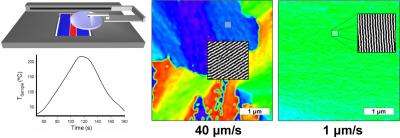
(Top L.) Schematic of the NIST 'cold zone' annealing process for polymer thin films on a semiconductor wafer. Experiment images are color-coded to show regions with different cylinder orientations, as measured by atomic force microscopy. Relatively rapid transit times (top r.) leave a jumble of different regions that become largely homogeneous at slower speeds (r.). Credit: NIST

All researchers at the National Institute of Standards and Technology wanted was a simple, quick method for making thin films of block copolymers or BCPs (chemically distinct polymers linked together) in order to have decent samples for taking measurements important to the microelectronics industry. What they got for their efforts, as detailed in the Sept. 12, 2007, Nano Letters, was an unexpected bonus: a unique annealing process that may make practical the use of BCP thin films for patterning nanoscale features in next-generation microchips and data storage devices.

BCP thin films have been highly desired by semiconductor manufacturers as patterns for laying down very fine features on microchips, such as arrays of tightly spaced, nanoscale lines. Annealing certain BCP films—a controlled heating process—causes one of the two polymer components to segregate into regular patterns of nanocylinder lines separated by distances as small as five nanometers or equally regular arrays of nanoscale dots. Chemically removing the other polymer leaves the pattern behind as a template for building structures on the microchip.

In traditional oven annealing the quality of the films is still insufficient even after days of annealing. A process called hot zone annealing—where the thin film moves at an extremely slow speed through a heated region that temporarily raises its temperature to a point just above that at which the cylinders become disordered—has previously been used for creating highly ordered BCP thin films with a minimum of defects but little orientation control. For some polymer combinations, the order-disorder transition temperature is so high that it is virtually impossible for manufacturers to heat them sufficiently without degradation occurring.

To eliminate the time and temperature restraints without losing the order yielded by hot zone annealing, the NIST researchers developed a “cold zone” annealing system where the polymers are completely processed well below their order-disorder transition temperature. Properly controlled, the lower-temperature processing not only works with BCPs for which hot-zone annealing is impractical, but, as the NIST experiments showed, also repeatedly produces a highly ordered thin film in a matter of minutes. NIST researchers also discovered that the alignment of the cylinders was controlled by the “cold zone” annealing conditions. Because it is simple, yields consistent product quality and has virtually no limitations on sample dimensions, the NIST method is being evaluated by microelectronic companies to fabricate highly ordered sub 30 nm features.

The next step, the NIST researchers say, is to better understand the fundamental processes that make the cold zone annealing system work so well and refine the measurements needed to evaluate its performance.

Citation: B.C. Berry, A.W. Bosse, J.F. Douglas, R.L. Jones and A. Karim.Orientational order in block copolymer films zone annealed below the order-disorder transition temperature. Nano Letters, Vol. 7, No. 9, pp. 2789-2794, (Sept. 12, 2007).

Source: National Institute of Standards and Technology


print this article email this article download pdf blog this article bookmark this article     Digg this Stumble it share on Facebook share on Reddit add to delicious save to Yahoo! bookmarks
4.8/5 after 13 votes


September 14th, 2007 all stories
Nanotechnology / Nanophysics

Comments: 0
Rank: 4.8/5 after 13 votes

  • Stumble this up

  • Digg this

  • Share it:
  • share on Facebook
  • share on MySpace
  • share on Slashdot
  • rss-newsfeed
  • share on Google
  • share on Reddit
  • add to delicious
  • save to Yahoo! bookmarks
  • share on Windows Live
  • Add to Mixx!
Rating: 4.8/5 after 13 votes

  • Related Stories

  • Silicon Micro-islands and Nano-spikes Channel Water on Glass Slides
    created Mar 26, 2009 | popularity not rated yet | comments 0
  • Low Temperature Laser Processing Solves a Problem in Smart Materials Manufacturing
    created Dec 18, 2008 | popularity not rated yet | comments 0
  • Stress Management: X-Rays Reveal Si Thin-Film Defects
    created Jul 06, 2006 | popularity not rated yet | comments 0
  • World's first MOSFETs with epitaxial Gd2O3
    created Feb 03, 2006 | popularity not rated yet | comments 0
  • Slimmer Nanorods Good Fit for Next-Gen 3-D Computer Chips
    created Mar 17, 2009 | popularity not rated yet | comments 0

Tags


  • Physicists Demonstrate Quantum Memory with Matter Qubits
    Physicists Demonstrate Quantum Memory with Matter Qubits
    Physics / General Physics
    created Jul 03, 2009 | popularity 4.4 / 5 (17) | comments 1
  • 'Holey' Nanosheets for Wastewater Dye Removal
    Nanotechnology / Nanomaterials
    created Jul 01, 2009 | popularity 5 / 5 (5) | comments 1
  • Jellyfish Robot Swims Like its Biological Counterpart
    Jellyfish Robot Swims Like its Biological Counterpart
    Electronics / Robotics
    created Jun 26, 2009 | popularity 4.4 / 5 (8) | comments 1
  • Could Maxwell's Demon Exist in Nanoscale Systems?
    Could Maxwell's Demon Exist in Nanoscale Systems?
    Physics / General Physics
    created Jun 24, 2009 | popularity 4.4 / 5 (18) | comments 29
  • Living Safely with Robots, Beyond Asimov's Laws
    Living Safely with Robots, Beyond Asimov's Laws
    Electronics / Robotics
    created Jun 22, 2009 | popularity 4.6 / 5 (54) | comments 40
  • Other News

    Physics research with atomic force microscope could lead to better health care

    Atomic force microscope research could lead to better health care

    Nanotechnology / Nanophysics

    created 49 minutes ago | popularity 5 / 5 (1) | comments 0

    Where biology, chemistry and physics intersect, a Kansas State University professor expects to find applications to improve human health.


    Canadian researchers set to study impact of nanomaterials on aquatic ecosystems

    Nanotechnology / Bio & Medicine

    created 2 hours ago | popularity 5 / 5 (1) | comments 0

    A team of Canadian scientists and engineers, led by the University of Alberta and the National Research Council of Canada, will collaborate on a $3.39 million, three-year study to assess the potential effects of nanoparticles ...


    Nano Measurement in the 3rd Dimension

    Nano Measurement in the 3rd Dimension

    Nanotechnology / Nanophysics

    created 4 hours ago | popularity 3 / 5 (1) | comments 0

    From the motion sensor to the computer chip - in many products of daily life components are used whose functioning is based on smallest structures of the size of thousandths - or even millionths - of millimetres. ...


    A 'quantum of sol' -- how nanotechnology could hold the key to a solar-powered future

    A 'quantum of sol' -- how nanotechnology could hold the key to a solar-powered future

    Nanotechnology / Nanomaterials

    created Jun 30, 2009 | popularity 3.9 / 5 (16) | comments 17

    (PhysOrg.com) -- A new generation of 'nano-structured' millimetre-sized solar cells that could convert the sun's energy to electricity more than twice as efficiently as current technology, is the subject of ...


    Australian researchers are set to begin human trials of a tiny nano-cell that acts as a "Trojan horse" against cancer

    Hi-tech 'Trojan horse' can kill cancer cells: researchers

    Nanotechnology / Bio & Medicine

    created Jun 29, 2009 | popularity 4.7 / 5 (12) | comments 7

    Australian researchers are set to begin human trials of a tiny nano-cell that acts as a "Trojan horse" against cancer cells, a breakthrough they say may curb the need for debilitating chemotherapy.