'Radio Wave Cooling' Offers New Twist on Laser Cooling
September 14, 2007
'Radio Wave Cooling' Offers New Twist on Laser Cooling

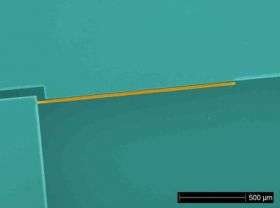
NIST physicists used radio waves to cool this silicon micro-cantilever, the narrow orange strip across the middle of this colorized micrograph. The cantilever, created by ion etching through a silicon wafer, lies parallel to a silicon radio-frequency electrode. Credit: J. Britton/ NIST

Visible and ultraviolet laser light has been used for years to cool trapped atoms—and more recently larger objects—by reducing the extent of their thermal motion. Now, applying a different form of radiation for a similar purpose, physicists at the National Institute of Standards and Technology have used radio waves to dampen the motion of a miniature mechanical oscillator containing more than a quadrillion atoms, a cooling technique that may open a new window into the quantum world using smaller and simpler equipment.

Described in a forthcoming issue of Physical Review Letters, this demonstration of radio-frequency (RF) cooling of a relatively large object may offer a new tool for exploring the elusive boundary where the familiar rules of the everyday, macroscale world give way to the bizarre quantum behavior seen in the smallest particles of matter and light. There may be technology applications as well: the RF circuit could be made small enough to be incorporated on a chip with tiny oscillators, a focus of intensive research for use in sensors to detect, for example, molecular forces.

The NIST experiments used an RF circuit to cool a 200 x 14 x 1,500 micrometer silicon cantilever—a tiny diving board affixed at one end to a chip and similar to the tuning forks used in quartz crystal watches—vibrating at 7,000 cycles per second, its natural “resonant” frequency. Scientists cooled it from room temperature (about 23 degrees C, or 73 degrees F) to -228 C (-379 F).

Other research groups have used optical techniques to chill micro-cantilevers to lower temperatures, but the RF technique may be more practical in some cases, because the equipment is smaller and easier to fabricate and integrate into cryogenic systems. By extending the RF method to higher frequencies at cryogenic temperatures, scientists hope eventually to cool a cantilever to its “ground state” near absolute zero (-273 C or -460 F) , where it would be essentially motionless and quantum behavior should emerge.

Laser cooling is akin to using the kinetic energy of millions of ping-pong balls (particles of light) striking a rolling bowling ball (such as an atom) to slow it down. The RF cooling technique, lead author Kenton Brown says, is more like pushing a child on a swing slightly out of synch with its back-and-forth motion to reduce its arc.

In the NIST experiments, the cantilever’s mechanical motion is reduced by the force created between two electrically charged plates, one of which is the cantilever, which store energy like electrical capacitors. In the absence of any movement, the force would be stable, but in this case, it is modulated by the cantilever vibrations. The stored energy takes some time to change in response to the cantilever’s movement, and this delay pushes the cantilever slightly out of synch, damping its motion.

Citation: K.R. Brown, J. Britton, R.J. Epstein, J. Chiaverini, D. Leibfried, and D.J. Wineland. 2007. Passive cooling of a micromechanical oscillator with a resonant electric circuit. Physical Review Letters. [Forthcoming].

Source: National Institute of Standards and Technology

4.5 /5 (24 votes)  

Rank 4.5 /5 (24 votes)
Tags

Related Stories
Relevant PhysicsForums posts

More news stories

Explained: Sigma

It's a question that arises with virtually every major new finding in science or medicine: What makes a result reliable enough to be taken seriously? The answer has to do with statistical significance -- but ...

Physics / General Physics

created Feb 09, 2012 | popularity 5 / 5 (20) | comments 76

Quantum physicist explains $100K offer for proof scaled-up quantum computing is impossible

(PhysOrg.com) -- MIT researcher Scott Aaronson has certainly riled the physics community with his offer this past Friday, of $100,000 to anyone who can prove that scaled-up quantum computing is impossible. ...

Physics / Quantum Physics

created Feb 08, 2012 | popularity 4.3 / 5 (14) | comments 37 | with audio podcast weblog

Diamond light, brighter than the sun

It’s the size of five football pitches and generates light 10 billion times brighter than the sun. As the Diamond Light Source celebrates its tenth anniversary this year, Penny Bailey visits one of the ...

Physics / General Physics

created Feb 07, 2012 | popularity 4.4 / 5 (9) | comments 18 | with audio podcast

Physicists 'record' magnetic breakthrough

An international team of scientists has demonstrated a revolutionary new way of magnetic recording which will allow information to be processed hundreds of times faster than by current hard drive technology.

Physics / General Physics

created Feb 07, 2012 | popularity 4.6 / 5 (43) | comments 14 | with audio podcast

Hints of the Higgs - papers are submitted

Back in December 2011, the ATLAS and CMS experiments at CERN presented some exciting results that provided tantalising hints of the Higgs boson.

Physics / General Physics

created Feb 08, 2012 | popularity 4.3 / 5 (8) | comments 10


Overeating may double risk of memory loss

New research suggests that consuming between 2,100 and 6,000 calories per day may double the risk of memory loss, or mild cognitive impairment (MCI), among people age 70 and older. The study was released today and will be ...

Google might launch Drive for cloud storage soon

(PhysOrg.com) -- Google's next big move, according to the Wall Street Journal, is a cloud storage service called Drive. Hardly first to the plate, Google is simply catching up to introducing its cloud reposi ...

Scientists discover molecular secrets of 2,000-year-old Chinese herbal remedy

For roughly two thousand years, Chinese herbalists have treated Malaria using a root extract, commonly known as Chang Shan, from a type of hydrangea that grows in Tibet and Nepal. More recent studies suggest that halofuginone, ...

New method to examine batteries -- MRI from the inside

There is an ever-increasing need for advanced batteries for portable electronics, such as phones, cameras, and music players, but also to power electric vehicles and to facilitate the distribution and storage of energy derived ...

Lab study raises questions over nano-particle impact

Tests involving chickens have raised questions about the impact on health from engineered nano-particles, the ultra-fine grains commonly used in drugs and processed foods, scientists said on Sunday.

Injured boomers beware: Know when to see doctor

(AP) -- It happened to nurse Jane Byron years after an in-line skating fall, business owner Haralee Weintraub while doing "men's" push-ups, and avid cyclist Gene Wilberg while lifting a heavy box.