Why is the Hercules Dwarf Galaxy so flat?
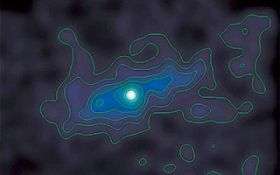
Through some of the very first scientific observations with the brand-new Large Binocular Telescope (LBT) in Arizona, an international team of astronomers has found that a recently discovered tiny companion galaxy to our Milky Way, named the Hercules Dwarf Galaxy, has truly exceptional properties: while basically all of its known peers in the realm of these tiny dwarf galaxies are rather round, this galaxy at a distance of 430,000 Light Years appears highly flattened, either the shape of a disk or of a cigar.
The stars in many large galaxies are arranged in a disk-like configuration, as in our own Milky Way. Yet in smaller galaxies like the Hercules Dwarf, which despite its name has only a 10-millionth as many stars as the Milky Way, a disk-like configuration has never been observed before. Among the millions of well-studied galaxies none has ever been observed to have a cigar-like shape.
An explanation for the galaxy's unusual shape is that it is being disrupted by the gravitational forces of the Milky Way. This effect is definitely seen in another of the Milky Way's satellites, the Sagittarius Dwarf. Yet, this object is 10 times closer to the Milky Way's centre than the Hercules Dwarf Galaxy, and hence more highly affected by the destructive "tidal forces" of our Galaxy.
The Hercules Dwarf Galaxy can only have experienced a similar fate if its orbit would have brought it exceptionally close to the inner parts of the Milky Way. So, "The Hercules Dwarf Galaxy is either unlike any of the millions of galaxies studied so far, or circles our Galaxy on an extremely plunging orbit: an exceptional, unparalleled object at any rate", says Matthew Coleman of the Max Planck Institute for Astronomy in Germany, who headed this study.
The world's single biggest telescope
These inferences were enabled by the very deep images provided by the brand-new Large Binocular Telescope (LBT), the largest single telescope in the world, which is located on the 3190-metre high Mount Graham in Arizona. Two giant mirrors with a diameter of 8.4 meters each, are hosted on the same mount acting as gigantic field glasses.
The pictures of the Hercules Dwarf Galaxy were created using the high-tech Large Binocular Camera (LBC-Blue), mounted at the Prime Focus of one of the two 8.4-metre mirrors. LBC-Blue and its future twin for the red spectral range, LBC-red, are being developed by Italian partners in the project. The camera and telescope work together like a giant digital camera which is able to capture images of ultra-faint objects with a field of view the size of the full moon. "I am delighted to see that the new camera is delivering such exciting images to the Astronomy community, off the bat," says Emanuele Giallongo of INAF/Rome, who built the camera. "We provided early ‘science demonstration time' to our astronomers," says Richard Green, LBT Director, "so that they could show what can be done with this new facility. This result is just the first, with many more to come."
New chances to study distant planets, stars and galaxies
By combining the optical paths of the two individual mirrors, the LBT will collect in its final increment as much light as a telescope whose mirrors have a diameter of 11.8 meters. This is a factor of 24 larger than the 2.4-metre mirror of the Hubble Space Telescope. Even more importantly, the LBT will then have the resolution of a 22.8-metre telescope, because it will use the most modern adaptive optics, superimposing pictures with an interferometric procedure. The astronomers are thus able to compensate for the blurring caused by air turbulence. With that power, the LBT will open completely new possibilities in researching planets outside the solar system and the investigation of the faintest and most distant galaxies.
The LBC camera is the first of a suite of high-tech instruments with which the LBT will be equipped in the future. These additional instruments include spectrographs with different resolution and spectral sensitivity as well as very complex instruments which will combine the light path of the two giant main mirrors. Both the telescope and instruments are being built by an international collaboration among institutions in the United States, Italy and Germany.
Source: Max-Planck-Gesellschaft


