Sheet of carbon atoms acts like a billiard table, physicists find
September 14, 2007 Sheet of carbon atoms acts like a billiard table, physicists find

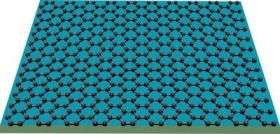
Image shows graphene, which can act as an atomic-scale billiard table, with electric charges acting as billiard balls. Credit: Lau lab, UC-Riverside

A game of billiards may never get smaller than this. Physicists at UC Riverside have demonstrated that graphene – a one-atom thick sheet of carbon atoms arranged in hexagonal rings – can act as an atomic-scale billiard table, with electric charges acting as billiard balls.

The finding underscores graphene’s potential for serving as an excellent electronic material, such as silicon, that can be used to develop new kinds of transistors based on quantum physics. Because they encounter no obstacles, the electrons in graphene roam freely across the sheet of carbon, conducting electric charge with extremely low resistance.

Study results appear in today’s issue of Science.

The research team, led by Chun Ning (Jeanie) Lau, found that the electrons in graphene are reflected back by the only obstacle they meet: graphene’s boundaries.

“These electrons meet no other obstacles and behave like quantum billiard balls,” said Lau, an assistant professor who joined UCR’s Department of Physics and Astronomy in 2004. “They display properties that resemble both particles and waves.”

Lau observed that when the electrons are reflected from one of the boundaries of graphene, the original and reflected components of the electron can interfere with each other, the way outgoing ripples in a pond might interfere with ripples reflected back from the banks.

Her lab detected the “electronic interference” by measuring graphene’s electrical conductivity at extremely low (0.26 Kelvin) temperatures. She explained that at such low temperatures the quantum properties of electrons can be studied more easily.

“We found that the electrons in graphene can display wave-like properties, which could lead to interesting applications such as ballistic transistors, which is a new type of transistor, as well as resonant cavities for electrons,” Lau said. She explained that a resonant cavity is a chamber, like a kitchen microwave, in which waves can bounce back and forth.

In their experiments, Lau and her colleagues first peeled off a single sheet of graphene from graphite, a layered structure consisting of rings of six carbon atoms arranged in stacked horizontal sheets. Next, the researchers attached nanoscale electrodes to the graphene sheet, which they then refrigerated in a cooling device. Finally, they measured the electrical conductivity of the graphene sheet.

Graphene, first isolated experimentally less than three years ago, is a two-dimensional honeycomb lattice of carbon atoms, and, structurally, is related to carbon nanotubes (tiny hollow tubes formed by rolling up sheets of graphene) and buckyballs (hollow carbon molecules that form a closed cage).

Scientifically, it has become a new model system for condensed-matter physics, the branch of physics that deals with the physical properties of solid materials. Graphene enables table-top experimental tests of a number of phenomena in physics involving quantum mechanics and relativity.

Bearing excellent material properties, such as high current-carrying capacity and thermal conductivity, graphene ideally is suited for creating components for semiconductor circuits and computers. Its planar geometry allows the fabrication of electronic devices and the tailoring of a variety of electrical properties. Because it is only one-atom thick, it can potentially be used to make ultra-small devices and further miniaturize electronics.

Source: University of California - Riverside


print this article email this article download pdf blog this article bookmark this article     Stumble it Digg this share on Facebook retweet share on Reddit add to delicious
Rate this story - 4.5 /5 (34 votes)


September 14, 2007 all stories

Comments: 0

4.5 /5 (34 votes)
  • Stumble this up

  • Digg this

  • share this

  • hide
  • Related Stories

  • New study confirms exotic electric properties of graphene
    created Nov 17, 2009 | popularity not rated yet | comments 0
  • Physicist wins Packard Fellowship
    created Oct 16, 2009 | popularity not rated yet | comments 0
  • Physicists discover novel electronic properties in two-dimensional carbon structure
    created Oct 14, 2009 | popularity not rated yet | comments 0
  • Graphite mimics iron's magnetism
    created Oct 04, 2009 | popularity not rated yet | comments 0
  • Graphene and gallium arsenide: Two perfect partners find each other
    created Sep 16, 2009 | popularity not rated yet | comments 0


  • hide
  • Relevant PhysicsForums posts

  • moment of inertia and friction
    created 8 hours ago
  • two-dimensional collision
    created 11 hours ago
  • The acceleration of mass using light
    created 13 hours ago
  • Badminton
    created 14 hours ago
  • More from Physics Forums - General Physics

Other News

Peptides control crystal growth with 'switches, throttles and brakes'

Peptides control crystal growth with 'switches, throttles and brakes'

Nanotechnology / Bio & Medicine

created 19 hours ago | popularity 5 / 5 (3) | comments 0

(PhysOrg.com) -- By producing some of the highest resolution images of peptides attaching to mineral surfaces, scientists have a deeper understanding how biomolecules manipulate the growth crystals. This research ...


Water droplets direct self-assembly process in thin-film materials

Nanotechnology / Nanomaterials

created 19 hours ago | popularity 5 / 5 (4) | comments 2

You can think of it as origami - very high-tech origami. Researchers at the University of Illinois have developed a technique for fabricating three-dimensional, single-crystalline silicon structures from thin films by coupling ...


Nanoparticles used in common household items caused genetic damage in mice

Nanotechnology / Bio & Medicine

created Nov 16, 2009 | popularity 4.8 / 5 (24) | comments 11

Titanium dioxide (TiO2) nanoparticles, found in everything from cosmetics to sunscreen to paint to vitamins, caused systemic genetic damage in mice, according to a comprehensive study conducted by researchers at UCLA's Jonsson ...


Nanotube defects equal better energy and storage systems

Nanotube defects equal better energy and storage systems

Nanotechnology / Nanomaterials

created Nov 19, 2009 | popularity 4.4 / 5 (10) | comments 2

(PhysOrg.com) -- Most people would like to be able to charge their cell phones and other personal electronics quickly and not too often. A recent discovery made by UC San Diego engineers could lead to carbon ...


Using superconducting probes to get a picture of what it's like inside CNTs

Nanotechnology / Nanophysics

created Nov 20, 2009 | popularity 4.4 / 5 (9) | comments 0

(PhysOrg.com) -- "Carbon nanotubes are exciting for fundamental physics, and for potential technological applications," Nadya Mason tells PhysOrg.com. "However, we are generally limited in the way that we can study them. ...