Argonne physicists create landmark accelerator gradient
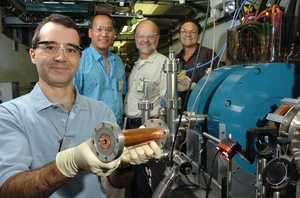
The Argonne Wakefield Accelerator Group (AWA) works on particle accelerators in much the same way that horsepower junkies work on muscle cars. Although their research doesn't involve turbochargers, stall torque converters or cat back exhaust systems, the AWA group obsesses over the power of their machine.
This past spring, Manoel Conde and his colleagues in the AWA group, led by physicist Wei Gai, crossed a major frontier in accelerator science: They generated an accelerating gradient five times stronger than that of conventional linear accelerators. The gradient – a region of increasing electrical potential – works like an electrical "motor," transferring enormous amounts of energy to charged particles as they shoot through an accelerator. By substituting a dielectric ceramic for the copper medium used to support these accelerating electric fields, Conde and his colleagues generated a gradient of 100 MV/m; conventional linear accelerators generally cannot support a gradient above 20 MV/m.
Higher gradients could allow for more compact accelerators with the same or greater energy as today's high-energy accelerators, which often stretch for miles. Aside from extending the energy frontier, materials that can support higher gradients will allow for the miniaturization of the medium- and low-energy accelerators used in hospitals for radiation therapy, improving their accuracy while reducing their cost, Gai said.
High-energy physicists have begun to realize that they cannot continue their decades-long trend of building ever-larger accelerators, said John Power, a physicist in the AWA group. He sees projects like CERN's Large Hadron Collider, with a circumference of about 17 miles, or the proposed 20-to-25-mile-long International Linear Collider (ILC) as the ceiling for traditional accelerators.
"Right now, high-energy physics is building the last set of machines that it can ever build," Power said. "We're pushing conventional technology to the ultimate limit and accelerators are getting to be so long — the only thing left now is to raise the gradient."
Physicists have started to look for ways to make accelerators more powerful. The limiting factor lies in finding a suitable alternative to copper, which provides the foundation for the accelerators that Power called "the workhorses of high-energy physics for 50 years."
Current accelerators typically operate at gradients of approximately 20 MV/m, because subjecting the copper to stronger electric fields produces a phenomenon known as field emission, in which free electrons circulating in the highly conductive metal get pulled out of its surface, generating discharges that can damage the accelerator. At high gradients, copper accelerators also tend to produce high wall currents, which sap energy from the beam, said physicist Zikri Yusof, another member of the AWA group.
Accelerator scientists trying to push copper to its limits were able to increase the gradient to 65 MV/m, above which point the accelerator would suffer irreversible damage due to a combination of these effects, according to Power. However, even at that intensity, the copper became so unstable that the ILC Global Design team decided to abandon the idea of using it as the foundation for their accelerator.
Having seen copper undone by its own electrical conductance at high voltages, Gai and his colleagues turned to dielectrics — or insulating materials — as viable alternatives. "If the dielectrics can support these kinds of gradients, we've got a great shot at a working accelerator," Power said. "The power sources and the size of the supporting structures are the same that accelerator physicists have always used, so everything should work."
Although other scientists have achieved success with other advanced accelerator technologies, from plasma- to laser-based accelerators, Power believes that dielectrics may provide the most pragmatic tool to break down the barrier currently facing high-energy physics. "Other advanced schemes have several major hurdles to cross, and we have only one: This dielectric has to be able to sustain the higher gradients," he said.
While Gai cautioned that other challenges still impede the manufacture of a high-gradient accelerator, he agreed with Power's observation. "This is one of the most promising advanced technologies on the horizon," he said.
Unlike conventional accelerators, which employ only one particle beam, wakefield accelerators use two beams: a “drive beam” to create the high gradient and a “main beam” to be accelerated. Within the drive beam, one or several highly charged "bunches" of electrons are shot through the dielectric structure. Like a speedboat rushing over a lake, each drive bunch leaves behind an electromagnetic wake. The electric gradients produced by these wakes are then used to accelerate the main beam. By synchronizing the emission of each successive drive bunch with the wake's waves, scientists can create stronger wakes that produce higher gradients, Yusof explained.
Although the 100 MV/m figure constitutes a true landmark for accelerator physicists — "it's a milestone we've pursued for 10 years," Power said — dielectrics or similar materials could produce even higher gradients. The absolute upper bound on solid-based accelerators is believed to be about 10 GV/m, at which point all solids will begin to ionize and destabilize. However, that figure represents a 100-fold improvement over the gradients that the scientists on the AWA have generated, leaving considerable room for later improvements.
Power believes that the successful construction of higher-gradient accelerators will precipitate a revolution, as high-energy physicists — the AWA's "primary customers" — will gain access to a whole new regime of energies. "Right now, the 20-mile ILC is expected to give you about half a tera-electronvolt (TeV) of energy. If you take the same 20 miles and apply our technology, you can get 2.5 TeV or perhaps even more. That opens up many different possibilities," he said.
Source: Argonne National Laboratory


