Parkes telescope finds new kind of star
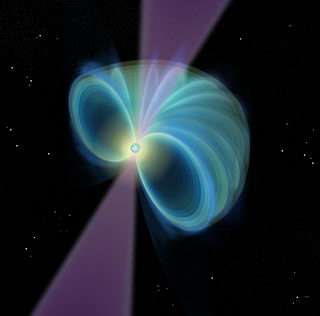
February 16, 2006 Illustration of a pulsar showing magnetic field lines (cut away) and radio beam.

Illustration of a pulsar showing magnetic field lines (cut away) and radio beam. Credit: Russell Kightley Media

An international team of astronomers using CSIRO’s Parkes radio telescope in eastern Australia has found a new kind of cosmic object.

An international team of astronomers using CSIRO’s Parkes radio telescope in eastern Australia has found a new kind of cosmic object — small, compressed ‘neutron stars’ that show no activity most of the time but once in a while spit out a single burst of radio waves. The discovery will be published in this week’s issue of the journal Nature.

The new objects — dubbed Rotating Radio Transients or RRATs — are likely to be related to conventional radio pulsars (small stars that emit regular pulses of radio waves, up to hundreds of times a second). But the new objects probably far outnumber their old cousins, the scientists say.

Eleven RRATs have been found, first detected by the Parkes Multibeam Pulsar Survey and then observed again several times. Their isolated bursts last for between two and 30 milliseconds. In between, for times ranging from four minutes to three hours, they are silent.

'These things were very difficult to pin down,' says CSIRO’s Dr Dick Manchester, a member of the research team and a veteran pulsar hunter. 'For each object we’ve been detecting radio emission for less than one second a day. And because these are single bursts, we’ve had to take great care to distinguish them from terrestrial radio interference.'

By analysing the burst arrival times, the astronomers have found that 10 of the 11 sources have underlying periods of between 0.4 seconds and seven seconds. It is this that suggests that they are rotating neutron stars.

Because RRATs are ‘silent’ most of the time, the chance of being able to detect one is low. Many more must lurk unseen in our Galaxy, the astronomers argue — perhaps a few hundred thousand. The number of ‘normal’ radio pulsars in our Galaxy is estimated to be about 100,000.

Unlike some other kinds of stars that show periodic eruptions, the RRATs show no evidence for being in binary systems (that is, each orbiting another star).

A handful of ‘normal’ pulsars produce the occasional ‘giant’ pulse, along with their usual train of regular, smaller pulses. The RRATs appear to differ from these by having magnetic field strengths in the emission region about a hundred thousand times weaker.

The research team was drawn from institutions in the UK, USA, Australia, Canada and Italy.

Source: CSIRO


print this article email this article download pdf blog this article bookmark this article     Stumble it Digg this share on Facebook retweet share on Reddit add to delicious
Rate this story - 4.2 /5 (29 votes)


February 16, 2006 all stories

Comments: 0

4.2 /5 (29 votes)
  • Stumble this up

  • Digg this

  • share this

  • hide
  • Related Stories

  • The Stars My Destination
    created Nov 10, 2009 | popularity not rated yet | comments 0
  • Swift, XMM-Newton satellites tune into a middleweight black hole
    created Nov 10, 2009 | popularity not rated yet | comments 0
  • Carbon Atmosphere Discovered on Neutron Star
    created Nov 04, 2009 | popularity not rated yet | comments 0
  • Bacteria 'invest' wisely to survive uncertain times, scientists report
    created Nov 02, 2009 | popularity not rated yet | comments 0
  • Breakthrough in industrial-scale nanotube processing
    created Nov 02, 2009 | popularity not rated yet | comments 0


Other News

2 Earth-sized bodies with oxygen rich atmospheres found -- but they're stars not planets

Two Earth-sized bodies with oxygen rich atmospheres found -- but they're stars not planets

Space & Earth / Astronomy

created 8 hours ago | popularity 4.6 / 5 (11) | comments 1

(PhysOrg.com) -- Astrophysicists at the University of Warwick and Kiel University have discovered two earth sized bodies with oxygen rich atmospheres - however there is a bit of a disappointing snag for anyone ...


Greenland ice cap melting faster than ever

Greenland ice cap melting faster than ever

Space & Earth / Earth Sciences

created 8 hours ago | popularity 3.6 / 5 (16) | comments 10

Satellite observations and a state-of-the art regional atmospheric model have independently confirmed that the Greenland ice sheet is loosing mass at an accelerating rate, reports a new study in Science.


Research gives new insights into 4 billion year-old meteorites

Research gives new insights into 4 billion year-old meteorites

Space & Earth / Astronomy

created 6 hours ago | popularity not rated yet | comments 0

(PhysOrg.com) -- Scientists have gained new insight into the makeup of ancient meteorites called Carbonaceous Chondrites, in research published in the October edition of the journal Earth Science and Planetary Le ...


A faraway planet intrigues: Exoplanet with extremely tilted orbit raises new interest in stellar astronomy

A faraway planet intrigues: Exoplanet with extremely tilted orbit raises new interest in stellar astronomy

Space & Earth / Astronomy

created 16 hours ago | popularity 4.8 / 5 (9) | comments 5

(PhysOrg.com) -- Two teams of astronomers have found a planet outside the solar system that might be orbiting backwards compared to its star's rotation, a discovery that could shed light on how unique the ...


NASA to Begin Attempts to Free Sand-Trapped Mars Rover

NASA to Begin Attempts to Free Sand-Trapped Mars Rover

Space & Earth / Space Exploration

created 7 hours ago | popularity not rated yet | comments 0

(PhysOrg.com) -- NASA will begin transmitting commands to its Mars exploration rover Spirit on Monday as part of an escape plan to free the venerable robot from its Martian sand trap.