It’s The Way It’s Written...
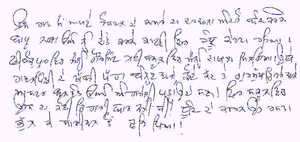
Forensic experts believe a Punjabi equivalent of English pangram ‘The quick brown fox jumps over the lazy dog’ could help profile the criminal authors of documents.
The well known English language pangram contains all the letters of the alphabet in one sentence.
University of Derby forensic experts used a Punjabi ‘pangram’– a paragraph in the Punjabi script Gurmukhi which contained all 40 characters of the Indo-Aryan language – as part of a study to see if written text could be used to help build up a profile of its author.
Punjabi is spoken by approximately 104 million people worldwide, predominately in the Punjab region of India, parts of Pakistan and countries with Punjabi migrants.
Studies of the same paragraph written by 200 volunteers showed the handwriting could be used to determine if someone was a native from a foreign country, a first generation descendent (born in India or Pakistan but who has moved to the UK) or second generation (born in the UK).
The findings could have important implications for forensic science, for example if police were investigating a case where they needed to identify the author of a document or threatening letter.
Dr Ian Turner, a Forensic Science Lecturer at Derby, worked on the study with Forensic Science Programme Leader Julian Love and BSc (Hons) Forensic Science with Criminology student Rajvinder Kaur (a recent graduate) – who chose to concentrate on the Punjabi script.
Dr Turner said: "It wasn’t quite a pangram we constructed, but a short paragraph which contained all of the characters of the Gurmukhi alphabet.
"The results were analysed and we have discovered these exciting trends in differences which could help determine the writer’s origin.
"The text the academics chose included not only all of the characters but also the key ‘matras’ (pronunciation) in order to gauge a comprehensive view of different writing styles.
The first and second generation participants from across the UK, took part in a postal study where they submitted written passages for the scientists to examine, after an initial appeal for volunteers from among University students. Other texts from residents native to Pakistan were also studied.
Derby’s Forensic Science team found clear class characteristics in each of the populations defined above in how individual letters are formed and general features of the text – ie how cursive or joined-up the writing is.
The Gurmukhi control passage used in the study reads:
"That night I closed my hostel room door from inside, was remembering my dad and I cried. I got admission in a government high school in Ferozepore.
There was a teacher from Rawalpindi there who wore a left sided turban, was of a small height and had a gentle face.
The teacher Balwant Singh was teaching English. He had no close friends in the school. Because of the fog he lost his way and fell off his bicycle."
The study: Investigation of Class Characteristics in the Gurmukhi Handwriting of first and second Generation Punjabis, identified up to eight major differences between the handwriting styles of first and second generation Punjabi populations as well as numerous individual character differences.
Key differences were outlined as:
-- Script Type – the construction of the script (cursive, mixed or printed)
-- Letter Size – the overall area covered by the written text on the paper (small, medium, large or irregular)
-- Slant – the angle of the axis of a letter to the baseline (upright, backwards, forward or irregular)
-- Angularity – shape of individual characters in the script (rounded, oblong or angular)
-- Alignment – relation of letters in a line to an actual or imaginary baseline (horizontal, descending, uneven, ascending, or arched).
The researchers determined that the writing style of an individual is determined during childhood by factors such as the teaching systems and styles employed.
Dr Turner said: "There are several different writing systems used to write the Punjabi script, the use of these systems depends on a number of factors including geographical location, local dialect and religious beliefs."
Rajvinder, 22, from Willenhall Road, Wolverhampton, said: "Our work shows some interesting patterns and trends that could be applied to other foreign scripts."
The academic team are set to have their findings published and plan to work on further research in this area in other languages and with police forces and the Government.
Source: University of Derby


