New carbon nanotube technology to reduce large-scale emissions
September 18th, 2007 New technology to reduce large-scale emissions

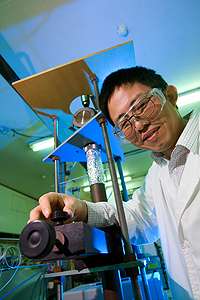
Dr Zhu

A novel technology to trap large-scale greenhouse gas emissions caused by coal mining and power generation is being developed by a University of Queensland researcher.

Dr John Zhu, Senior Lecturer in the School of Engineering, aims to develop a carbon nanotube (CNT) membrane for gas separation that will work like a sieve to separate high volumes of methane or carbon dioxide from other gases.

Dr Zhu said that the CNT technology was exciting because it would trap moving gases up to 100 times faster than other gas separation techniques and could therefore be used by large-scale plants such as power stations.

“Conventional membranes such as polymeric and metal membranes, porous silica and carbon molecular sieves all show a trade-off between how well they separate gases and how much gas they can process,” he said.

“The CNT membranes can both separate effectively and process large volumes of gas, making them superior to conventional membranes at the large scale required for coal-fired power plants or natural gas processing.

“If the technology is successful, it may be able to significantly reduce the amount of greenhouse gases produced through power generation. This is especially important in Queensland where we are dependent on power generated from coal.”

The carbon nanotube technology works by “sieving” gas as it passes through the membrane, and can be applied to various aspects of the power-generation process including during the mining process and after the fuel is burnt.

During underground coal mining, methane (an explosive gas which is present in the coal) must be removed before the coal can be extracted. In current practice, the methane is so diluted with air that it cannot be used and is therefore released into the atmosphere. The CNT membrane will enable the methane to be separated and harnessed for use as valuable pipeline quality gas.

In power stations, after coal or gas is burnt, a CNT membrane may be used to separate carbon dioxide from waste gas. The carbon dioxide can then be permanently and safely disposed of through methods such as sequestration.

If successful, the CNT membrane is likely to be commercialised and available for use in the next 10 to 15 years.

Dr Zhu said he was both pleased and grateful that his research was being recognised by the University with the award, and for the opportunity to advance research in an area so critical to the future health of the planet.

“I have been concerned about humankind's impact on the environment for many years. It is imperative that we reduce greenhouse emissions. I hope the CNT membrane will help to achieve that,” Dr Zhu said.

Source: UQ


print this article email this article download pdf blog this article bookmark this article     Digg this Stumble it share on Facebook share on Reddit add to delicious save to Yahoo! bookmarks
4.2/5 after 17 votes

Rank Filter

Move the slider to adjust rank threshold, so that you can hide some of the comments.


Display comments: newest first

  • HappyPhil - Feb 20, 2009
    • Rank: not rated yet
    You might try separating fullerenes themselves from the Co2 with CNT membranes . This could open up the future of manufacturing with tons of inexpensive carbon cage molecules, instead of the current cost of $300 per gram.

September 18th, 2007 all stories
Nanotechnology / Nanomaterials

Comments: 1
Rank: 4.2/5 after 17 votes

  • Stumble this up

  • Digg this

  • Share it:
  • share on Facebook
  • share on MySpace
  • share on Slashdot
  • rss-newsfeed
  • share on Google
  • share on Reddit
  • add to delicious
  • save to Yahoo! bookmarks
  • share on Windows Live
  • Add to Mixx!
Rating: 4.2/5 after 17 votes


Tags


  • Physicists Demonstrate Quantum Memory with Matter Qubits
    Physicists Demonstrate Quantum Memory with Matter Qubits
    Physics / General Physics
    created 11 hours ago | popularity 4.8 / 5 (8) | comments 1
  • 'Holey' Nanosheets for Wastewater Dye Removal
    Nanotechnology / Nanomaterials
    created Jul 01, 2009 | popularity 5 / 5 (5) | comments 1
  • Jellyfish Robot Swims Like its Biological Counterpart
    Jellyfish Robot Swims Like its Biological Counterpart
    Electronics / Robotics
    created Jun 26, 2009 | popularity 4.4 / 5 (7) | comments 1
  • Could Maxwell's Demon Exist in Nanoscale Systems?
    Could Maxwell's Demon Exist in Nanoscale Systems?
    Physics / General Physics
    created Jun 24, 2009 | popularity 4.4 / 5 (18) | comments 29
  • Living Safely with Robots, Beyond Asimov's Laws
    Living Safely with Robots, Beyond Asimov's Laws
    Electronics / Robotics
    created Jun 22, 2009 | popularity 4.6 / 5 (50) | comments 39
  • Other News

    Harnessing Nanoparticles To Track Cancer Cell Changes

    Nanotechnology / Bio & Medicine

    created 9 hours ago | popularity not rated yet | comments 0

    The more dots there are, the more accurate a picture you get when you connect them. Cancer researchers adopting that philosophy have developed a new imaging technology that could give scientists the ability to simultaneously ...


    A 'quantum of sol' -- how nanotechnology could hold the key to a solar-powered future

    A 'quantum of sol' -- how nanotechnology could hold the key to a solar-powered future

    Nanotechnology / Nanomaterials

    created Jun 30, 2009 | popularity 3.5 / 5 (11) | comments 16

    (PhysOrg.com) -- A new generation of 'nano-structured' millimetre-sized solar cells that could convert the sun's energy to electricity more than twice as efficiently as current technology, is the subject of ...


    Australian researchers are set to begin human trials of a tiny nano-cell that acts as a "Trojan horse" against cancer

    Hi-tech 'Trojan horse' can kill cancer cells: researchers

    Nanotechnology / Bio & Medicine

    created Jun 29, 2009 | popularity 4.6 / 5 (11) | comments 7

    Australian researchers are set to begin human trials of a tiny nano-cell that acts as a "Trojan horse" against cancer cells, a breakthrough they say may curb the need for debilitating chemotherapy.


    'Holey' Nanosheets for Wastewater Dye Removal

    Nanotechnology / Nanomaterials

    created Jul 01, 2009 | popularity 5 / 5 (5) | comments 1

    (PhysOrg.com) -- Researchers have discovered that extremely thin sheets of nickel oxide with hexagonally shaped holes can absorb hazardous dyes from wastewater nearly as well as the best traditional methods, but are recyclable. ...


    New statistical technique improves precision of nanotechnology data

    New statistical technique improves precision of nanotechnology data

    Nanotechnology / Nanophysics

    created Jul 01, 2009 | popularity 3 / 5 (2) | comments 0

    A new statistical analysis technique that identifies and removes systematic bias, noise and equipment-based artifacts from experimental data could lead to more precise and reliable measurement of nanomaterials ...