Spitzer Finds Violent Galaxies Smothered in 'Crushed Glass'
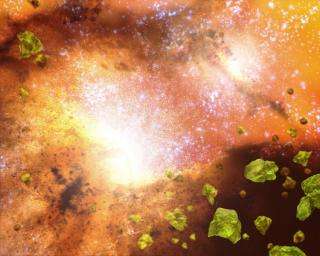
NASA's Spitzer Space Telescope has observed a rare population of colliding galaxies whose entangled hearts are wrapped in tiny crystals resembling crushed glass.
The crystals are essentially sand, or silicate, grains that were formed like glass, probably in the stellar equivalent of furnaces. This is the first time silicate crystals have been detected in a galaxy outside of our own.
"We were surprised to find such delicate, little crystals in the centers of some of the most violent places in the universe," said Dr. Henrik Spoon of Cornell University, Ithaca, N.Y. He is first author of a paper on the research appearing in the Feb. 20 issue of the Astrophysical Journal. "Crystals like these are easily destroyed, but in this case, they are probably being churned out by massive, dying stars faster than they are disappearing."
The discovery will ultimately help astronomers better understand the evolution of galaxies, including our Milky Way, which will merge with the nearby Andromeda galaxy billions of years from now.
"It's as though there's a huge dust storm taking place at the center of merging galaxies," said Dr. Lee Armus, a co-author of the paper from NASA's Spitzer Science Center at the California Institute of Technology in Pasadena. "The silicates get kicked up and wrap the galaxies' nuclei in giant, dusty glass blankets."
Silicates, like glass, require heat to transform into crystals. The gem-like particles can be found in the Milky Way in limited quantities around certain types of stars, such as our sun. On Earth, they sparkle in sandy beaches, and at night, they can be seen smashing into our atmosphere with other dust particles as shooting stars. Recently, the crystals were also observed by Spitzer inside comet Tempel 1, which was hit by NASA's Deep Impact probe.
The crystal-coated galaxies observed by Spitzer are quite different from our Milky Way. These bright and dusty galaxies, called ultraluminous infrared galaxies, or "Ulirgs," are swimming in silicate crystals. While a small fraction of the Ulirgs cannot be seen clearly enough to characterize, most consist of two spiral-shaped galaxies in the process of merging into one. Their jumbled cores are hectic places, often bursting with massive, newborn stars. Some Ulirgs are dominated by central supermassive black holes.
So, where are all the crystals coming from? Astronomers believe the massive stars at the galaxies' centers are the main manufacturers. According to Spoon and his team, these stars probably shed the crystals both before and as they blow apart in fiery explosions called supernovae. But the delicate crystals won't be around for long. The scientists say that particles from supernova blasts will bombard and convert the crystals back to a shapeless form. This whole process is thought to be relatively short-lived.
"Imagine two flour trucks crashing into each other and kicking up a temporary white cloud," said Spoon. "With Spitzer, we're seeing a temporary cloud of crystallized silicates created when two galaxies smashed together."
Spitzer's infrared spectrograph spotted the silicate crystals in 21 of 77 Ulirgs studied. The 21 galaxies range from 240 million to 5.9 billion light-years away and are scattered across the sky. Spoon said the galaxies were most likely caught at just the right time to see the crystals. The other 56 galaxies might be about to kick up the substance, or the substance could have already settled.
Others authors of this work include Drs. A.G.G.M. Tielens and J. Cami of NASA's Ames Research Center, Moffett Field, Calif.; Drs. G.C. Sloan and Jim R. Houck of Cornell; B. Sargent of the University of Rochester, N.Y.; Dr. V. Charmandaris of the University of Crete, Greece; and Dr. B.T. Soifer of the Spitzer Science Center.
Source: NASA


