21st-century pack mule: MIT's 'exoskeleton' lightens the load
September 19, 2007
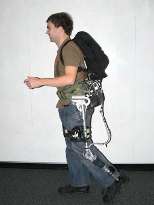
Graduate student Conor Walsh demonstrates a prototype of the 'exoskeleton' he and other MIT researchers have devised. The invention can successfully take on 80 percent of an 80-pound load carried on a person's back. Photo: Samuel Au
Researchers in the MIT Media Lab's Biomechatronics Group have created a device to lighten the burden for soldiers and others who carry heavy packs and equipment.
Their invention, known as an exoskeleton, can support much of the weight of a heavy backpack and transfer that weight directly to the ground, effectively taking a load off the back of the person wearing the device.
In the September issue of the International Journal of Humanoid Robotics, the researchers report that their prototype can successfully take on 80 percent of an 80-pound load carried on a person's back, but there's one catch: The current model impedes the natural walking gait of the person wearing it.
"You can definitely tell it's affecting your gait," said Conor Walsh, a graduate student who worked on the project, but "you do feel it taking the load off and you definitely feel less stress on your upper body."
The research team was led by Hugh Herr, principal investigator of the Biomechatronics Group and associate professor in the MIT Media Lab. Earlier this summer, Herr and his colleagues unveiled the world's first robotic ankle for lower-limb amputees.
Eventually Herr hopes to create assistive leg devices that can be useful for anyone. Herr said he envisions leg exoskeletons that could help people run without breathing hard, as well as help to carry heavy loads.
"Our dream is that 20 years from now, people won't go to bike racks--they'll go to leg racks," he said.
Exoskeleton devices could boost the weight that a person can carry, lessen the likelihood of leg or back injury and reduce the perceived level of difficulty of carrying a heavy load.
The person wearing the exoskeleton places his or her feet in boots attached to a series of tubes that run up the leg to the backpack, transferring the weight of the backpack to the ground. Springs at the ankle and hip and a damping device at the knee allow the device to approximate the walking motion of a human leg, with a very small external power input (one watt).
Other research teams have produced exoskeleton devices that can successfully carry a load but require a large power source (about 3,000 watts, supplied by a gasoline engine).
When the MIT researchers tested their device, they found that although the load borne by the wearer's back was lightened, the person carrying the load had to consume 10 percent more oxygen than normal, because of the extra effort to compensate for the gait interference.
The team hopes to revise the design so the exoskeleton more closely mimics the movement of a human leg, allowing for more normal walking motion. The most important result of this study, says Walsh, is that the team's spring-based, low-energy design shows promise.
"This is the first time that it has been tested," he said. "We didn't know what to expect."
Source: MIT
-
Investigators identify cleat/natural grass combination may be less likely to result in ACL injury
Jan 20, 2010 |
not rated yet |
0
-
How to spur energy storage innovations
Dec 17, 2009 |
2 / 5 (2) |
0
-
Of life and limb
Jan 05, 2012 |
not rated yet |
0
-
ORNL technology could mean improved prosthesis fitting, design
Dec 29, 2011 |
not rated yet |
1
-
Parkinson's & dance: An unusual partnership unites
Dec 07, 2011 |
not rated yet |
1
-
Engineers build first sub-10-nm carbon nanotube transistor
Feb 01, 2012 |
4.9 / 5 (31) |
30
-
Something old, something new: Evolution and the structural divergence of duplicate genes
Jan 31, 2012 |
4.6 / 5 (7) |
1
-
The hidden nanoworld of ice crystals: Revealing the dynamic behavior of quasi-liquid layers
Jan 30, 2012 |
5 / 5 (3) |
1
-
Stock market network reveals investor clustering
Jan 27, 2012 |
3.9 / 5 (23) |
8
-
Of microchemistry and molecules: Electronic microfluidic device synthesizes biocompatible probes
Jan 26, 2012 |
5 / 5 (1) |
0
-
Calling function with no input argument
9 hours ago
-
Force free body diagram problem on gym equipment
10 hours ago
-
Empirical data regarding shower heads and water
18 hours ago
-
feed hold button on CNC lathe
Feb 09, 2012
-
RFAC in Fortran
Feb 09, 2012
-
dynamics 2/32
Feb 08, 2012
- More from Physics Forums - General Engineering
More news stories
Google users warned of threat to smartphone wallets
Users of Google smartphone wallets were being warned on Friday that there is a way to crack pass codes intended to thwart thieves from going on illicit shopping sprees.
2 hours ago |
5 / 5 (1) |
0
Anonymous knocks CIA website offline (Update)
The website of the Central Intelligence Agency was inaccessible on Friday after the hacker group Anonymous claimed to have knocked it offline.
4 hours ago |
5 / 5 (6) |
10
New error-correcting codes guarantee the fastest possible rate of data transmission
Error-correcting codes are one of the triumphs of the digital age. Theyre a way of encoding information so that it can be transmitted across a communication channel such as an optical fiber o ...
Technology / Computer Sciences
12 hours ago |
5 / 5 (4) |
5
|
New power source discovered
(PhysOrg.com) -- Researchers at the Massachusetts Institute of Technology (MIT) and RMIT University have made a breakthrough in energy storage and power generation.
Technology / Energy & Green Tech
11 hours ago |
4.8 / 5 (19) |
7
|
Small modular reactor design could be a 'SUPERSTAR'
(PhysOrg.com) -- Though most of today's nuclear reactors are cooled by water, we've long known that there are alternatives; in fact, the world's first nuclear-powered electricity in 1951 came from a reactor ...
Technology / Energy & Green Tech
12 hours ago |
4.2 / 5 (10) |
20
|
Complex wiring of the nervous system may rely on a just a handful of genes and proteins
Researchers at the Salk Institute have discovered a startling feature of early brain development that helps to explain how complex neuron wiring patterns are programmed using just a handful of critical genes. ...
Putting the squeeze on planets outside our solar system
(PhysOrg.com) -- Using high-powered lasers, scientists at Lawrence Livermore National Laboratory and collaborators discovered that molten magnesium silicate undergoes a phase change in the liquid state, abruptly ...
NASA sees wide-eyed cyclone Jasmine
Cyclone Jasmine's eye has opened wider on NASA satellite imagery, as it moves through the Southern Pacific Ocean.
The power of estrogen -- male snakes attract other males
A new study has shown that boosting the estrogen levels of male garter snakes causes them to secrete the same pheromones that females use to attract suitors, and turned the males into just about the sexiest ...
NASA sees Giovanna reach cyclone strength, threaten Madagascar
Tropical Storm 12S built up steam and became a cyclone on February 10, 2012 as NASA's Terra satellite passed overhead. Residents of east-central Madagascar should prepare for this cyclone to make landfall ...
Humans may have helped the decline of African rainforests 3000 years ago
(PhysOrg.com) -- Large areas of rainforests in Central Africa mysteriously disappeared over three thousand years ago, to be replaced by savannas. The prevailing theory has been that the cause was a change ...