Smithsonian identifies invasive crab species in Panama Canal expansion area
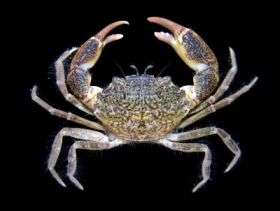
A Smithsonian scientist and colleague report that a potentially harmful, invasive crab species that has spread to several countries is now established and reproducing in Panama. The researchers report that Harris mud crabs are reproducing in the small, man-made lake designated to become the third set of locks in Panama’s new $5 billion canal expansion project.
Mark Torchin, a staff scientist at the Smithsonian Tropical Research Institute in Panama, and Dominique Roche, a McGill University pre-doctoral student, report their research in the September issue of Aquatic Invasions.
The Harris mud crab, Rhithropanopeus harrisii, native to estuarine environments along the East coast of North America, has spread to at least 21 countries, causing varying degrees of both environmental and economic damage. This mud crab has the potential to disrupt local ecosystems, invade inland freshwater lakes and harbor crustacean diseases. It also fouls pipes and preys upon fish in gill nets.
Torchin and Roche first discovered R. harrisii on the shoreline of the Miraflores Third Lock Lake in February. In March, they collected males, egg-bearing females and juveniles. While individual Harris mud crabs were reported from Panama in 1969, this is the first report of an established and reproducing population in the country.
The Miraflores Third Lock Lake was created in the early 1940s, during an aborted project to further expand the canal. The new canal expansion project, formally inaugurated Sept. 3, will reconnect this lake to the waterway.
Additional surveys will determine whether the crab is ubiquitous in the canal waters and if it is established at other sites. Genetic analysis will reveal the origin of this population and will determine if all populations in the canal are related or whether they result from independent introductions. The Panama Canal Authority supports STRI’s survey efforts.
This study is part of a major ongoing project by Torchin and the Smithsonian Marine Science Network to document the movement of invasive species as a result of the significant expansion of world marine trade.
Source: Smithsonian Tropical Research Institute


