September 20, 2007 feature
Bats may use magnetic polarity for navigation
Researchers have found that bats have a special ability to detect the polarity of a magnetic field, meaning that the creatures can tell the difference between north and south. The only other animal known to have this ability is the mole rat, while birds, fish, amphibians, and all other non-mammals possess a different version of the magnetic compass.
The finding may not only explain bats’ long-distance navigation and foraging abilities, but also may provide insight on when and how magnetic field detection evolved in mammals and non-mammals. So explain the researchers, Yinan Wang, Yongxin Pan, Stuart Parsons, Michael Walker, and Shuyi Zhang, who are from the Chinese Academy of Sciences in Beijing, East China Normal University in Shanghai, and the University of Auckland in New Zealand.
“The fact that the only two flying vertebrates, bats and birds, do not derive the same information about direction from the Earth's magnetic field despite apparently similar navigational requirements has very important implications for the evolution of the magnetic sense in vertebrates,” Parsons told PhysOrg.com. “I think it is likely that other mammals possess the ability to detect the field, i.e. have the physiological and anatomical specialization necessary. However, this does not mean that they actually use this information.”
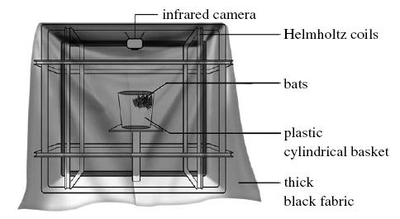
In their experiment, the scientists studied the reactions of Nyctalus plancyi bats in an experimental chamber when exposed to an altered magnetic field. The team recorded the hanging positions of the bats with an infrared camera, and then used Helmholtz coils to generate a magnetic field that aligned with the local geomagnetic axis at Beijing, where the experiment took place, with twice the intensity of Earth’s magnetic field.
After exposing the bats to the induced magnetic field for several days, the researchers then altered the horizontal and vertical components of the field, both simultaneously and independently. As the group explained, altering the vertical field affects the magnetic inclination, while altering the horizontal field affects the magnetic polarity.
Many birds and other non-mammals are known to react to inclination, meaning that they can use information about the different angles that the Earth’s magnetic field is tilted toward the Earth to determine relative latitude. For example, inclination is 90 degrees at the poles (perpendicular to the Earth) and 0 degrees at the equator (parallel to the Earth)—similar to the pattern that lead filings make when placed around a bar magnet. Some birds, like the Arctic Tern, use inclination to annually navigate all the way from the North Pole to the South Pole and back.
However, unlike birds, the bats did not react to a change in the vertical field, implying that they do not use inclination when roosting or navigating. On the other hand, when the researchers altered the horizontal field, the bats changed their hanging positions, switching from the northern to the southern end of their basket.
The scientists predict that magnetic polarity may help the bats in thermoregulation, since they choose warmer sites to control lactation and development, as well as to minimize the energy used during torpor (hibernation). If they used magnetic polarity in roosting, the scientists suggest, the bats are also likely use polarity to navigate, such as when Nyctalus noctula migrate up to 1600 km between seasons.
How do they do it? The scientists explain that animals which use magnetism to navigate are generally thought to use light exposure, magnetite receptors, or both. For example, birds may use a light-dependent mechanism in the right eye for directional information, and a magnetite receptor in the upper beak for detecting variations in magnetic intensity. Most likely, bats use some kind of magnetite receptor.
Why the two animals developed sensitivities to different magnetic information is still a question, however. Parsons speculated that an inclination compass may offer more tolerance for birds crossing the equator. Also, when the Earth’s magnetic field occasionally reverses, the birds will not be confused.
“It has been suggested that the ability of birds to detect the inclination of the Earth's magnetic field means that reversal of the polarity of the Earth's magnetic field will not affect the ability of birds, particularly migratory birds, to set compass courses because there will be a magnetic pole in each hemisphere and the birds will know the direction toward the near pole and the equator as a consequence,” added Walker. “In contrast, the fact that mammals appear to respond to magnetic polarity suggests they will know where magnetic north is but not which hemisphere they are in and may get misled following a reversal of the polarity of the Earth's magnetic field.”
Another significant point from the experiments is that polarity alone is sufficient to navigate long distances. The research also suggests that inclination and polarity detection may have evolved independently in birds and mammals, which means the ability would have emerged after the evolutionary transition from land to air—and would also explain why humans are quite poor at navigating in the absence of a map and a GPS.
Citation: Wang, Yinan, Pan, Yongxin, Parsons, Stuart, Walker, Michael, and Zhang, Shuyi. “Bats respond to polarity of a magnetic field.” Proceedings of the Royal Society B. doi:10.1098/rspb.2007.0904.
Copyright 2007 PhysOrg.com.
All rights reserved. This material may not be published, broadcast, rewritten or redistributed in whole or part without the express written permission of PhysOrg.com.


