Orphan stars found in long galaxy tail
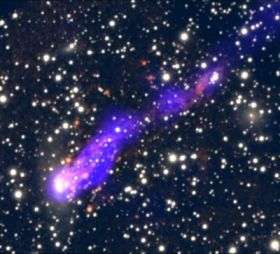
September 20th, 2007 X-ray and Optical Image of Abell 3627

This composite image shows a tail that has been created as a galaxy plunges into the galaxy cluster Abell 3627. X-rays from Chandra (blue) and optical light (white and red) from the SOAR telescope show that as the galaxy plummets, it sheds material and forming stars behind it in a tail that stretches over 200,000 light years long. This result demonstrates that stars can form well outside of their parent galaxy. Credit: X-ray: NASA/CXC/MSU/M. Sun et al. Optical: SOAR/MSU/NOAO/UNC/CNPq-Brazil/M. Sun et al.

Astronomers have found evidence that stars have been forming in a long tail of gas that extends well outside its parent galaxy. This discovery suggests that such "orphan" stars may be much more prevalent than previously thought.

The comet-like tail was observed in X-ray light with NASA's Chandra X-ray Observatory and in optical light with the Southern Astrophysical Research (SOAR) telescope in Chile. The feature extends for more than 200,000 light years and was created as gas was stripped from a galaxy called ESO 137-001 that is plunging toward the center of Abell 3627, a giant cluster of galaxies.

"This is one of the longest tails like this we have ever seen," said Ming Sun of Michigan State University, who led the study. "And, it turns out that this is a giant wake of creation, not of destruction."

The observations indicate that the gas in the tail has formed millions of stars. Because the large amounts of gas and dust needed to form stars are typically found only within galaxies, astronomers have previously thought it unlikely that large numbers of stars would form outside a galaxy.

"This isn't the first time that stars have been seen to form between galaxies," said team member Megan Donahue, also of MSU. "But the number of stars forming here is unprecedented."

The evidence for star formation in this tail includes 29 regions of ionized hydrogen glowing in optical light, thought to be from newly formed stars. These regions are all downstream of the galaxy, located in or near the tail. Two Chandra X-ray sources are near these regions, another indication of star formation activity. The researchers believe the orphan stars formed within the last 10 million years or so.

The stars in the tail of this fast-moving galaxy, which is some 220 million light years away, would be much more isolated than the vast majority of stars in galaxies.

"By our galactic standards, these are extremely lonely stars," said Mark Voit, another team member from MSU. "If life was to form out there on a planet a few billion years from now, they would have very dark skies."

The gas that formed the orphan stars was stripped out of its parent galaxy by the pressure induced by the motion of the galaxy through the multimillion degree gas that pervades the intergalactic space of the galaxy cluster. Eventually most of the gas will be scoured from the galaxy, depleting the raw material for new stars, and effectively stopping further star formation in the galaxy.

This process may represent an important but short-lived stage in the transformation of a galaxy. Although apparently rare in the present-day universe, galactic tails of gas and orphan stars may have been more common billions of years ago when galaxies were younger and richer in star-forming gas.

These results will appear in the December 10th issue of The Astrophysical Journal.

Source: Chandra X-ray Center


print this article email this article download pdf blog this article bookmark this article     Digg this Stumble it share on Facebook share on Reddit add to delicious save to Yahoo! bookmarks
4.5/5 after 19 votes


September 20th, 2007 all stories
Space & Earth / Astronomy

Comments: 0
Rank: 4.5/5 after 19 votes

  • Stumble this up

  • Digg this

  • Share it:
  • share on Facebook
  • share on MySpace
  • share on Slashdot
  • rss-newsfeed
  • share on Google
  • share on Reddit
  • add to delicious
  • save to Yahoo! bookmarks
  • share on Windows Live
  • Add to Mixx!
Rating: 4.5/5 after 19 votes


Tags


  • Physicists Demonstrate Quantum Memory with Matter Qubits
    Physicists Demonstrate Quantum Memory with Matter Qubits
    Physics / General Physics
    created Jul 03, 2009 | popularity 4.4 / 5 (17) | comments 1
  • 'Holey' Nanosheets for Wastewater Dye Removal
    Nanotechnology / Nanomaterials
    created Jul 01, 2009 | popularity 5 / 5 (5) | comments 1
  • Jellyfish Robot Swims Like its Biological Counterpart
    Jellyfish Robot Swims Like its Biological Counterpart
    Electronics / Robotics
    created Jun 26, 2009 | popularity 4.4 / 5 (8) | comments 1
  • Could Maxwell's Demon Exist in Nanoscale Systems?
    Could Maxwell's Demon Exist in Nanoscale Systems?
    Physics / General Physics
    created Jun 24, 2009 | popularity 4.4 / 5 (18) | comments 29
  • Living Safely with Robots, Beyond Asimov's Laws
    Living Safely with Robots, Beyond Asimov's Laws
    Electronics / Robotics
    created Jun 22, 2009 | popularity 4.6 / 5 (52) | comments 40
  • Other News

    Forty years ago man first walked on the moon

    Space & Earth / Space Exploration

    created 8 hours ago | popularity 5 / 5 (2) | comments 0

    Forty years ago on July 20, 1969, American astronaut Neil Armstrong realized the oldest dream of human civilizations when he became the first man to walk on the moon.


    The least sea ice in 800 years

    The least sea ice in 800 years

    Space & Earth / Earth Sciences

    created Jul 01, 2009 | popularity 4.3 / 5 (59) | comments 52

    New research, which reconstructs the extent of ice in the sea between Greenland and Svalbard from the 13th century to the present indicates that there has never been so little sea ice as there is now. The ...


    Gas around young galaxy

    Intense heat killed the Universe's would-be galaxies, researchers say

    Space & Earth / Astronomy

    created Jul 01, 2009 | popularity 3.2 / 5 (19) | comments 25

    (PhysOrg.com) -- Our Milky Way galaxy only survived because it was already immersed in a large clump of dark matter which trapped gases inside it, scientists led by Durham University's Institute for Computational ...


    Scientists' Drill Hits Magma: Only Third Time on Record

    Scientists' Drill Hits Magma: Only Third Time on Record

    Space & Earth / Earth Sciences

    created Jun 29, 2009 | popularity 4.7 / 5 (20) | comments 19

    (PhysOrg.com) -- Scientists drilling a borehole deep into Iceland’s rocky crust to explore new methods of using geothermal energy hit a major roadblock on Thursday: Their drill ran into molten rock at a depth ...


    NASA manager pitches a cheaper return-to-moon plan

    Space & Earth / Space Exploration

    created Jun 30, 2009 | popularity 4 / 5 (7) | comments 18

    (AP) -- Like a car salesman pushing a luxury vehicle that the customer no longer can afford, NASA has pulled out of its back pocket a deal for a cheaper ride to the moon.