Study reveals the regulatory mechanism of key enzyme
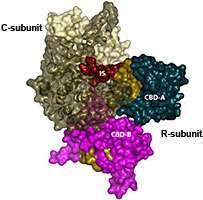
Research conducted at the University of California, San Diego (UCSD) School of Medicine has shed new light on the structure and function of one of the key proteins in all mammalian cells, protein kinase A (PKA), an enzyme which plays an essential role in memory formation, communication between nerve cells, and cardiac function.
Utilizing a process called x-ray crystallography, the scientists solved the structure of the large PKA complex, revealing a totally new structure that shows PKA’s amazing ability to function as a “scaffold,” that supports and controls the release of chemicals involved in transmitting signals. The structure is shown in the September 21 issue of the journal Cell, featuring the study that describes the dynamic regulatory subunit of PKA.
PKA belongs to a large superfamily of proteins whose activity is regulated by an important small molecule, cyclic AMP (cAMP), in the cell. Protein kinases transmit chemical signals within the cell to regulate a host of functions, such as cell growth or metabolism. Certain protein kinases have been implicated in the uncontrolled growth of cells; for example, when PKA somehow stays “on,” its prolonged activation can lead to cardiac disease and breast cancer.
By revealing its highly accurate three-dimensional structure, the UCSD scientists have shown how PKA is inhibited and activated by cAMP. PKA contains two components, the regulatory and catalytic subunits. When the subunits are together in the absence of cAMP, the signaling is turned off; when the two parts break apart after being activated by cAMP, PKA is turned on.
“We knew how the two subunits, the catalytic and regulatory subunits, looked as separate entities. But we didn’t understand how they actually fit together and are activated by cAMP until we saw this structure,” said Susan Taylor, Ph.D., Howard Hughes Medical Institute Investor and professor of pharmacology at UCSD School of Medicine, who headed the study.
Discovery of this enzyme’s molecular structure may help researchers to design drugs that specifically block the protein kinase activity involved in cancer or cardiac disease.
“Scientists didn’t really understand how the structure unfolded before now,” said Taylor, adding that preventing the subunits from coming apart may be an effective way to inhibit diseases caused when PKA is activated and can’t turn itself off.
Taylor said the researchers were surprised at how much the structure changed when PKA is turned off. “The regulatory subunit opens up and literally wraps itself around the catalytic subunit, thus completely turning the signal off,” she said.
Taylor is one of the world’s leading experts on the cAMP-dependent protein kinase, an enzyme that serves as a prototype for the entire protein kinase family. This family of enzymes has more than 500 members that are critical for regulation in all multi-cellular organisms, such as humans.
Taylor’s work in 1991 (reported in the July 26, 1991 issue of the journal Science) revealed the first-ever molecular structure of the catalytic subunit of a protein kinase, one involved in the action of adrenalin within cells. Understanding its structure was a sort of Rosetta stone for learning the structure of all protein kinases, because they all share certain fundamental characteristics.
Source: University of California - San Diego


