Researchers unravel the working of the bicycle
September 20, 2007
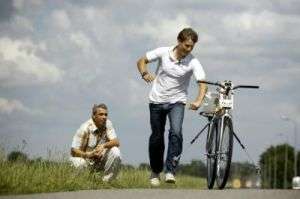
Dr. Arend Schwab en ir. Jodi Kooijman investigate the behavior of a moving bicycle. Credit: Sam Rentmeester/FMAX
For nearly 150 years, scientists have been baffled by the bicycle. How is it possible that a moving bicycle can, all by itself, be so stable?
Researchers of the Delft University of Technology (Netherlands), working with colleagues from Cornell University and the University of Nottingham, UK, believe they have now found the ultimate model of the bicycle. The researchers discuss their findings in the new edition of Delft Outlook, the science magazine of TU Delft.
'Bicycle manufacturers have never been able to say precisely how a bicycle works', explains Dr Arend Schwab of the Faculty of Mechanical, Maritime and Materials Engineering (3mE). 'They have always had to refine their designs purely through experimentation. In our model, they can enter into the computer all of the various factors that influence the stability and handling of their bicycle. The model then calculates how the bicycle will react at specific speeds.' The model has recently been published in the science magazine Proceedings of the Royal Society, Series A.
Because the model has the ability to indicate whether a design will deliver a jittery bicycle, or indeed a stable one for seniors, the bicycle industry is highly interested in the findings. The head of product development at the Dutch bicycle manufacturing company Batavus, Rob van Regenmortel, is following the research being conducted by Arend Schwab and his fellow researcher Jodi Kooijman very closely.
Van Regenmortel: ‘In designing our bicycles, for years we have worked with three parameters: The overall geometry, the distance between the axles and the angle at which the fork points downwards. These choices were once made by all bicycle makers and have been rarely deviated from because the bicycle appeared to work properly. However, with the new model, we soon hope to be able to design bicycles that are much better oriented toward specific target groups.'
Rob Van Regenmortel hopes to collaborate with Arend Schwab and Jodi Kooijman on a follow-up project to study the human control. The ultimate goal of the bicycle research is to study the interaction between bicycle and rider in order to determine the handling quality of the bicycle. 'In this way, we can – in theory – create a customised bicycle for every rider', says van Regenmortel. 'Individuals who have trouble maintaining their balance, for example, would then no longer be restricted to a tricycle.'
Source: Delft University of Technology
-
Under the electron microscope -- A 3-D image of an individual protein
Jan 25, 2012 |
4.9 / 5 (12) |
0
-
New research finds that homeowners and city planners should 'hit the trail'
Oct 11, 2011 |
not rated yet |
0
-
Study shows that vehicle-to-vehicle navigation systems really do work
Sep 07, 2011 |
5 / 5 (9) |
15
-
Researchers say helmet laws effective
Apr 22, 2011 |
not rated yet |
2
-
Cleaning up slum life with sewage cycle
Nov 19, 2010 |
4.5 / 5 (8) |
2
-
Engineers build first sub-10-nm carbon nanotube transistor
Feb 01, 2012 |
4.9 / 5 (30) |
30
-
Something old, something new: Evolution and the structural divergence of duplicate genes
Jan 31, 2012 |
4.6 / 5 (7) |
1
-
The hidden nanoworld of ice crystals: Revealing the dynamic behavior of quasi-liquid layers
Jan 30, 2012 |
5 / 5 (3) |
1
-
Stock market network reveals investor clustering
Jan 27, 2012 |
3.9 / 5 (23) |
8
-
Of microchemistry and molecules: Electronic microfluidic device synthesizes biocompatible probes
Jan 26, 2012 |
5 / 5 (1) |
0
-
Empirical data regarding shower heads and water
1 hour ago
-
feed hold button on CNC lathe
21 hours ago
-
Mechanics of Solids ( Final exam question) please help!
23 hours ago
-
RFAC in Fortran
Feb 09, 2012
-
dynamics 2/32
Feb 08, 2012
-
dynamics
Feb 08, 2012
- More from Physics Forums - General Engineering
More news stories
Soraa LED light may dim 50-watt halogen rivals
(PhysOrg.com) -- Soraa, a Fremont, California company founded in 2008, this week launched its first product, a light that uses LEDS (light emitting diodes). The "Soraa LED MR16 lamp" is the "perfect" replacement ...
Samsung can continue selling Galaxy tabs in Germany: court
South Korea's Samsung Electronics can continue to sell its Galaxy Tab 10.1N tablet computer in Germany, a German court ruled Thursday, rejecting a bid by arch-rival Apple to have them banned.
19 hours ago |
3.7 / 5 (3) |
3
Digital photos could put kids at risk
A study published in the International Journal of Electronic Security and Digital Forensics this month suggests that parents and carers could be putting children at risk if they upload digital photos that are automatically "geota ...
15 hours ago |
5 / 5 (1) |
3
Google launches Chrome browser for Android smartphones
With more and more people connecting to the Internet through a phone or a tablet instead of a PC, Google Inc. is bringing its fast-growing browser, Chrome, to the newest Android-powered mobile devices.
18 hours ago |
5 / 5 (4) |
0
Model analyzes shape-memory alloys for use in earthquake-resistant structures
Recent earthquake damage has exposed the vulnerability of existing structures to strong ground movement. At the Georgia Institute of Technology, researchers are analyzing shape-memory alloys for their potential ...
16 hours ago |
5 / 5 (1) |
0
|
'Dark plasmons' transmit energy
Microscopic channels of gold nanoparticles have the ability to transmit electromagnetic energy that starts as light and propagates via "dark plasmons," according to researchers at Rice University.
FDA-approved drug rapidly clears amyloid from the brain, reverses Alzheimer's symptoms in mice
Neuroscientists at Case Western Reserve University School of Medicine have made a dramatic breakthrough in their efforts to find a cure for Alzheimer's disease. The researchers' findings, published in the journal Science, show t ...
Hydrogen from acidic water: Researchers develop potential low cost alternative to platinum for splitting water
A technique for creating a new molecule that structurally and chemically replicates the active part of the widely used industrial catalyst molybdenite has been developed by researchers with the Lawrence Berkeley ...
Ultraviolet protection molecule in plants yields its secrets
Lying around in the sun all day is hazardous not just for humans but also for plants, which have no means of escape. Ultraviolet (UV) radiation from the sun can damage proteins and DNA inside cells, leading ...
Anyone can learn to be more inventive, cognitive researcher says
There will always be a wild and unpredictable quality to creativity and invention, says Anthony McCaffrey, a cognitive psychology researcher at the University of Massachusetts Amherst, because an "Aha moment" is rare and ...
Flexible paper robots
(PhysOrg.com) -- These inexpensive robots can stretch, bend and twist under control, and lift objects up to 120 times their own weight. Being soft, they can apply gentle and even pressure, and adapt to varied ...