Carnegie Mellon building robot for lunar prospecting
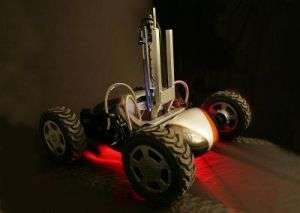
Researchers in the Robotics Institute of Carnegie Mellon University’s School of Computer Science are building a robotic prospector for NASA that can creep over rocky slopes and then anchor itself as a stable platform for drilling deep into extraterrestrial soils.
Called “Scarab,” this four-wheeled robot will never leave the Earth. But it will demonstrate technologies that a lunar rover will need to find concentrations of hydrogen, possibly water and other volatile chemicals on the moon that could be mined to produce fuel, water and air that are essential for supporting lunar outposts.
Scarab is equipped with a Canadian-made drill for obtaining meter-long geological core samples and features a novel rocker-arm suspension that enables the robot to plant its belly on the ground for drilling operations.
“A lunar prospector will face a hostile environment in the perpetual darkness of craters at the moon’s southern pole, where ground temperatures are minus 385 degrees and no energy source is at hand,” said William “Red” Whittaker, the Fredkin Research Professor and principal investigator of the NASA-funded project. “It’s a place where humans can’t work effectively, but where Scarab will thrive, even while operating on the electrical power required to illuminate a 100-watt light bulb.”
Robotic prospecting on the moon poses substantial, sometimes conflicting challenges. Scarab must be agile enough to travel miles over sandy, rock-strewn soil, but also serve as a stable drilling platform. Operating for months in total darkness, it cannot rely on solar energy or batteries for power. Instead it will use a radioisotope source that places a premium on energy efficiency. To navigate in total darkness, Scarab must rely on new, low-power, laser-based sensors.
“As a consequence of the power restrictions, it’s not very speedy,” said David Wettergreen, associate research professor of robotics and leader of Scarab’s software and autonomy development. With a top speed of just four inches per second, Scarab tries the patience of even the most laid-back observer. When faced with particularly large obstacles or drilling tasks, it may pause to store up extra power.
To optimize efficiency, the robot must be as light as possible. But to operate the coring drill, the vehicle also has to be massive enough to apply sufficient downward pressure on the drill and counter the torque of the rotating drill. Researchers estimate it must weigh at least 250 kilograms, or about 550 pounds.
The suspension allows Scarab to make the most of its weight by enabling it to lower its 5-1/2-foot-by-3-foot body to the ground for drilling operations. “One of the design innovations was to put the drill in the center of the robot,” Wettergreen said, rather than attaching it to an arm. “Scarab can apply its entire mass onto the drill, so that everything is assisting the drilling operation.”
The suspension also makes it possible for Scarab to raise its body as much as 21 inches off the ground, so it can straddle rocks or lean as it negotiates steep slopes.
“It’s a good combination vehicle that does two things very well,” said John Caruso, project manager at NASA’s Glenn Research Center in Cleveland. “Scarab is successful because it achieves the design simplicity of a single-purpose machine while accomplishing the multiple purposes of driving and drilling in darkness.”
Also important is that the vehicle has been developed as an integrated package based on the requirements of an entire prospecting mission, Caruso said. NASA hasn’t announced such a mission as yet, he noted, but developing the technology now will ultimately lower the technical risk for such an undertaking. Glenn Research Center is developing radioisotope power sources for deep space and lunar applications.
The drill is being built by the Northern Centre For Advanced Technology Inc. in Sudbury, Ontario, and will be capable of processing and analyzing the geologic cores it obtains.
Researchers at NASA’s Ames Research Center are collaborating to evaluate navigational sensors and algorithms for operation in darkness, such as a “light striper” being built at Carnegie Mellon that detects obstructions by shining laser beams and then looking for distortions in the beams.
Researchers at the Robotics Institute have been working since March to build the robot and develop its autonomous navigation and scientific software. The carbon-composite body was designed and built by a team of engineers headed by John Thornton, a student who also builds streamlined racers featured in Carnegie Mellon’s annual Buggy Races.
Development work continues on software that can use all of Scarab’s motions to best advantage and enable it to navigate autonomously in the dark. A field experiment planned for the end of the year will put driving and drilling in the dark together in a complete demonstration of the lunar mission concept.
The project is funded through NASA’s Johnson Space Center in Houston and its In-situ Resource Utilization program.
Whittaker has announced that he is assembling a team to compete for the Google Lunar X-Prize and its $20 million grand prize for operating a privately funded robot on the moon by 2012. That effort is separate and distinct from the NASA-funded Scarab project, which is developing technologies that could be used on the moon but are being tested on Earth.
Source: Carnegie Mellon University


