Low-Alpha Mode Increases Possibilities at SSRL
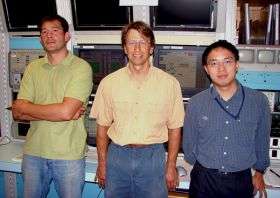
Since the Stanford Synchrotron Radiation Laboratory (SSRL) began experiments in 1973, it has proven to be a bottomless well of scientific discovery. Now, a team of SLAC accelerator physicists is working to add new functionality to the SPEAR synchrotron accelerator. The team—James Safranek, Xiaobiao Huang and Andrei Terebilo—has tested a new "low-alpha mode" for SPEAR that results in shorter x-ray pulses that could be advantageous for some users.
The path a particle travels around the 234-meter SPEAR ring can vary slightly because of minute differences in the energy of each electron in the beam. This causes accelerator magnets to create slightly different paths around the ring for each particle. Because the beam is actually 280 separate packets of particles—the length of which determines the length of pulses of x-rays created—the small variations in how far each particle travels—alpha—affects how short the pulses of x-rays can be made.
Shorter x-ray pulses allow scientists to study tiny processes in extremely short time frames, such as the movement of molecules of liquid water. In fact, short x-ray pulses are one of the defining characteristics of the Linac Coherent Light Source (LCLS) project currently under construction at SLAC. Although SPEAR's x-rays are longer than those that will be created by the LCLS, they are less powerful and won't damage fragile samples.
"The new operating mode for SPEAR provides a chance to do really unique experiments, some that even the LCLS won't be able to do," said SLAC PULSE Center physicist Aaron Lindenberg. "It definitely represents a new opportunity."
The new operating mode was achieved by adjusting the optics and the current of the beam. In its standard operating mode of 100 milliamperes (mA), SPEAR creates x-ray pulses lasting 17 picoseconds. Adjusting only the optics of SPEAR can reduce that to 6.9 picoseconds. However, the team took it one step further and managed to create bunches lasting only 1 picosecond.
Although the difference may not seem like much, there is a huge gap between what can be studied with a picosecond pulse than with one lasting 17 picoseconds, according to Lindenberg. On 1-picosecond time scales and below, scientists can see the movements of atoms in materials and the forming and breaking of chemical bonds. These kinds of processes would be completely blurred in the normal operating mode.
However, there is one catch.
In order to get such short x-ray pulses, SPEAR's current had to be adjusted down to 0.28 mA, about 350 times less than normal. Whereas this is great for Lindenberg and others, such low current would render SPEAR useless for most other experiments. Additionally, the beam position monitors responsible for keeping the beam's path precisely in line struggle to detect the beam at the lower current setting.
"It's unsure how often SSRL would use the low alpha mode," said Safranek. "It's a very special mode and would be used on a very limited basis, perhaps a few days a month."
But Lindenberg is still very excited about the possibilities the low alpha mode presents. He sees potential uses for the new mode in every technique available at SSRL.
"What's beautiful about the technique is that effectively every beam line gets access. This means that a really wide range of x-ray techniques, including x-ray absorption, x-ray emission, scattering, and photoemission, could be extended to the ultra-fast domain," said Lindenberg.
In any event, more research and development is needed before SPEAR can be operated using the new settings. But, according to Safranek, it could be used as early as next year.
Source: by Ken Kingery, SLAC Today


