Astronomers Pinpoint Origin of Nature's Most Powerful Magnetic Bursts
September 20, 2007 Magnetar

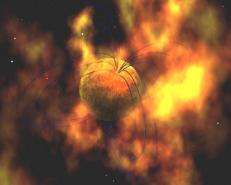
This is an artistic illustration of a magnetar. (Credit: Robert Mallozzi, NASA Marshall Space Flight Center)

University of Arizona astronomers have pinpointed the origin of powerful bursts from nature's most magnetic objects. The bursts are from "magnetars," some of the most enigmatic objects in the universe.

Magnetars are a type of neutron star, which are superdense stars that pack the mass of a sun into a body the size of Manhattan Island. Tiny magnetars possess magnetic fields that are at least 100 trillion times as powerful as Earth's magnetic field. They occasionally produce powerful bursts, hurling high-energy radiation cascading across space. The origin of these energetic eruptions and the strong magnetic fields is a mystery.

Astronomers discovered a magnetar with the NASA's X-Ray Timing Explorer in July 2003, when it brightened by about 100 times its usual faint luminosity. They continued monitoring it regularly with the European Photon Imaging Camera, known as EPIC, on the European Space Agency's XMM-Newton Observatory until March 2006, when the object faded to its pre-outburst brightness.

As the magnetar faded, EPIC recorded changes in the energies of the X-rays released.

Tolga Guver, who is a visiting graduate student at the UA, working with Assistant Professor Feryal Ozel of the UA physics and UA astronomy departments, compared the magnetar's changing X-ray spectrum with predictions from a computer model. They developed the model to describe the physical properties of a magnetar's surface and magnetic field in detail.

Guver, Ozel and their collaborators found that the data was best fitted with a model that traced the outburst to just below the surface of the magnetar and confined it to an area about 3.5 kilometers (about two miles) across.

"This is the first time both the surface emission and its subsequent reprocessing in the magnetosphere have been incorporated into the same computer model," Ozel said.

"This is a breakthrough because we can now distinguish between surface and magnetospheric phenomena,'' Guver said.

Determining both the size and the location of the powerful burst is like "performing anatomy on a distant, tiny star,'' Ozel added.

Their model also allowed Guver, Ozel and their colleagues to determine spectroscopically the strength of this object's magnetic field. The magnetar's magnetic field is around 600 trillion times stronger than the Earth's magnetic field.

The scientists say they are encouraged because the measurement is similar to an earlier estimate made based on how fast the source is "spinning down," which is the change in the spin period over time. They said it boosts their confidence that their model is correct.

"It is tremendously exciting to be able to compute exotic quantum phenomena that appear only in these ultrastrong magnetic fields and to see these predictions appear in actual data,'' Ozel added.

The astronomers say that they don't yet understand the mechanism of the outburst, which is probably somehow magnetically triggered.

The researchers say they plan to use their computer model to study more magnetars, using more data from X-ray observatories, in the quest for answers.

They are publishing their results in today's edition (Sept. 20, 2007) of the Astrophysical Journal Letters. The paper's authors are Guver, Ozel, Ersin Gogus of Sabanci University, Istanbul, Turkey, and Chryssa Kouveliotou of the NASA Marshall Space Flight Center, Huntsville, Ala.

Source: University of Arizona


print this article email this article download pdf blog this article bookmark this article     Stumble it Digg this share on Facebook retweet share on Reddit add to delicious
Rate this story - 4.3 /5 (43 votes)


September 20, 2007 all stories

Comments: 0

4.3 /5 (43 votes)
  • Stumble this up

  • Digg this

  • share this

  • hide
  • Related Stories

  • Carbon Atmosphere Discovered on Neutron Star
    created Nov 04, 2009 | popularity not rated yet | comments 0
  • Research sheds new light on neutron stars (w/ Video)
    created Nov 02, 2009 | popularity not rated yet | comments 0
  • Solar winds triggered by magnetic fields
    created Nov 02, 2009 | popularity not rated yet | comments 0
  • SMOS, Proba-2: Two new ESA satellites successfully lofted into orbit (w/ Video)
    created Nov 02, 2009 | popularity not rated yet | comments 0
  • Magnetism Turns Drug Release On and Off
    created Oct 30, 2009 | popularity not rated yet | comments 0


  • hide
  • Relevant PhysicsForums posts

  • The shape of our solar system's orbits.
    created Nov 07, 2009
  • Above or Below the Line of Nodes
    created Nov 07, 2009
  • Supernova vs. Nova?
    created Nov 07, 2009
  • Supernova's Gamma Rays and Comets
    created Nov 06, 2009
  • More from Physics Forums - General Astronomy

Other News

L-R: Chiwetel Ejiofor, Amanda Peet and John Cusack at the premiere of "2012"

NASA on crusade to debunk 2012 apocalypse myths

Space & Earth / Space Exploration

created 3 hours ago | popularity not rated yet | comments 0

The world is not coming to an end on December 21, 2012, the US space agency insisted Monday in a rare campaign to dispel widespread rumors fueled by the Internet and a new Hollywood movie.


Making Climate Forecasts More Useful to Farmers

Making Climate Forecasts More Useful to Farmers

Space & Earth / Environment

created 1hour ago | popularity not rated yet | comments 0

(PhysOrg.com) -- Climate forecasts are becoming more useful to farmers and ranchers, thanks to research by Agricultural Research Service (ARS) scientists and their cooperators.


NASA satellites make a movie and get rainfall, wind info on Ida

NASA satellites make a movie and get rainfall, wind info on Ida (w/ Video)

Space & Earth / Earth Sciences

created 4 hours ago | popularity not rated yet | comments 0

NASA satellites are amazing examples of technology. The TRMM satellite peers into tropical cyclones and can tell how much rain is falling per hour and where. QuikScat uses microwave technology to measure Ida's ...


Antarctica glacier retreat creates new carbon dioxide store

Antarctica glacier retreat creates new carbon dioxide store

Space & Earth / Earth Sciences

created 8 hours ago | popularity 4.3 / 5 (3) | comments 0

Large blooms of tiny marine plants called phytoplankton are flourishing in areas of open water left exposed by the recent and rapid melting of ice shelves and glaciers around the Antarctic Peninsula. This ...


NASA's TRMM Satellite sees most of Ida's heaviest rain stayed off coasts

NASA's TRMM Satellite sees most of Ida's heaviest rain stayed off coasts

Space & Earth / Earth Sciences

created 5 hours ago | popularity not rated yet | comments 0

NASA and the Japanese Space Agency's Tropical Rainfall Measuring Mission (TRMM) satellite flew over Ida and captured her rainfall when she passed by Nicaragua, Honduras and Belize this weekend. TRMM data revealed ...