Scientists launch deep-sea scientific drilling program to study volatile earthquake zone
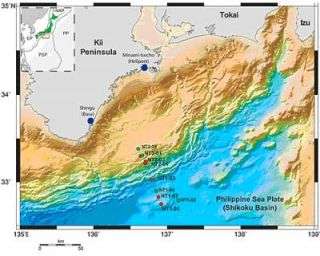
Today, the Nankai Trough Seismogenic Zone Experiment (NanTroSEIZE) gets underway, with the Japanese drilling vessel Chikyu departing from Shingu Port with scientists aboard, all ready to log, drill, sample, and install monitoring instrumentation in one of the most active earthquake zones on Earth. The vessel's launch starts the first of a series of scientific drilling expeditions that will retrieve geological samples and provide scientific data from the Nankai Trough fault zone for the first time.
Situated off Japan's southwest coast, the Nankai Trough has reliably generated large-scale earthquakes and tsunamis for millions of years, including historic earthquakes in 1944 and 1946, which measured 8.1 and 8.3, respectively, on the Richter scale. The NanTroSEIZE expeditions are supported by the Integrated Ocean Drilling Program, a marine research initiative jointly funded by Japan, the United States, a consortium of European countries, the People's Republic of China, and South Korea.
NanTroSEIZE scientists are prepared to drill deeply into the Earth to observe earthquake mechanisms in a well-known subduction zone. The process of subduction occurs when tectonic plates collide and one plate slides beneath another. Geological samples will be collected from the subduction zone, so that IODP scientists can analyze them and study the frictional properties of the rock. Later, sensors are to be installed deep beneath the sea floor- in the seismogenic fault zone-to monitor development of earthquakes at close range. These sensors and data collected from cored samples are expected to yield new insights into naturally occurring processes responsible for earthquakes. IODP scientists anticipate that the new data also will help them understand water motion and how water affects subduction zones.
Ocean Drilling Program Director James F. Allan of the U.S. National Science Foundation (NSF) characterized the first NanTroSEIZE expedition as an important milestone. "NSF welcomes the beginning of a new tomorrow, where the Chikyu enables us to explore the origins of devastating earthquakes at their source, study Earth history through coring of unstable, thick sediment sections, and investigate the fundamentals of ocean crust formation. These new capabilities," Allan notes, "complement those provided by the U.S. scientific ocean drilling vessel and European mission-specific platforms, which also support IODP scientific investigations, and that have investigated the subseafloor biosphere and Earth's dynamic climate with great success."
The full range of NanTroSEIZE investigations will occur in four stages:
-- Stage 1, now underway, calls for drilling and sampling at six drill sites to characterize the region's geology and provide geotechnical information for subsequent deep riser drilling (see Figure 1).
-- Stage 2 involves drilling the first of two deep holes, using Chikyu's unique riser drilling technology to target the mega-splay fault zone (where an array of faults occur) at ~3,500 meters below the seafloor.
-- Stage 3 focuses on 6,000-meter deep drilling into the seismogenic zone and across the plate interface into subducting crust.
-- Stage 4 includes installing long-term observatory systems in two ultra-deep boreholes.
During Stage 1, drill targets are 1) the incoming sediment of Shikoku Basin and the underlying oceanic crust, 2) the frontal thrust system at the toe of the accretionary wedge (where sediment is added to tectonic plates through frictional contact), 3) the mid-wedge multiple-fault system (mega-splays), and 4) two, approximately 1,000-meter deep holes at sites identified for later deep penetration into seismogenic zone faults. The current Stage 1 expedition will continue until November 16. The following Stage 1 expedition will sail from Nov. 17-Dec. 19, 2007, with new scientist participation.
Logging While Drilling (LWD) investigations will occur at all Stage 1 drill sites. LWD operations consist of continuously drilling one or more holes at each site by drilling down at a controlled rate, with logging tools incorporated into the bottom-hole assembly, a relatively short distance (tens of meters) behind the drill bit. Log data are acquired very soon after the hole is cut, providing the best possible data quality. LWD operational and science data are crucial for optimizing subsequent Stage 1 expeditions and future drilling stages.
The current NanTroSEIZE expedition is led by Co-Chief Scientist Harold Tobin, a marine geologist on the faculty of University of Wisconsin-Madison, and Co-Chief Scientist Masa Kinoshita, a marine geophysicist at the Japan Agency for Marine-Earth Science and Technology (JAMSTEC), a leading research institution in Japan.
"A fundamental goal of the NanTroSEIZE expedition," says Dr. Tobin, "is to put long-term monitoring instruments down inside the earthquake fault, so we can look at the physics of the fault process. We will be able to determine whether earthquakes actually have precursory signalsþuthings that happen before the earthquakesþuwe can measure that will provide early warning systems for people on land."
Co-chief scientist Dr. Kinoshita explains that to people in Japan, earthquakes and tsunamis are serious matters. "Consequently, it is logical and relatively easy to excavate into the earthquake source to learn about its mechanism," he says. The NanTroSEIZE science party will excavate 6,000 meters below the 2,000-meter deep oceanic bottom to meet the expedition's scientific objectives.
Prior to its role in NanTroSEIZE, the Chikyu underwent a full schedule of systems integration testing near Shimokita Peninsula and in-situ testing of its drilling, coring, and navigation systems. Sea trials for the custom-built drilling vessel began in 2005 and concluded more than two years later. The Chikyu is the first riser-equipped scientific research vessel in the world. Its high-tech laboratories are specifically designed for core retrieval, description, and analysis. Complex data sets are assembled onboard and entered into a vast IODP database. Daily and weekly logs are posted online from the ship for access by a global community of research scientists eager to glean news of these ground-breaking investigations. (Find logs at www.jamstec.go.jp/chikyu/eng/CHIKYU/status.html)
Source: Integrated Ocean Drilling Program Management International


