Amazon forest shows unexpected resiliency during drought
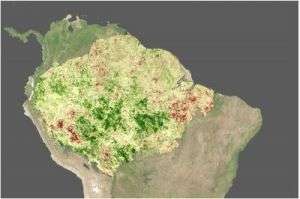
Drought-stricken regions of the Amazon forest grew particularly vigorously during the 2005 drought, according to new research.
The counterintuitive finding contradicts a prominent global climate model that predicts the Amazon forest would begin to "brown down" after just a month of drought and eventually collapse as the drought progressed.
“Instead of ‘hunkering down’ during a drought as you might expect, the forest responded positively to drought, at least in the short term," said study author Scott R. Saleska of The University of Arizona. "It's a very interesting and surprising response."
UA co-author Kamel Didan added, "The forest showed signs of being more productive. That's the big news."
The 2005 drought reached its peak at the start of the Amazon's annual dry season, from July through September. Although the double whammy of the parched conditions might be expected to slow growth of the forest's leafy canopy, for many of the areas hit by drought, the canopy of the undisturbed forest became significantly greener -- indicating increased photosynthetic activity.
Saleska, a UA assistant professor of ecology and evolutionary biology, and his colleagues at the UA and at the University of São Paulo in Brazil used data from two NASA satellites to figure out that undisturbed Amazon forest flourished as rainfall levels plummeted.
"No one had looked at the observations that are available from satellites," said Didan, an associate research scientist in the UA's department of soil, water and environmental science. "We took the opportunity of the most recent drought, the 2005 drought, to do so."
"A big chunk of the Amazon forest, the southwest region where the drought was severest, reacted positively," said Didan, a NASA-EOS MODIS associate science team member.
The study, "Amazon Forests Green-up during 2005 drought," is online in the current issue of Science Express, the early-online version of the journal Science. The paper will be published in the October 26, 2007, issue of Science.
Saleska and Didan's co-authors are Alfredo Huete, UA professor of soil, water and environmental science and NASA-EOS MODIS science team member, and Humberto Ribeiro da Rocha of the department of atmospheric science at the University of São Paulo in Brazil. The research was funded by NASA.
The UA scientists and their Brazilian colleague already knew the Amazon forest took advantage of the annual dry season's relatively cloudless skies to soak up the sun and grow. The UA scientists and some other researchers had conducted previous research using satellite data in combination with field measurements and showed that intact Amazon forest increases photosynthesis, actually "greening up," during the dry season.
However, no one had examined how the forest responded to a drought. The severe 2005 drought and the detailed, long-term observations from two NASA satellites -- one that maps the greenness of vegetation, one that measures rainfall in the tropics -- gave the researchers what they needed to see how the Amazon forest responds to a major drought.
The researchers used the month-to-month maps of changes in vegetation status across the Amazon available from the Moderate Resolution Imaging Spectroradiometer, or MODIS, carried by the Terra satellite, launched in 1999. The team gathered observations of rainfall in the Amazon from the Tropical Rainfall Measuring Mission spacecraft, launched in 1997.
The seven-to-nine years of observations from the satellites allowed the scientists to map "normal" rainfall and greenness conditions in non-drought years. When the team compared those conditions to the same months of the 2005 drought, the researchers found that areas of Amazon's intact forests that had received below-normal rainfall in 2005 also had above-average greenness.
Global climate models predict the Amazon forest will cut back photosynthesis quickly when a drought starts. That slowdown in plant growth would create a positive feedback loop -- as the forest shuts down more and more, it removes less and less carbon dioxide from the atmosphere. The CO2 ordinarily sequestered by growing trees would remain in the atmosphere, increasing global warming and further accelerating the forest's decline and additional CO2-fueled warming.
By contrast, the UA-led team's findings suggest the opposite happens, at least in the short-term. The drought-induced flush of forest growth would dampen global warming, not accelerate it. During the 2005 drought, Amazon forest trees flourished in the sunnier-than-average weather, most likely by tapping water deep in the forest soil. To grow, trees must take up carbon dioxide, thus drawing down the levels of atmospheric CO2. That negative feedback loop would slow warming from greenhouse gases.
Evolutionarily, the forest's resilience in the face of a single drought year makes sense, Saleska said. During El Nino, which occurs about every four to eight years, the Amazon forest receives significantly less rain than average.
The limit of the forest's resiliency is unknown, Saleska said, adding, "But if you take away enough water for long enough, the trees will die."
Source: University of Arizona


