Nano fights cancer

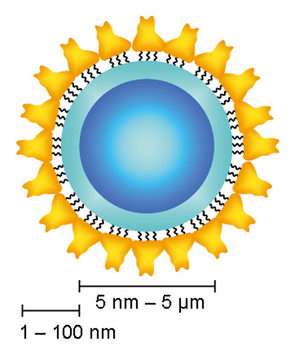
February 17, 2006 Nanocytes® consist of a silicate nucleus and an outer protein layer

Nanocytes® consist of a silicate nucleus and an outer protein layer. © Fraunhofer IGB

They are only a few nanometers in size, but their impact is tremendous: The tiny particles drive cancer cells to their death in no time at all. At nano tech 2006 in Japan from February 21 to 23 Fraunhofer researchers will demonstrate the great efficiency of nanoscopic particles as a vehicle for drug delivery.

Medicines that will make their own way through the body and attack precisely the diseased cells on reaching their destination – such has been the dream of physicians and pharmacists since time immemorial. Fraunhofer researchers working in the Nanotechnology Alliance have now come a little closer to reaching this goal. They
have developed bio-functional nanoparticles that cause necrosis in cancer cells. “These cell-like structures have a solid nucleus surrounded by proteins that detect and destroy cancer cells,“ explains Dr. Günter Tovar of the Fraunhofer Institute for Interfacial Engineering and Biotechnology IGB.

So how does it work? “Communication in the human body is a biochemical process based on the exchange of molecules,“ says Tovar. “We are trying to understand these communication processes and harness them for our own purposes.“ The tumor necrosis factor TNF for instance, releases a molecule that attaches itself to the receptors of the cancer cell and passes on its deadly message. To introduce the biological messenger TNF into the body, Tovar and his colleagues at Stuttgart University have developed bio-functional nanoparticles. Known as nanocytes®, these carry TNF proteins on their surface. “In producing these particles, we benefit from the self-organizing capability of the 'building blocks': Once a contact has been established between the particles and the proteins, the proteins grow and envelop the nuclei without any further effort on our part,“ the researcher explains. Tovar tested the finished nanoparticles in a Petri dish. His findings were most encouraging: cancer cells that came into contact with the particles did indeed perish. The researchers documented this process on video, and will be showing the film at the Fraunhofer stand at nano tech 2006.

It will be a while before nanocytes® can be used in the battle against cancer. First of all, a great deal of time and effort must be invested in clinical studies. But meanwhile the bio-functional nanoparticles have already proved their mettle in practical applications – as a tool for cell research or as a component in reagents for medical analysis.

Source: Fraunhofer-Gesellschaft


print this article email this article download pdf blog this article bookmark this article     Stumble it Digg this share on Facebook retweet share on Reddit add to delicious
Rate this story - 4.1 /5 (25 votes)


February 17, 2006 all stories

Comments: 0

4.1 /5 (25 votes)
  • Stumble this up

  • Digg this

  • share this

  • hide
  • Related Stories

  • Crashing the size barrier
    created Nov 18, 2009 | popularity not rated yet | comments 0
  • Detecting the Undetectable in Prostate Cancer Testing
    created Nov 18, 2009 | popularity not rated yet | comments 0
  • Nanoparticles used in common household items caused genetic damage in mice
    created Nov 16, 2009 | popularity not rated yet | comments 0
  • No-entry zones for AIDS virus
    created Nov 12, 2009 | popularity not rated yet | comments 0
  • Ideal nanoparticle cancer therapies surf the bloodstream
    created Nov 09, 2009 | popularity not rated yet | comments 0


Other News

Nanowire Formation

Nanowires key to future transistors, electronics

Nanotechnology / Nanophysics

created Nov 26, 2009 | popularity 4.8 / 5 (8) | comments 1

(PhysOrg.com) -- A new generation of ultrasmall transistors and more powerful computer chips using tiny structures called semiconducting nanowires are closer to reality after a key discovery by researchers ...


Water droplets direct self-assembly process in thin-film materials

Nanotechnology / Nanomaterials

created Nov 23, 2009 | popularity 5 / 5 (4) | comments 2

You can think of it as origami - very high-tech origami. Researchers at the University of Illinois have developed a technique for fabricating three-dimensional, single-crystalline silicon structures from thin films by coupling ...


Using superconducting probes to get a picture of what it's like inside CNTs

Nanotechnology / Nanophysics

created Nov 20, 2009 | popularity 4.4 / 5 (9) | comments 0

(PhysOrg.com) -- "Carbon nanotubes are exciting for fundamental physics, and for potential technological applications," Nadya Mason tells PhysOrg.com. "However, we are generally limited in the way that we can study them. ...


Peptides control crystal growth with 'switches, throttles and brakes'

Peptides control crystal growth with 'switches, throttles and brakes'

Nanotechnology / Bio & Medicine

created Nov 23, 2009 | popularity 4.8 / 5 (5) | comments 0

(PhysOrg.com) -- By producing some of the highest resolution images of peptides attaching to mineral surfaces, scientists have a deeper understanding how biomolecules manipulate the growth crystals. This research ...


Fast, easy, and highly sensitive arsenic detection with gold nanoparticles

Nanotechnology / Nanomaterials

created Nov 25, 2009 | popularity 5 / 5 (1) | comments 0

(PhysOrg.com) -- Mention of arsenic poisoning usually brings to mind underhanded murder. However, the danger of arsenic poisoning from contaminated drinking water is far greater. Low concentrations of arsenic are found in ...