New model could improve some drugs' effectiveness
September 23, 2007
New model could improve some drugs' effectiveness

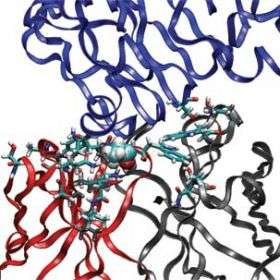
In this image, a fragment of the antibody Erbitux (cetuximab) binds to its target, a fragment of epidermal growth factor receptor (EGFR). The blue ribbon at the top is the backbone of the EGFR fragment, and the red and gray ribbons at the bottom are the backbone of the antibody fragment. The licorice sticks and the balls in the central portion represent protein side chains making close interactions between the antigen (EGFR) and the antibody, with the balls representing one of the mutations designed computationally. Image / Shaun Lippow

MIT researchers have developed a computer modeling approach that could improve a class of drugs based on antibodies, molecules key to the immune system. The model can predict structural changes in an antibody that will improve its effectiveness.

The team has already used the model to create a new version of cetuximab, a drug commonly used to treat colorectal cancer, that binds to its target with 10 times greater affinity than the original molecule.

The work, which will appear Sept. 23 in an advance publication of Nature Biotechnology, results from a collaboration using both laboratory experiments and computer simulations, between MIT Professors Dane Wittrup and Bruce Tidor.

“New and better methods for improving antibody development represent critical technologies for medicine and biotechnology,” says Wittrup, who holds appointments in MIT's Department of Biological Engineering and Department of Chemical Engineering. Tidor holds appointments in Biological Engineering and the Department of Electrical Engineering and Computer Science.

Antibodies, which are part of nature's own defense system against pathogens, are often used for diagnostics and therapeutics. Starting with a specific antibody, the MIT model looks at many possible amino-acid substitutions that could occur in the antibody. It then calculates which substitutions would result in a structure that would form a stronger interaction with the target.

“Combining information about protein (antibody) structure with calculations that address the underlying atomic interactions allows us to make rational choices about which changes should be made to a protein to improve its function,” said Shaun Lippow, lead author of the Nature Biotechnology paper.

“Protein modeling can reduce the cost of developing antibody-based drugs,” Lippow added, “as well as enable the design of additional protein-based products such as enzymes for the conversion of biomass to fuel.” Lippow conducted the research as part of his thesis work in chemical engineering at MIT, and is now a member of the protein engineering group at Codon Devices in Cambridge, Mass.

“Making drugs out of huge, complicated molecules like antibodies is incredibly hard,” said Janna Wehrle, who oversees computational biology grants at the National Institute of General Medical Sciences, which partially supported the research. “Dr. Tidor's new computational method can predict which changes in an antibody will make it work better, allowing chemists to focus their efforts on the most promising candidates. This is a perfect example of how modern computing can be harnessed to speed up the development of new drugs.”

Traditionally, researchers have developed antibody-based drugs using an evolutionary approach. They remove antibodies from mice and further evolve them in the laboratory, screening for improved efficacy. This can lead to improved binding affinities but the process is time-consuming, and it restricts the control that researchers have over the design of antibodies.

In contrast, the MIT computational approach can quickly calculate a huge number of possible antibody variants and conformations, and predict the molecules' binding affinity for their targets based on the interactions that occur between atoms.

Using the new approach, researchers can predict the effectiveness of mutations that might never arise by natural evolution.

“The work demonstrates that by building on the physics underlying biological molecules, you can engineer improvements in a very precise way,” said Tidor.

Expanding on that theme, Wittrup and Tidor also co-teach a class and are writing a textbook focusing on connecting fundamental molecular and cellular events to biological function through the use of mathematical models and computer simulations.

The team also used the model with an anti-lysozyme antibody called D44.1, and they were able to achieve a 140-fold improvement in its binding affinity. The authors expect the model will be useful with other antibodies as well.

Source: Massachusetts Institute of Technology

4.9 /5 (10 votes)  

Rank 4.9 /5 (10 votes)
Tags

Relevant PhysicsForums posts

More news stories

A mitosis mystery solved: How chromosomes align perfectly in a dividing cell

Although the process of mitotic cell division has been studied intensely for more than 50 years, Whitehead Institute researchers have only now solved the mystery of how cells correctly align their chromosomes during symmetric ...

Biology / Cell & Microbiology

created 3 hours ago | popularity 5 / 5 (4) | comments 0 | with audio podcast

The proteins ensuring genome protection

Researchers from the University of Geneva (UNIGE), Switzerland, have discovered the crucial role of two proteins in developing a cell 'anti-enzyme shield'. This protection system, which operates at the level of molecular ...

Biology / Cell & Microbiology

created 3 hours ago | popularity 5 / 5 (2) | comments 0 | with audio podcast

Researchers find extensive RNA editing in human transcriptome

In a new study published online in Nature Biotechnology, researchers from BGI, the world's largest genomics organization, reported the evidence of extensive RNA editing in a human cell line by analysis of RNA-seq data, demons ...

Biology / Biotechnology

created 3 hours ago | popularity 5 / 5 (3) | comments 0 | with audio podcast

Entire genome of extinct human decoded from fossil

(PhysOrg.com) -- In 2010, Svante Pääbo and his colleagues presented a draft version of the genome from a small fragment of a human finger bone discovered in Denisova Cave in southern Siberia. The ...

Biology / Biotechnology

created Feb 07, 2012 | popularity 4.7 / 5 (59) | comments 48 | with audio podcast

Why are there so few fish in the Earth's oceans?

(PhysOrg.com) -- A Stony Brook University researcher has found that, contrary to popular belief, there are not plenty of fish in the sea.

Biology / Plants & Animals

created Feb 08, 2012 | popularity 4.2 / 5 (18) | comments 27 | with audio podcast


Overeating may double risk of memory loss

New research suggests that consuming between 2,100 and 6,000 calories per day may double the risk of memory loss, or mild cognitive impairment (MCI), among people age 70 and older. The study was released today and will be ...

Google might launch Drive for cloud storage soon

(PhysOrg.com) -- Google's next big move, according to the Wall Street Journal, is a cloud storage service called Drive. Hardly first to the plate, Google is simply catching up to introducing its cloud reposi ...

Scientists discover molecular secrets of 2,000-year-old Chinese herbal remedy

For roughly two thousand years, Chinese herbalists have treated Malaria using a root extract, commonly known as Chang Shan, from a type of hydrangea that grows in Tibet and Nepal. More recent studies suggest that halofuginone, ...

New method to examine batteries -- MRI from the inside

There is an ever-increasing need for advanced batteries for portable electronics, such as phones, cameras, and music players, but also to power electric vehicles and to facilitate the distribution and storage of energy derived ...

Lab study raises questions over nano-particle impact

Tests involving chickens have raised questions about the impact on health from engineered nano-particles, the ultra-fine grains commonly used in drugs and processed foods, scientists said on Sunday.

Injured boomers beware: Know when to see doctor

(AP) -- It happened to nurse Jane Byron years after an in-line skating fall, business owner Haralee Weintraub while doing "men's" push-ups, and avid cyclist Gene Wilberg while lifting a heavy box.