Warmer than a Hot Tub: Atlantic Ocean Temperatures Much Higher in the Past
Scientists have found evidence that tropical Atlantic Ocean temperatures may have once reached 107°F (42°C)—about 25°F (14°C) higher than ocean temperatures today and warmer than a hot tub.
The surprisingly high ocean temperatures, the warmest estimates to date for any place on Earth, occurred millions of year ago when carbon dioxide levels in Earth’s atmosphere were also high, but researchers say they may be an indication that greenhouse gases could heat the oceans in the future much more than currently anticipated. The study suggests that climate models underestimate future warming.
“These temperatures are off the charts from what we’ve seen before,” said Karen Bice, a paleoclimatologist at Woods Hole Oceanographic Institution (WHOI). Bice reported the findings Feb. 17 at the annual meeting of the American Association for the Advancement of Science (AAAS) in St. Louis and is also lead author of a study to be published in an upcoming issue of the journal Paleoceanography, published by the American Geophysical Union.
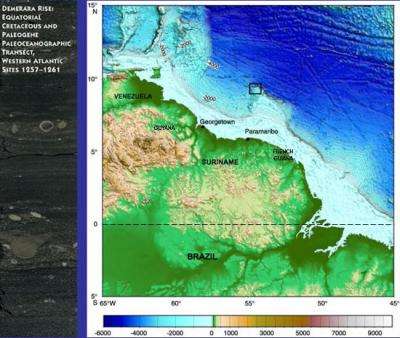
Bice and a multi-institutional team of scientists studied three long columns of sediment cored from the seafloor in 2003 off Suriname, on the northeast coast of South America, by the drillship JOIDES Resolution, operated by the international Ocean Drilling Program.
The sediments contained an unusually rich and well-preserved accumulation of both carbon-rich organic matter and the fossilized shells of microscopic marine organisms that had settled and piled up on the seafloor over tens of millions of years. The deeper down in the core the scientists analyzed, the further back in time they went.
The team analyzed the shells’ isotopic and trace element chemistry, which changes along with temperature changes in the surface waters where they lived. They determined that ocean temperatures in the region ranged between 91° and 107°F (33° and 42°C) between 84 million and 100 million years ago in an era when dinosaurs roamed the Earth. Temperatures range between 75° and 82°F (24° and 28°C) in the same region now. The approximate uncertainty in the paleotemperature estimates is +/-2°C.
Using organic matter from the sediments, the group also estimated atmospheric carbon dioxide concentrations during the same time span. They were 1,300 to 2,300 parts per million (ppm), compared with 380 ppm today.
The findings, if confirmed, create a dilemma for scientists seeking to forecast how Earth’s climate and environment will change in response to the rising amounts of heat-trapping carbon dioxide in the atmosphere, caused by deforestation and the burning of oil, coal, and other fossil fuels. When 1,300 to 2,300 ppm of carbon dioxide is factored into current computer models that simulate global climate, it does not produce such high ocean temperatures.
“The climate models underestimate temperatures and the amount of warming that would accompany an increase in CO2 of more than 1,000 ppm above today’s level.” Bice said..
If the scientists’ interpretations of past ocean temperatures and carbon dioxide levels prove accurate, actual future warming from elevated atmospheric carbon dioxide concentrations may be much greater than predicted by the models, the scientists reported.
“One of the most important impacts this evidence suggests is the change to the Earth’ hydrologic cycle,” Bice said. “Higher tropical temperatures will increase the intensity of hurricanes and winter storms. In addition, precipitation patterns will change, moving even more rain that now falls on the central U.S. - an area known as the breadbasket of the U.S. for its food production - to higher latitudes where the quality of the soil may not be as conducive to agriculture”
“Policymakers use these models to predict likely climate change with increasing CO2 levels, and if the models are not right, society is not well informed or well served.”
Alternatively, the models used to predict future climate may be missing a critical factor that amplifies heating, Bice said. During past warm periods, oceans and wetlands may have released much more methane gas to the atmosphere. Methane traps heat 10 times more effectively than carbon dioxide.
However, extraordinarily high concentrations of methane in the model still fail to produce the tropical Atlantic and Arctic Ocean temperatures inferred for 91 million years ago. This supports the idea that the model’s response to increased greenhouse gas concentrations underestimates the actual climate system’s response.
Source: Woods Hole Oceanographic Institution


