Using catalysts to stamp nanopatterns without ink
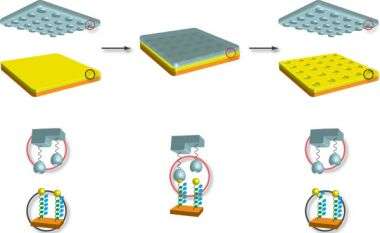
Using enzymes from E. coli bacteria, Duke University chemists and engineers have introduced a hundred-fold improvement in the precision of features imprinted to create microdevices such as labs-on-a-hip.
Their inkless microcontact printing technique can imprint details measuring close to 1 nanometer, or billionths of a meter, the Duke team reported in the Sept. 24, 2007 issue of the Journal of Organic Chemistry.
"This has a lot of potential, because we don't have the resolution issue," said Robert Clark, a professor of mechanical engineering and materials science and dean at Duke’s Pratt School of Engineering. “The really important part is that with a biological catalyst there’s no ink involved,” added Duke chemistry professor Eric Toone.
Clark, Toone and three graduate students authored the report on their study, which was funded by the National Science Foundation (NSF).
In traditional microcontact printing -- also called soft lithography or microstamping -- an elastic stamp’s end is cast from a mold created via photolithograpy – a technique used to generate microscopic patterns with light. Those patterns are then transferred to a surface by employing various biomolecules as inks, rather like a rubber stamp.
Microcontact printing was first reported by Ralph Nuzzo and Dave Allara at Pennsylvania State University, and developed extensively in the laboratory of George Whitesides at Harvard.
A shortcoming of traditional microcontact printing is that pattern transfer relies on the diffusion of ink from the stamp to the surface. This same diffusion spreads out beyond the limits of the pattern as the stamp touches the surface, degrading resolution and blurring the feature edges, Clark and Toone said.
Because of this mini-blurring, the practical limit to defect-free patterning is “in excess of 100 nanometers,” said the report, whose first author, Phillip Snyder, is a former Toone graduate student now working as a postdoctoral researcher in Whitesides’ group.
A 100 nanometer limit of resolution is about 1,000 times tinier than a human hair’s width. While that seems very precise, the Duke team now reports it can boost accuracy limits to less than 2 nanometers by entirely eliminating inking.
Clark and graduate student Matthew Johannes crafted a microstamp out of a gel-like material called polyacrylamide, which compresses more uniformly than the silicone material known as PDMS which is normally used in microstamping.
In lieu of ink, Snyder, Toone and graduate student Briana Vogen suspended a biological catalyst on the stamp with a molecular “tether” of amino acids. For this proof-of-principle demonstration, Toone’s team chose as a catalyst the biological enzyme exonuclease I, derived from the bacterium E. coli.
In one set of experiments, the polyacrylamide stamp pattern bearing the tethered enzymes was then pressed on a surface of gold that had been covered with a uniform coating of single-stranded DNA molecules. The DNA molecules had also been linked to fluorescent dye molecules to make the coating visible under a microscope.
Wherever the enzyme met the DNA, the end of the DNA chain and its attached dye were broken off and removed. That created a dye-less pattern of dots on the DNA coating, each dot measuring about 10 millionths of a meter diameter each.
The microdots are very precise because the catalyst that created them could not shift its position more than the length of its chemical tether -- less than 1 nanometer, the Duke team reported. "Whether the stamp was left on for a short period of time, or for days, the pattern did not change,” Clark said.
The inkless microstamp could also re-use the same suspended catalyst molecule repeatedly. “Enzymes can deteriorate with extended use,” Clark acknowledged. “But because of our tether attachment chemistry, we can easily wash the old enzyme off, put on a new one and keep going,” Clark said.
In follow-up research, Clark and Toone are now evaluating more durable microstamping materials attached to longer lasting catalysts that are non-enzymatic.
By using different catalysts in succession, future versions of the inkless technique could be used to build complex nanoscale devices with unprecedented precision, the two predicted.
“Soft lithography has really revolutionized the field of surface science over the last 30 years,” said Toone. “And I honestly believe that using catalysts instead of diffusive processes is going to become the way that soft lithography is done in the future.”
Source: Duke University


