Magnetic Snakes Create Water Current
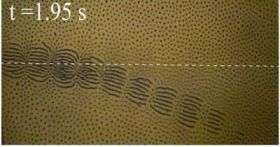
September 24, 2007 Magnetic Snake

Alternating magnetic fields create snake-like chains of magnetic particles suspended in fluid. The snakes direct the flow of the surrounding fluid along their lengths, potentially leading to new methods to control fluids in chip-based chemical analysis. Credit: M. Belkin, A. Snezhko, I.S. Aranson, and W.-K. Kwok

Physicists at Argonne National Laboratory have found that magnetic particles suspended in water and subjected to an alternating magnetic field will form snake-shaped structures that can control the flow of the surrounding fluid.

Current incarnations of the magnetic snake are a few centimeters long, but the team envisions much smaller versions as pumps to manipulate liquids on microscopic scales or precursors for next-generation magnetic recording media in future computers. The team's recent experiment shows that the speed of the water flowing along the snake depends on how quickly the magnetic field alternates.

To make a magnetic snake, the team put a water-filled beaker at the center of a magnetic coil. In the water, they suspended magnetic nickel spheres a little smaller than one tenth of a millimeter in diameter. These particles reacted to an alternating magnetic field created by the coil. The nickel spheres aligned themselves head-to-tail with nearby particles as though they contained tiny bar magnets.

The movements of the particle chain made waves on the surface of the water, encouraging the formation of parallel chains and causing a segmented pattern. The self-assembly of the snakes can take anywhere from a fraction of a second to several minutes.

Citation: M. Belkin et at., Physical Review Letters, forthcoming article

Source: American Physical Society


print this article email this article download pdf blog this article bookmark this article     Stumble it Digg this share on Facebook retweet share on Reddit add to delicious
Rate this story - 4.4 /5 (24 votes)


September 24, 2007 all stories

Comments: 0

4.4 /5 (24 votes)
  • Stumble this up

  • Digg this

  • share this

  • hide
  • Related Stories


  • hide
  • Relevant PhysicsForums posts

  • Drop of Water
    created 1hour ago
  • Generalized Coordinate Systems
    created 1hour ago
  • Electromagnet design
    created 3 hours ago
  • Physics practice, please help me!
    created 3 hours ago
  • More from Physics Forums - General Physics

Other News

Stars Fueled by Dark Matter Could Hold Secrets to the Universe

Stars Fueled by Dark Matter Could Hold Secrets to the Universe

Physics / General Physics

created Nov 03, 2009 | popularity 4.5 / 5 (51) | comments 41

(PhysOrg.com) -- The first stars in the universe may have been very different from the stars we see today, yet they may hold clues to understanding some of the mysterious features of the universe. These "dark ...


Second Law of Thermodynamics May Explain Economic Evolution

Second Law of Thermodynamics May Explain Economic Evolution

Physics / General Physics

created Nov 02, 2009 | popularity 4.3 / 5 (30) | comments 28

(PhysOrg.com) -- Terms such as the "invisible hand," laissez-faire policy, and free-market principles suggest that economic growth and decline in capitalist societies seem to be somehow self-regulated. Now, ...


High-performance plasmas may make reliable, efficient fusion power a reality

High-performance plasmas may make reliable, efficient fusion power a reality

Physics / Plasma Physics

created Nov 02, 2009 | popularity 4.7 / 5 (39) | comments 33

In the quest to produce nuclear fusion energy, researchers from the DIII-D National Fusion Facility have recently confirmed long-standing theoretical predictions that performance, efficiency and reliability ...


'Teapot effect' solved

Solving Teapot Effect

Physics / General Physics

created Nov 02, 2009 | popularity 4.9 / 5 (11) | comments 10

(PhysOrg.com) -- A team of scientists from France have worked out why teapots dribble at low flow rates, and how to stop them. The effect is called the "teapot effect", and solving it could finally put an ...


Laser accelerated protons to the highest energies so far

Researchers use trident laser to accelerate protons to record energies

Physics / General Physics

created Nov 02, 2009 | popularity 4.7 / 5 (6) | comments 10

An international team of physicists at Los Alamos National Laboratory has succeeded in using intense laser light to accelerate protons to energies never before achieved. Using this technique, scientists can ...